


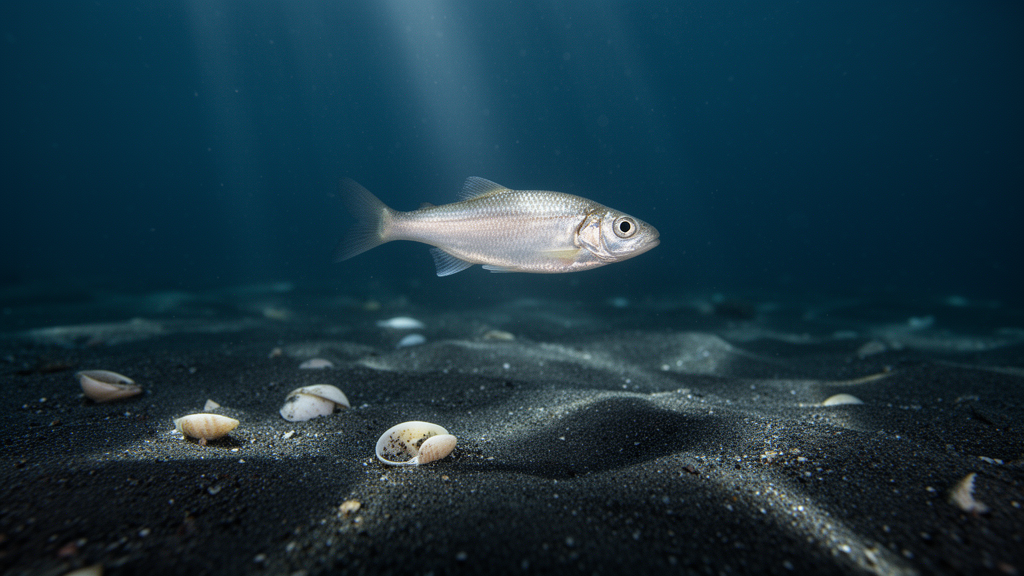
Deep beneath the ice-covered surface of the Central Arctic Ocean, two endemic cod species have been quietly enduring planetary ice ages for tens of thousands of years, according to a new study that rewrites our understanding of life in one of Earth’s most extreme marine environments. By analyzing fish ear stones preserved in deep-sea sediments, researchers discovered that ice cod (Arctogadus glacialis) and polar cod (Boreogadus saida) thrived at latitudes of 87–89°N roughly 48,000 to 35,000 years ago, vanished during the harshest conditions of the Last Glacial Maximum, and then reappeared at the onset of the Holocene about 12,000 years ago. The findings, published in Nature Communications, suggest the glacial Arctic Ocean was not a barren frozen desert but rather a breeding ground for the evolution of cold adaptation in marine fish.
The research team, led by Julek Chawarski of Stockholm University, analyzed 256 otoliths—calcium carbonate structures found in the heads of bony fishes—collected from deep-sea sediments at water depths ranging from 901 to 1,537 meters across five sampling stations between 84°N and 89°N. Otoliths have species-specific morphology, and those preserved in sediments provide a valuable archive of past species occurrences spanning thousands to millions of years. Of the 256 otoliths, 206 could be identified to the species level, with 57 belonging to ice cod and 145 to polar cod, along with four otoliths from snailfishes. The highest otolith densities were observed on the western Lomonosov Ridge in the Central Arctic Ocean, while the lowest were found on the Morris Jesup Rise, which extends into the Eurasian Basin from the Northeast Greenland Shelf.
Radiocarbon dating of a subset of 79 otoliths revealed calibrated ages ranging from 1.3 to 47.8 thousand years before present. Thirty-seven otoliths dated to the Holocene, 13 to the Last Glacial Maximum between 20.3 and 18.6 thousand years ago, and 29 to the last ice age before the Last Glacial Maximum. The otoliths consist of precipitated calcium carbonate in the form of aragonite or vaterite, which are more prone to dissolution than calcite. However, the researchers ruled out dissolution bias through multiple lines of evidence: the modern aragonite lysocline occurs at approximately 3,500 meters of ocean depth, well below their sampling stations, and scanning electron microscopy with energy dispersive spectroscopy showed no difference in structure or chemical composition between sediment otoliths and recent polar cod otoliths, except that recent otoliths have an organic surface coating rich in carbon and nitrogen that is missing in the sediment otoliths.
There was no linear correlation between sediment depth and the radiocarbon age of the otoliths. Instead, two distinct layers indicated two separate time periods: otoliths younger than 12,000 years were found in the darker-brown top 0 to 5 centimeters of sediment, while otoliths older than 35,000 years were found in the lighter-colored, calcium-enriched lower 5 to 15 centimeters. This pattern suggests that sedimentation rates during the second half of the last ice age, but before the Last Glacial Maximum, were relatively high for a short period, which could explain the apparent clustering of older otoliths in a larger sediment layer interval. Subsequently, as the climate cooled toward the peak of the Last Glacial Maximum, primary productivity, sedimentation rates, and bioturbation were essentially halted in the Central Arctic Ocean beneath very thick perennial ice. The Last Glacial Maximum period would thus be a very condensed horizon of less than 1 centimeter in the records, or possibly a hiatus, corresponding to the lithological boundary observed around 5 centimeters of sediment depth.
The geological record covered by the study encompasses three Marine Isotope Stages: much of MIS 3 from approximately 57 to 29 thousand years ago, MIS 2 from 29 to 12 thousand years ago, and MIS 1, the Holocene since about 12 thousand years ago. On the western Lomonosov Ridge, the earliest period with otolith occurrences of both ice cod and polar cod spanned MIS 3 from about 48 to 35 thousand years ago. Overall, MIS 3 was characterized by climate instability and abrupt global warming periods known as Dansgaard-Oeschger events, providing a plausible mechanism for short-lived improvements in environmental conditions in the Central Arctic Ocean. These millennial-scale pulses of Atlantic and Pacific water entering the Arctic basins during Dansgaard-Oeschger events reduced marine glacial conditions and caused periods of reduced sea-ice extent and increased biological productivity sufficient to support vertebrate life.
Independent geological data from the broader Arctic region support intermittently milder conditions during MIS 3. Sediment records from the Norwegian Sea during this period show minima in the sea-ice proxy P_B/IP_25 and maxima in the phytoplankton-derived biomarker brassicasterol, indicating periods of open water, Atlantic water inflow, and increased surface productivity in the Nordic Seas during Dansgaard-Oeschger events. Furthermore, the Northeast Greenland Ice Stream retreated beyond its current extent, the Laurentide Ice Sheet underwent a marked reduction, and central Scandinavia was likely ice-free from approximately 55 to 35 thousand years ago. Sea-level rise from melting ice sheets during MIS 3 submerged the glacial land bridge across the Bering Strait, allowing nutrient-rich Pacific waters to flow in and further boost biological productivity. Collectively, these conditions suggest that biological productivity in the Central Arctic Ocean during MIS 3 was probably—at least periodically—sufficient to support populations of gadoid fishes, potentially reaching levels similar to their modern abundances and distributions.
By around 35 thousand years ago, the climate began to cool toward the Last Glacial Maximum. Extreme glaciation caused global sea levels to drop by more than 100 meters, exposing large areas of the Arctic continental shelves and re-establishing a land bridge across the Bering Strait. Advection of nutrients and plankton to the Central Arctic Ocean sharply declined as the Pacific inflow ceased and the Atlantic inflow decreased. Consistent with these environmental changes, the sedimentary otolith records from the western Lomonosov Ridge show an approximately 25,000-year absence of both ice cod and polar cod otoliths toward the end of MIS 3 and throughout MIS 2. Of the 44 radiocarbon-dated otoliths from these two stations, 25 are older than 35,000 years, 19 are younger than 12,000 years, and none are from the period between 12 and 35 thousand years ago. These data suggest that during the Last Glacial Maximum, biological productivity in the Central Arctic Ocean fell below levels needed to sustain significant gadoid fish populations, coinciding with thick perennial sea ice across much of the deep basins and with ice shelves potentially extending hundreds of kilometers from the coasts.
After about 25,000 years of absence, otoliths of both species reappeared on the western Lomonosov Ridge at the onset of the Holocene, around 12 thousand years ago. A reduction in global ice sheet volume led to approximately 100 meters of sea-level rise, reopening the Bering Strait and increasing inflow to the Central Arctic Ocean through both the Atlantic and Pacific gateways. The reappearance of the two Arctic endemic gadoids was likely driven by increased nutrient advection from the Atlantic and Pacific Oceans, along with thinner sea ice that enhanced biological productivity. Maximum otolith occurrence during MIS 1 coincided with the Holocene Climatic Optimum in the western Arctic, roughly 11 to 9 thousand years ago, when ice sheet retreat and the subsequent establishment of consistent summer ice-free conditions enabled a post-glacial range expansion for many pelagic marine species and likely facilitated the arrival of Arctic fish predators, including seabirds, seals, and whales.
Crucially, the otolith records from 84–85°N on the Morris Jesup Rise show sporadic, low occurrences of ice cod otoliths and the complete absence of polar cod otoliths during the glacial periods MIS 3 and MIS 2. A distinct period of increased ice cod otolith presence occurred in the middle of the Last Glacial Maximum over a narrow span of about 1,700 years, between 20.3 and 18.6 thousand years ago. This period coincides with the formation of open-water areas surrounded by sea ice, known as polynyas, along the northwestern margin of the Eurasian ice sheet around 20 to 19 thousand years ago, following the collapse of the Svalbard-Barents ice sheet. Modern polynyas form through the combined effects of katabatic winds blowing seaward from ice shelves and the upwelling of warmer, subsurface Atlantic water. Similar conditions during this short period may have created oases of biological productivity in the glacial Arctic north of Greenland, providing refugia that enabled ice cod survival and divergence from polar cod under the harshest climate conditions.
Differences in the size distributions of ice cod otoliths across marine isotope stages indicate shifts in ecological conditions. Otolith-based size reconstructions show that the mean size of ice cod was larger during MIS 3 than during MIS 1 at the Lomonosov Ridge. At the Morris Jesup Rise, both mean size and size diversity of ice cod were higher during a period of increased occurrence during MIS 2 than during MIS 3 and MIS 1. In contrast, no significant changes in size distributions between marine isotope stages or regions were observed for polar cod. Together with the absence of polar cod from the Morris Jesup Rise during MIS 3 and MIS 2, these patterns suggest that changes in habitat structure contributed to the subtle divergence in the life histories of the two species we see today. The two species are sister taxa thought to have diverged between 5 and 10 million years ago, and have likely undergone allopatric speciation after establishing reproductive isolation, with little to no ongoing gene flow. While remaining sympatric during mild interstadial and interglacial conditions, climate-driven divergence between the two species, such as during the Last Glacial Maximum, highlights a potentially important aspect of their speciation process.
The findings carry significant implications for how these Arctic endemics will fare under anthropogenic global warming. Contemporary observations show that ice cod thrives in glacier-proximal waters of northeast Greenland, including deep fjords and the Northeast Water Polynya, suggesting it is an ice-dependent glacial-edge specialist. Its low intraspecific genetic variability may constitute a bottleneck during warmer periods, making it probably the Arctic endemic gadoid most vulnerable to ongoing warming. Polar cod is also cold-adapted but might have a greater capacity to adapt to changing environmental conditions because of high genetic variation, and can be found as far south as the Gulf of St. Lawrence at 46°N, whereas ice cod is more strictly Arctic within its current southernmost Atlantic distribution limit at the Greenland coast around 60°N. In 2024, the global average temperature exceeded 1.5°C above the nineteenth-century level for the first time in human history, roughly doubling the warming during the Holocene Climatic Optimum. Further warming is likely to soon exceed the thermal tolerance of these two cryophilic cod species, which have inhabited the unique permanently ice-covered marine ecosystem of the Central Arctic Ocean for the past 50,000 years, while northward expansion of boreal species will increase competition and predation, putting them at significant risk of population declines.
Subject of Research: Evolutionary ecology
Article Title: Survival and divergence of Arctic endemic cod species during 50,000 years of climate change
Article References: Chawarski, J., Vermassen, F., Vane, K., Flores, H., Wollenburg, J., Grotheer, H., Morys, C., Hildebrandt, N., Coxall, H. K., & Snoeijs-Leijonmalm, P. (2026). Survival and divergence of Arctic endemic cod species during 50,000 years of climate change. Nature Communications, 17(1), Article 10876. https://doi.org/10.1038/s41467-026-78810-4
Image Credits: AI Generated
DOI: 10.1038/s41467-026-78810-4
Keywords: Arctic Ocean, ice cod, polar cod, otoliths, Last Glacial Maximum, paleoecology, climate change, Dansgaard-Oeschger events, refugia, Nature Communications, Survival, divergence
Cite Scienmag News
Violet Maxwell. (October 17, 2026). Arctic cod survived 50,000 years of ice ages hidden in deep-sea sediments. Scienmag. https://scienmag.com/arctic-cod-survived-50000-years-of-ice-ages-hidden-in-deep-sea-sediments/
Violet Maxwell. "Arctic cod survived 50,000 years of ice ages hidden in deep-sea sediments." Scienmag, 17 October 2026, https://scienmag.com/arctic-cod-survived-50000-years-of-ice-ages-hidden-in-deep-sea-sediments/. Accessed 17 October 2026.
Violet Maxwell. "Arctic cod survived 50,000 years of ice ages hidden in deep-sea sediments." Scienmag. October 17, 2026. https://scienmag.com/arctic-cod-survived-50000-years-of-ice-ages-hidden-in-deep-sea-sediments/


