


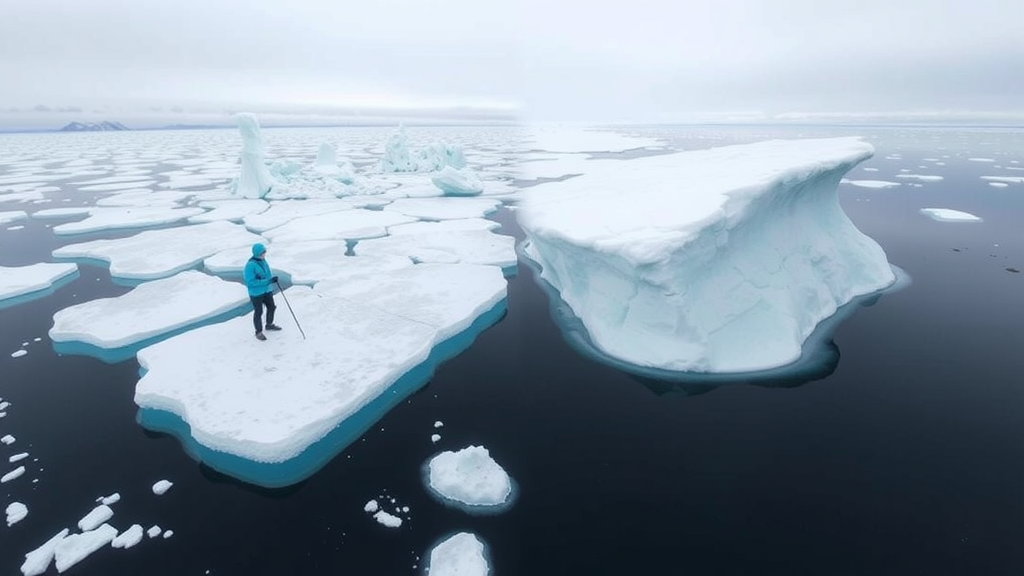
Sea ice covers only about nine percent of the world’s oceans, yet its presence or absence exerts an outsized influence on the energetic balance of Earth’s climate system. A sweeping new review published in Nature Reviews Earth & Environment has assembled, for the first time in a single synthesis, the full record of how the frozen skins of the Arctic and Southern Oceans have changed over nearly five decades of satellite observation and much longer ship-based measurement. The picture that emerges is one of two polar ice covers moving in opposite directions, driven by fundamentally different geography, dynamics and feedbacks, and responding unevenly to both natural variability and anthropogenic warming.
In the Arctic, the transformation is unambiguous and accelerating. The melt season has lengthened by approximately 7.4 days per decade between 1979 and 2024, a shift that compounds year after year as earlier snowmelt and later freeze-up expose dark ocean water to sunlight for longer periods. Winter sea-ice thickness has declined to a mean total of roughly 1.6 metres over 1980 to 2023, down from values that once routinely exceeded three metres in the central Arctic. Summer surface albedo, the fraction of incoming solar radiation reflected back to space, has fallen by about 0.03 per decade over 1979 to 2020, while spring snow depth on the ice has thinned by 2.5 centimetres per decade over the period 1954 to 2024. Each of these trends feeds the others in a self-reinforcing cascade.
The physical mechanism behind this cascade is the ice-albedo feedback. Fresh snow reflects up to ninety percent of incident sunlight, but once the snow melts, bare ice reflects far less, and melt ponds pooling on the surface reflect less still. As the Arctic melt season lengthens, more solar energy is absorbed by the ice-ocean system, warming the upper ocean and thinning the ice from below. Thinner ice breaks up more easily, creating more open water, which absorbs more heat and delays freeze-up further. Satellite records show that the Arctic’s once-dominant multiyear ice, ice that survives at least one summer melt, has been progressively replaced by thinner, more saline first-year ice that melts more readily. A regime shift in Arctic Ocean ice thickness has been documented, and the age structure of the ice pack has shifted decisively toward young ice.
The Antarctic tells a strikingly different story. Antarctic sea ice sits at the edge of a vast, cold continent surrounded by a circumpolar ocean, and its thickness is limited by rapid drift away from the coast and by heavy snow loading that can push the ice surface below sea level, flooding it and forming snow-ice. Unlike the Arctic, the Antarctic record through the satellite era showed a slight overall increase in extent through 2014, followed by abrupt declines, including record lows in 2017 and again in 2023 that have led some researchers to argue the region may have entered a new sea-ice state. Because regional trends in the Antarctic point in different directions in different sectors and different decades, the hemisphere-wide changes in ice properties are smaller than those observed in the Arctic, and the underlying drivers remain contested.
Snow plays a fundamentally different role at each pole. In the Arctic, snow insulates the ice from the cold atmosphere in winter, slowing growth, but its high albedo protects the ice in spring. Declining snow depth therefore removes a protective layer and accelerates surface melt. In the Antarctic, thick snow cover frequently depresses the ice surface below the waterline, and the resulting slush refreezes into snow-ice, adding mass from above. Antarctic snow also modulates the penetration of light into the ice and upper ocean, shaping the timing and productivity of ice-algal blooms that anchor polar marine food webs. Recent work shows that summer snowfall events in the Arctic, increasingly modulated by the Arctic Oscillation, can temporarily brighten the surface and slow melt, while rain-on-snow events darken it and hasten melt onset, making precipitation a critical and underappreciated player in the seasonal ice budget.
Dynamically, both hemispheres are becoming more restless. Sea-ice motion has increased by 0.63 centimetres per second per decade in the Arctic between 1978 and 2024 and by 0.69 centimetres per second per decade in the Antarctic between 1982 and 2024. Faster drift is partly a consequence of thinner, weaker ice that deforms more readily under wind and ocean stress, and partly a response to changing atmospheric circulation patterns. In the Arctic, accelerated drift increases export of ice through Fram Strait into the North Atlantic, draining the ice pack and contributing to the stepwise reduction of multiyear ice area since 1980. Smoother ice with fewer pressure ridges has been observed in a more dynamic Arctic, which reduces surface drag and further enhances drift speeds, another positive feedback loop.
Polynyas, recurring areas of open water within the ice pack, reveal some of the sharpest inter-hemispheric contrasts. Antarctic coastal polynyas, sustained by fierce katabatic winds off the ice sheet, are engines of sea-ice production and of Antarctic Bottom Water formation, the densest water mass in the global overturning circulation. Their occurrence and extent show regionally diverging trends, with emerging long-term trends and interdecadal cycles documented across the continent. In the Arctic, polynyas such as those in the Canadian Arctic Archipelago and the Siberian shelves sustain hyperproductive ecosystems and contribute to intermediate and deep water formation, but their trends differ by region and are tied to distinct atmospheric and oceanic drivers. Offshore polynyas in the Antarctic, including the famous Weddell Polynya of the 1970s and its intermittent modern successors, are linked to Southern Hemisphere climate anomalies and to ocean heat ventilation, and recent extremes in Antarctic sea-ice extent have been modulated by this ventilation of ocean heat.
The consequences ripple far beyond the poles. Arctic amplification, the phenomenon by which the Arctic has warmed nearly four times faster than the globe since 1979, is substantially driven by sea-ice loss and the associated albedo feedback. Observational studies have quantified the radiative heating contributed by vanishing Arctic ice, and the loss of sea ice alters air-sea exchanges of heat, moisture and momentum, with implications for mid-latitude weather patterns. Ecologically, earlier melt onset and longer open-water seasons disrupt the tight phenological coupling between ice algae, zooplankton, fish, seabirds and marine mammals that have evolved around the seasonal ice cycle. In the Antarctic, strengthening snow and ice albedo feedback driven by recent sea-ice loss has now been observed, suggesting the Southern Ocean may be catching up to the Arctic in its climatic significance.
Looking forward, the review highlights major knowledge gaps and calls for joint model-observation efforts to close them. Observationally constrained projections indicate the Arctic could see its first ice-free summer, and even its first ice-free day, before 2030 under low emission scenarios, with the ice-free season projected to extend deep into autumn by century’s end. Antarctic projections remain far more uncertain because current climate models struggle to reproduce the observed variability and recent structural change in the Southern Ocean sea-ice system, and because snow depth, freeboard retrieval and thickness estimates from satellite altimetry carry large uncertainties in the south. The authors recommend coordinated campaigns combining satellite altimetry from ICESat-2 and CryoSat-2, autonomous buoy networks, ship-based observations and improved climate models to constrain snow depth, thickness, albedo and drift together. Only by treating the two polar ice covers as a coupled, hemispherically contrasted system, they argue, can scientists anticipate how the remaining sea ice will behave as the twenty-first century unfolds, and what that behaviour will mean for the climate, ecosystems and communities that depend on it.
Subject of Research: Long-term changes in the physical properties and processes of Arctic and Antarctic sea ice
Article Title: Changes in Arctic and Antarctic sea-ice properties and processes
Article References: Webster, M. A., Arndt, S., Bliss, A., Kacimi, S., Maksym, T., Massonnet, F., Riihelä, A., & Toyota, T. (2026). Changes in Arctic and Antarctic sea-ice properties and processes. Nature Reviews Earth & Environment. https://doi.org/10.1038/s43017-026-00816-9
Image Credits: AI Generated
DOI: 10.1038/s43017-026-00816-9
Keywords: sea ice, Arctic, Antarctic, climate change, albedo, snow depth, sea-ice thickness, polynyas, melt season, satellite observations, cryosphere, polar climate
Cite Scienmag News
Violet Maxwell. (September 12, 2026). Arctic and Antarctic Sea Ice Are Changing in Radically Different Ways. Scienmag. https://scienmag.com/arctic-and-antarctic-sea-ice-are-changing-in-radically-different-ways/
Violet Maxwell. "Arctic and Antarctic Sea Ice Are Changing in Radically Different Ways." Scienmag, 12 September 2026, https://scienmag.com/arctic-and-antarctic-sea-ice-are-changing-in-radically-different-ways/. Accessed 4 October 2026.
Violet Maxwell. "Arctic and Antarctic Sea Ice Are Changing in Radically Different Ways." Scienmag. September 12, 2026. https://scienmag.com/arctic-and-antarctic-sea-ice-are-changing-in-radically-different-ways/


