


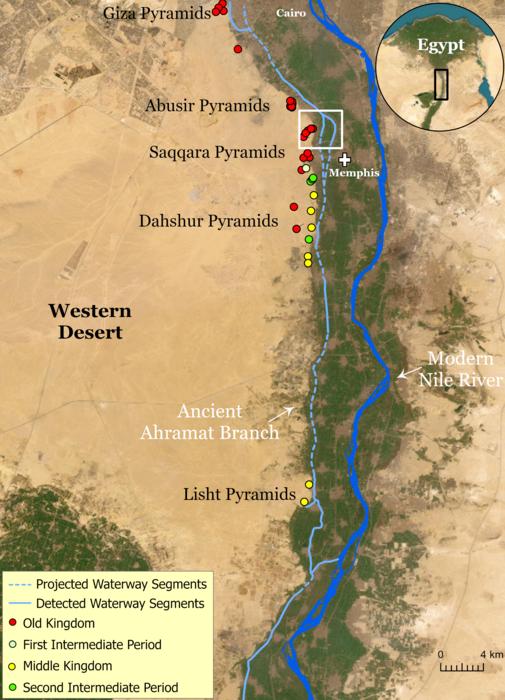
31 pyramids in Egypt, including the Giza pyramid complex, may originally have been built along a 64-km-long branch of the river Nile which has long since been buried beneath farmland and desert. The findings, reported in a paper in Communications Earth & Environment, could explain why these pyramids are concentrated in what is now a narrow, inhospitable desert strip.

Credit: Eman Ghoneim
31 pyramids in Egypt, including the Giza pyramid complex, may originally have been built along a 64-km-long branch of the river Nile which has long since been buried beneath farmland and desert. The findings, reported in a paper in Communications Earth & Environment, could explain why these pyramids are concentrated in what is now a narrow, inhospitable desert strip.
The Egyptian pyramid fields between Giza and Lisht, built over a nearly 1,000-year period starting approximately 4,700 years ago, now sit on the edge of the inhospitable Western Desert, part of the Sahara. Sedimentary evidence suggests that the Nile used to have a much higher discharge, with the river splitting into several branches in places. Researchers have previously speculated that one of these branches may have flown by the pyramid fields, but this has not been confirmed.
Eman Ghoneim and colleagues studied satellite imagery to find the possible location of a former river branch running along the foothills of the Western Desert Plateau, very near to the pyramid fields. They then used geophysical surveys and sediment cores to confirm the presence of river sediments and former channels beneath the modern land surface, indicating the presence of a former branch, which they propose naming ‘Ahramat’ (meaning ‘pyramids’ in Arabic). The authors suggest that an increased build-up of windblown sand, linked to a major drought which began approximately 4,200 years ago, could be one of the reasons for the branch’s migration east and eventual silting up.
The discovery may explain why these pyramid fields were concentrated along this particular strip of desert near the ancient Egyptian capital of Memphis, as they would have been easily accessible via the river branch at the time they were built. Additionally, the authors found that many of the pyramids had causeways which ended at the proposed riverbanks of the Ahramat branch, which they suggest is evidence the river was used for transporting construction materials.
The findings reiterate the importance of the Nile as a highway and cultural artery for ancient Egyptians, and also highlight how human society has historically been affected by environmental change, according to the authors. Future research to find more extinct Nile branches could help prioritise archaeological excavations along their banks and protect Egyptian cultural heritage, they add.
Journal
Communications Earth & Environment
Subject of Research
Not applicable
Article Title
The Egyptian pyramid chain was built along the now abandoned Ahramat Nile Branch
Article Publication Date
16-May-2024
COI Statement
The authors declare no competing interests. Permissions for collecting soil coring and sampling were obtained from the Faculty of Science, Tanta University, Egypt by co-authors Dr. Amr Fhail and Dr. Mohamed Fathy.
Cite Scienmag News
Courtney Benton. (May 16, 2024). Archaeology: Egyptian pyramids built along long-lost Ahramat branch of the Nile. Scienmag. https://scienmag.com/archaeology-egyptian-pyramids-built-along-long-lost-ahramat-branch-of-the-nile/
Courtney Benton. "Archaeology: Egyptian pyramids built along long-lost Ahramat branch of the Nile." Scienmag, 16 May 2024, https://scienmag.com/archaeology-egyptian-pyramids-built-along-long-lost-ahramat-branch-of-the-nile/. Accessed 3 September 2026.
Courtney Benton. "Archaeology: Egyptian pyramids built along long-lost Ahramat branch of the Nile." Scienmag. May 16, 2024. https://scienmag.com/archaeology-egyptian-pyramids-built-along-long-lost-ahramat-branch-of-the-nile/

