


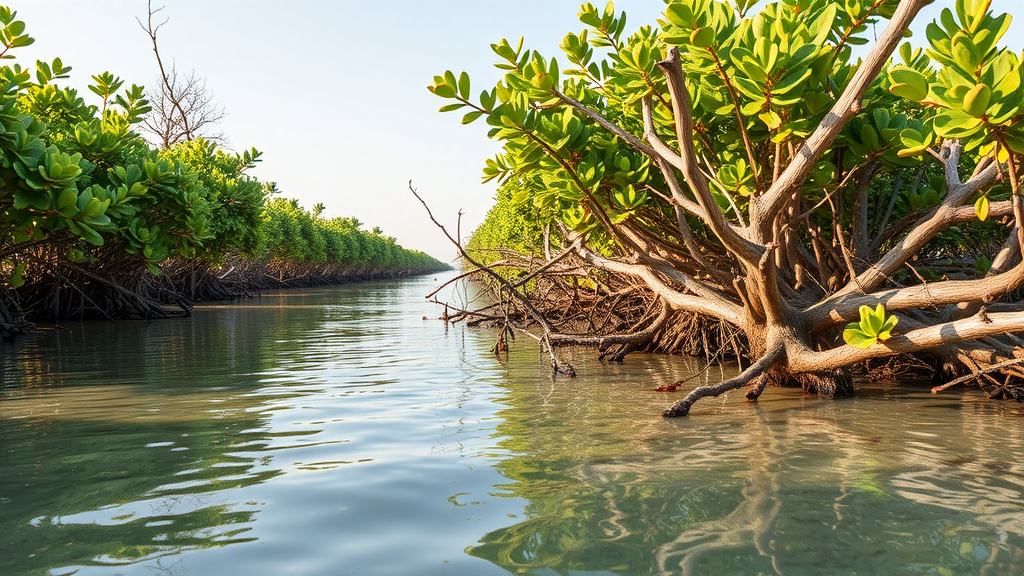
Mangrove forests are among the most powerful carbon reservoirs on Earth, locking away vast quantities of so-called blue carbon in waterlogged soils where decomposition proceeds slowly. Part of this remarkable preservation depends on chemistry that is easy to overlook: iron minerals in the sediment bind organic molecules and shield them from hungry microbes, creating a mineral armor around carbon that might otherwise escape into the atmosphere. At the same time, mangrove soils act as biological filters for coastal waters, transforming excess nitrogen that drains from farms, towns and fish ponds before it can fuel harmful algal blooms. A new study published in Forest Ecosystems suggests that both of these quiet services may be far more fragile than previously assumed when aquaculture wastewater seeps into the forest, weakening the iron–carbon partnership and rewiring the microbial machinery that governs nitrogen.
The research team, led by scientists from East China Normal University including Zhongzheng Yan, focused on mangrove stands in the Maowei Sea reserve in China’s Beibu Gulf, a region where shrimp and fish pond operations have long bordered the fringing forests. To capture a gradient of human influence, the researchers selected three contrasting sites. One served as a restored reference, located where nearby pond discharge had ceased roughly nine years before sampling. The other two sites sat directly beside active aquaculture pond systems that continued to release nutrient-rich effluent into the mangrove environment. By comparing soils, porewater chemistry and microbial gene profiles across this gradient, the team could trace how increasing wastewater exposure reshapes the underground processes that determine whether carbon stays buried and whether nitrogen is removed or merely recycled.
The chemical contrasts between the sites were striking. At the most heavily affected location, the concentration of dissolved organic carbon in porewater was approximately 99 percent lower than at the restored reference site. On its face, this might seem paradoxical, because aquaculture wastewater actually imports organic matter and nutrients into the forest. The explanation, the researchers conclude, lies in what those imports do to microbial communities. Nutrient enrichment appears to stimulate microbes to consume the readily available carbon pool far more aggressively, so the standing stock of dissolved organic carbon collapses even as carbon throughput increases. In effect, the wastewater does not simply add material to the soil; it activates an underground economy in which microbes burn through carbon faster than it can accumulate.
This accelerated carbon consumption carried a second, more consequential consequence: a shift toward more reducing conditions in the soil. As microbes devour oxygen and other oxidized compounds while processing organic matter, the sediment chemistry becomes progressively more anoxic and chemically reduced. That matters enormously for iron-bound carbon, because the protective coupling between organic matter and iron minerals depends on the oxidation state of the iron itself. Under increasingly reducing conditions, the mineral shields begin to destabilize, releasing previously protected organic carbon back into the microbial feeding ground. The study found that this enhanced consumption was associated with, and likely contributed to, the more reducing soil environment, together loosening the iron–organic carbon coupling that underpins long-term carbon storage.
The quantitative evidence for this destabilization is compelling. Around mangrove roots, the relatively persistent pool of organic carbon associated with crystalline iron minerals was 67 percent to 76 percent smaller at the two disturbed sites than at the restored reference. Crystalline iron oxides are among the most stable binding partners for organic matter, so a loss of this magnitude represents a substantial drawdown of the carbon that mangrove soils can preserve on decadal to centennial timescales. Intriguingly, carbon associated with a more reactive form of iron increased at the most affected site. The researchers interpret this as evidence of a fundamental shift in the carbon cycle: away from durable, mineral-protected storage and toward a more labile, less stable regime in which carbon circulates rapidly and remains vulnerable to microbial oxidation and eventual release as carbon dioxide.
The study’s second major finding concerns nitrogen, the nutrient that mangroves famously help scrub from coastal waters. Microbes handle nitrate through two principal pathways. Denitrification converts nitrate into gaseous forms of nitrogen that escape to the atmosphere, permanently removing it from the ecosystem. A competing pathway, dissimilatory nitrate reduction to ammonium, known as DNRA, instead converts nitrate into ammonium, keeping the nitrogen within the soil and making it available again to plants and microbes. The microbial gene evidence gathered in the Maowei Sea indicated that both pathways became active simultaneously under aquaculture stress, but with a telling emphasis: the balance appeared to tilt toward ammonium retention and internal recycling rather than permanent removal.
If that shift holds, the implications for coastal water quality could be significant. A mangrove forest functioning primarily as a nitrogen recycler acts more like a holding buffer than a sink, retaining reactive nitrogen within the ecosystem instead of eliminating the excess that flows in from aquaculture and other land uses. Under heavy nutrient loading, such a forest may no longer deliver the water-purifying service that coastal managers often count on, and ammonium retained in the soil could continue to fuel microbial activity and further carbon loss, linking the nitrogen and carbon findings into a self-reinforcing loop of change.
Among the study’s most practically interesting results is the identification of a marked transition in nitrogen cycling behavior around a dissolved organic carbon concentration of approximately 32 milligrams per liter. Below and above this porewater threshold, the microbial community’s nitrogen processing strategy appeared to differ noticeably, suggesting that DOC could serve as an early-warning signal of ecosystem state change. The authors are careful, however, to frame this value as a potential site-specific indicator rather than a universal rule. Because DOC dynamics vary with climate, sediment type, tidal regime and forest history, further studies across other mangrove systems will be needed before such a number can be confidently adopted as a general management threshold.
Taken together, the findings sketch a coherent mechanistic chain from aquaculture discharge to diminished carbon durability. Nutrient-rich wastewater stimulates microbial carbon consumption; intensified consumption drives soil chemistry toward more reducing conditions; reducing conditions destabilize the crystalline iron minerals that guard persistent organic carbon; and the resulting carbon mobilization feeds back into microbial activity while nitrogen pathways pivot from removal to retention. The two ecosystem services at stake, durable blue carbon storage and coastal nitrogen regulation, are therefore not independent functions but tightly coupled outcomes of the same underground chemistry and microbial ecology. Disturbing one leg of the system inevitably strains the other.
For coastal policymakers and restoration practitioners, the study underscores the importance of managing aquaculture discharge before it reaches mangrove soils, whether through improved pond effluent treatment, buffer zones or strategic placement of restoration sites away from active discharge. It also argues for monitoring programs that look beyond conventional water-quality parameters to track carbon–iron–microbial interactions directly, since the earliest signs of functional decline appear in porewater chemistry and gene profiles rather than in the visible health of the trees. As aquaculture continues to expand across tropical and subtropical coastlines worldwide, understanding these hidden soil processes may prove essential to preserving the blue carbon and nutrient-filtering benefits that mangrove forests quietly provide.
Subject of Research: The effects of aquaculture wastewater on iron-bound organic carbon stabilization and microbial nitrogen cycling in mangrove soils
Article Title: Aquaculture wastewater may weaken mangroves’ iron-based carbon storage and shift nitrogen cycling toward recycling
Article References: Aquaculture wastewater may weaken mangroves’ iron-based carbon storage and shift nitrogen cycling toward recycling. (n.d.). Original publication
Image Credits: AI Generated
DOI: Not provided
Keywords: mangroves, blue carbon, aquaculture wastewater, iron–organic carbon coupling, dissolved organic carbon, nitrogen cycling, denitrification, DNRA, soil microbes, Maowei Sea, coastal water quality, Forest Ecosystems
Cite Scienmag News
Alan Morgan. (September 21, 2026). Aquaculture runoff may erode mangroves’ iron-shielded carbon stores and flip nitrogen cycling toward recycling. Scienmag. https://scienmag.com/aquaculture-runoff-may-erode-mangroves-iron-shielded-carbon-stores-and-flip-nitrogen-cycling-toward-recycling/
Alan Morgan. "Aquaculture runoff may erode mangroves’ iron-shielded carbon stores and flip nitrogen cycling toward recycling." Scienmag, 21 September 2026, https://scienmag.com/aquaculture-runoff-may-erode-mangroves-iron-shielded-carbon-stores-and-flip-nitrogen-cycling-toward-recycling/. Accessed 5 October 2026.
Alan Morgan. "Aquaculture runoff may erode mangroves’ iron-shielded carbon stores and flip nitrogen cycling toward recycling." Scienmag. September 21, 2026. https://scienmag.com/aquaculture-runoff-may-erode-mangroves-iron-shielded-carbon-stores-and-flip-nitrogen-cycling-toward-recycling/


