


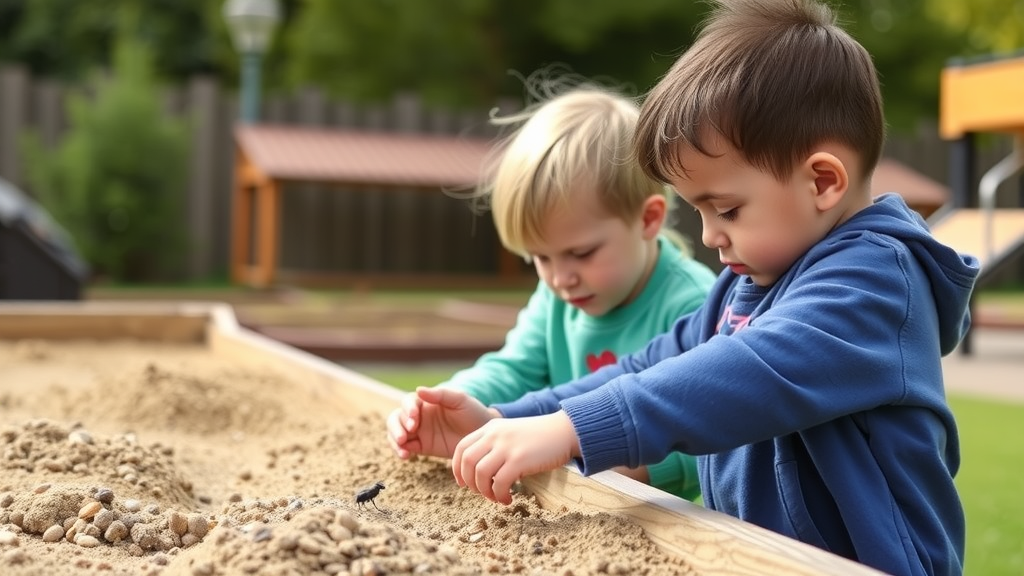
A line of ants marching across a concrete path in a kindergarten garden in Uşak, Türkiye, has offered researchers a striking demonstration of how early scientific thinking can emerge when children’s own curiosity is allowed to steer the curriculum. A new study published in Discover Education reports that a seven-week, child-initiated investigation into the lives of ants, structured through a project-based STEAM framework, measurably transformed how five- and six-year-old children observe, classify, explain, and communicate about the natural world. The findings add empirical weight to a growing body of evidence that preschoolers are not merely passive recipients of facts but capable young investigators who can engage in genuinely rigorous inquiry when adults provide the right scaffolding.
The study, conducted by Perıhan Tugba Seker and Ozge Savas of Uşak University’s Department of Preschool Education, followed 21 children aged 60 to 72 months attending a public kindergarten in central Uşak during the 2020–2021 academic year. The research adopted a qualitative single-case study design, a methodology chosen precisely because it allows researchers to examine a bounded, real-life classroom phenomenon in depth without manipulating children’s natural behavior. Ethical approval was granted by the Uşak University Social and Human Sciences Scientific Research and Publication Ethics Committee, and informed written consent was obtained from parents before data collection began.
Crucially, the topic of investigation was not selected by the researchers or the teacher. During an outdoor recess in early November, a small group of children noticed ants carrying breadcrumbs toward a soil mound and their questions multiplied rapidly: Where were they taking the crumbs? Did ants freeze in the rain? How did they find their way without getting lost? Was there a giant city beneath the soil? The researchers documented these spontaneous exchanges in anecdotal records and recognized in them the authentic spark of curiosity that would anchor the project. This genesis matters methodologically: rather than imposing an externally designed unit, the team traced how children’s pre-existing interests could be channeled into structured, multidimensional scientific inquiry.
The project was organized around the three canonical phases of the Project Approach as articulated by Katz and Chard and later developed by Helm and Katz. In the initiation phase, spanning the first two weeks, children’s prior knowledge and misconceptions were elicited through free drawing and collaborative discussion, and co-constructed concept maps were used to visualize initial hypotheses about ant anatomy, behavior, and ecology. The fieldwork phase, from weeks three to five, formed the analytical core of the intervention: children conducted guided nature walks, observed ants through magnifying glasses and digital microscopes, documented findings through field mapping, and collaboratively designed and built model ant farms, embedding engineering design and mathematical measurement of movement patterns and distances into authentic contexts. The finalization phase in weeks six and seven centered on reflection and public sharing, with children revising their concept maps and preparing a community exhibition of their work.
Sessions ran three days per week for 45 to 60 minutes, totaling approximately 21 structured project sessions, and were mapped deliberately onto the constructivist, child-centered Turkish National Preschool Education Program. The educators’ role was carefully calibrated. Rather than lecturing or dispensing answers, the teacher functioned as facilitator and co-investigator, deploying open-ended questions—such as asking what might happen if the texture of an ant’s path changed—to stimulate prediction and solution design, while enriching classroom learning centers with magnifiers, tweezers, field journals, and art supplies as the project’s needs evolved.
The most dramatic findings concerned the dismantling of anthropomorphic misconceptions. Before the project, interviews and drawings revealed that children largely interpreted ant biology through the lens of human life. They imagined ant families with mothers, fathers, and children, insisted that ants never sleep because they always work, and variously credited the insects with anywhere from two to seven legs. After the intervention, post-project interviews documented a profound conceptual shift: children correctly deployed scientific terminology including colony, larva, and maze-like chambers, and described accurate biological structures and behaviors. The researchers argue this demonstrates that preschoolers can master genuinely complex scientific vocabulary and concepts when those concepts are explored deeply rather than treated superficially.
Procedural skills evolved in parallel. Early in the project, children could perceive no diversity within the insect world, claiming there were only black ants or inventing fictional species such as ants made of iron. By the finalization stage, they had progressed from global descriptions to fine-grained, attribute-based classification, accurately distinguishing ecological and behavioral roles such as queen ants, worker ants, carpenter ants, and wood ants based on physical form and function. Children’s understanding of the antenna underwent a particularly striking transformation. Initially described as the thing that runs the television or simply as ears, the antenna was reconceptualized after the project as a multifunctional sensory organ through which ants find their way, avoid danger, hear, and taste—a shift the researchers interpret as evidence of transition from passive questioning to causal, evidence-based explanation.
The integrated STEAM design proved central to these gains, and the authors emphasize that the arts functioned as far more than decoration. When presented with a design challenge inspired by the temperature-regulated architecture of ant nests, children used salt ceramics to sculpt intricate, interconnected three-dimensional models of warehouse systems, verbally attributing functions and names to each component. This artistic modeling acted as a cognitive and symbolic language, allowing children to translate abstract biological findings into tangible engineered products, and to test and communicate mental models that verbal language alone could not yet carry. Robot designs inspired by ant body structure, antennae, and legs further extended the engineering dimension of the inquiry.
Collaboration and communication developed alongside cognitive skills. Because workshop tasks such as constructing interconnected colony pathways were too complex for any single child, cooperative problem-solving became a practical necessity, and the researchers observed a marked reduction in egocentric behavior as children negotiated design choices and built consensus. The culminating public exhibition, for which each child’s artifacts were systematically labeled, saw children confidently explaining their work and every structural detail to an audience, reinforcing scientific communication and metacognitive reflection. A spontaneous home-school learning loop also emerged: children carried their inquiries into daily life, identifying and naming real ants encountered outdoors according to their morphological traits, and sharing their observations with parents—an authentic cross-contextual transfer of knowledge that turned family involvement into an active support mechanism for early scientific literacy.
The authors acknowledge limitations, including winter weather that constrained outdoor observation of ants and forced some sessions to rely on simulated ant farms and digital resources, as well as administrative constraints that prevented families from physically attending the final exhibition, which had to be shared through photographs and video. Even so, the study concludes with a clear message for educators, teacher-training programs, and policymakers: when long-term, interest-driven projects are integrated with a STEAM framework and supported by responsive adult scaffolding, young children are fully capable of fine-grained observation, attribute-based classification, higher-order causal questioning, and collaborative engineering design. The lowly ant, it turns out, was all the invitation these preschool scientists needed.
Subject of Research: Development of scientific inquiry skills in preschool children through a project-based STEAM investigation of ants
Article Title: Preschool children develop scientific inquiry skills through STEM based investigations
Article References: Seker, P. T., & Savas, O. (2026). Preschool children develop scientific inquiry skills through STEM based investigations. Discover Education, 5(1), Article 898. https://doi.org/10.1007/s44217-026-02127-z
Image Credits: AI Generated
DOI: 10.1007/s44217-026-02127-z
Keywords: early childhood education, STEM education, STEAM, project-based learning, scientific inquiry, preschool, curiosity, science misconceptions, ants, Uşak University, qualitative case study, Discover Education
Cite Scienmag News
Courtney Benton. (September 12, 2026). Ants in the Playground Turn Preschoolers Into Real Scientists. Scienmag. https://scienmag.com/ants-in-the-playground-turn-preschoolers-into-real-scientists/
Courtney Benton. "Ants in the Playground Turn Preschoolers Into Real Scientists." Scienmag, 12 September 2026, https://scienmag.com/ants-in-the-playground-turn-preschoolers-into-real-scientists/. Accessed 16 October 2026.
Courtney Benton. "Ants in the Playground Turn Preschoolers Into Real Scientists." Scienmag. September 12, 2026. https://scienmag.com/ants-in-the-playground-turn-preschoolers-into-real-scientists/


