


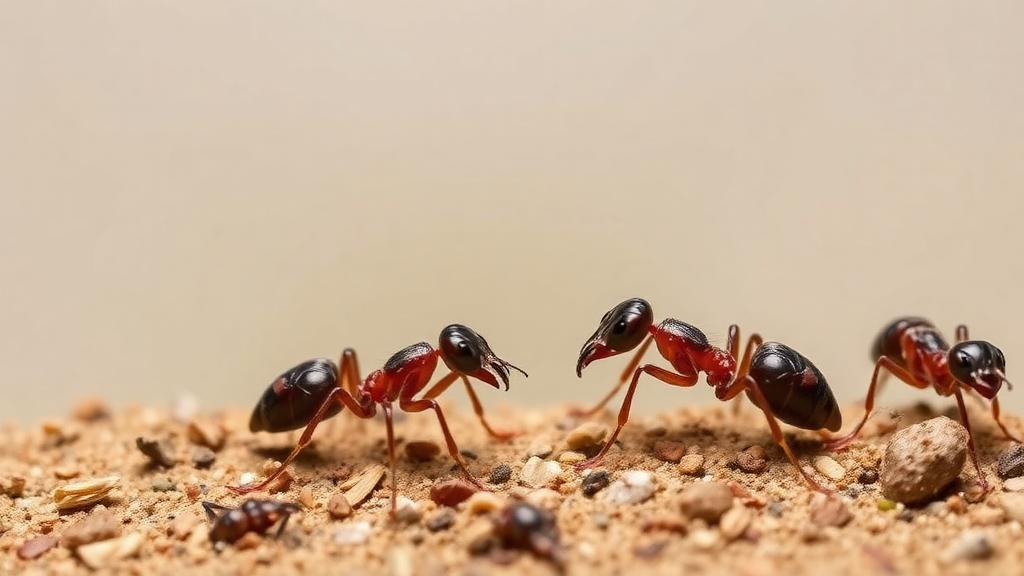
Bigger animals usually have bigger body parts, one of biology’s most familiar scaling patterns, yet some ants appear to break that rule. A new study led by researchers in the Eco-Evo-Devo lab at the University of Ottawa finds that ants can decouple antennae size from both head and body size as they develop into different social castes, revealing how social signals and hormones help shape traits for specialized colony roles. The discovery offers a new view of how evolution can loosen biological constraints and produce new combinations of traits.
The researchers studied Pheidole, a highly diverse genus of ants whose colonies include small workers and much larger soldiers. Within each caste, antennae still grow in proportion to body size. Surprisingly, across castes the relationship changes: the variation of worker and soldier antenna size completely overlaps, despite the fact that soldiers have substantially larger heads and bodies. The team combined laboratory experiments, field data, museum collections and comparative analyses. Measurements from 565 Pheidole species showed that this unusual antennal pattern is widespread across the genus, and comparisons with other ants suggest it may have originated near the common ancestor shared by Pheidole and the closely related Cephalotes turtle ants.
The observation arose by accident in the lab. “It was total serendipity. We were sitting at the microscope and Erica showed me the antennae of two individuals. One was clearly smaller, yet it turned out to be from the soldier!” says Rajendhran Rajakumar, Associate Professor in the Department of Biology at uOttawa’s Faculty of Science, where the research was conducted; Erica Vong is a graduate researcher and lead author of the study. “Much like when you are getting your favorite latte, both castes have small, medium, and large sizes of overlapping antennae.” The large antennae came from the biggest worker and the small antenna from the smallest soldier, which is still much bigger in both head and body size.
“Biologists have long assumed that traits such as antennae generally scale predictably with body size,” Professor Rajakumar says. “Our findings show that evolution can decouple a trait from body size in one context while preserving that relationship in another.” Antennae are essential to an ant’s survival: ants use them to detect chemical and physical cues, find their way through their surroundings and communicate with nestmates, all critical in the functioning of their societies. Their size and shape can also affect the number and arrangement of sensory structures available to each ant. “The antenna is not simply getting bigger because the ant is bigger,” Professor Rajakumar explains. “In these colonies, development preserves a flexible range of antennal forms that may help individuals compatibly respond together to changing environmental demands.”
Experiments with Pheidole dentata showed that this flexibility is regulated by the colony’s social environment, juvenile hormone, and signals from an allometry-regulating organ. Previously, Professor Rajakumar had played a vital role in work demonstrating that these same factors are critical for soldier and supersoldier development. By changing these factors, particularly the soldier inhibitory pheromone, the researchers produced novel “nanoworkers” and “nanosoldiers”; nanosoldiers with the body size of a worker and the head size and shape of a soldier. These ants revealed body-and-trait combinations that ordinary development usually keeps hidden, yet the developmental potential exists and can be activated.
The results also show how the colony acts as a superorganism, with social conditions influencing the development of individual ants. “Social signals and hormones do more than determine whether an ant becomes a worker or a soldier,” clarifies Professor Rajakumar. “They can also reshape how different traits grow and scale together, or decouple, within castes, between castes, and more broadly across species.”
The findings help explain how biological systems can escape familiar scaling rules, generating new forms. That flexibility may have contributed to the rise of complex caste systems, helping ants become one of the planet’s most diverse and ecologically successful species. “This work reminds us that evolution is not always a process of adding more or less of the same trait,” Professor Rajakumar concludes. “Sometimes new possibilities emerge when the expected connections between traits are broken and development is reorganized.”
The study, titled “Breaking trait scaling via the evolution and regulation of dimorphic decoupling in ants”, was published in Proceedings of the National Academy of Sciences on 6 October 2026, with authorship by Erica Vong, Shannon Parisien, Hélène Orfali, and Rajendhran Rajakumar.
Subject of Research: Decoupling of antennae size from body size across castes in Pheidole ants
Article Title: Ants break a basic rule of biology to help them adapt to new environments
Article References: Ants break a basic rule of biology to help them adapt to new environments. Original publication (Bibliographic details unavailable.)
Image Credits: AI Generated
DOI: Not provided
Keywords: ants, Pheidole, allometry, caste development, antennae, juvenile hormone, superorganism, evolutionary biology, decoupling, morphology, social insects, PNAS
Cite Scienmag News
Gavin Prescott. (October 24, 2026). Ants break a basic rule of biology to help them adapt to new environments. Scienmag. https://scienmag.com/ants-break-a-basic-rule-of-biology-to-help-them-adapt-to-new-environments/
Gavin Prescott. "Ants break a basic rule of biology to help them adapt to new environments." Scienmag, 24 October 2026, https://scienmag.com/ants-break-a-basic-rule-of-biology-to-help-them-adapt-to-new-environments/. Accessed 24 October 2026.
Gavin Prescott. "Ants break a basic rule of biology to help them adapt to new environments." Scienmag. October 24, 2026. https://scienmag.com/ants-break-a-basic-rule-of-biology-to-help-them-adapt-to-new-environments/


