


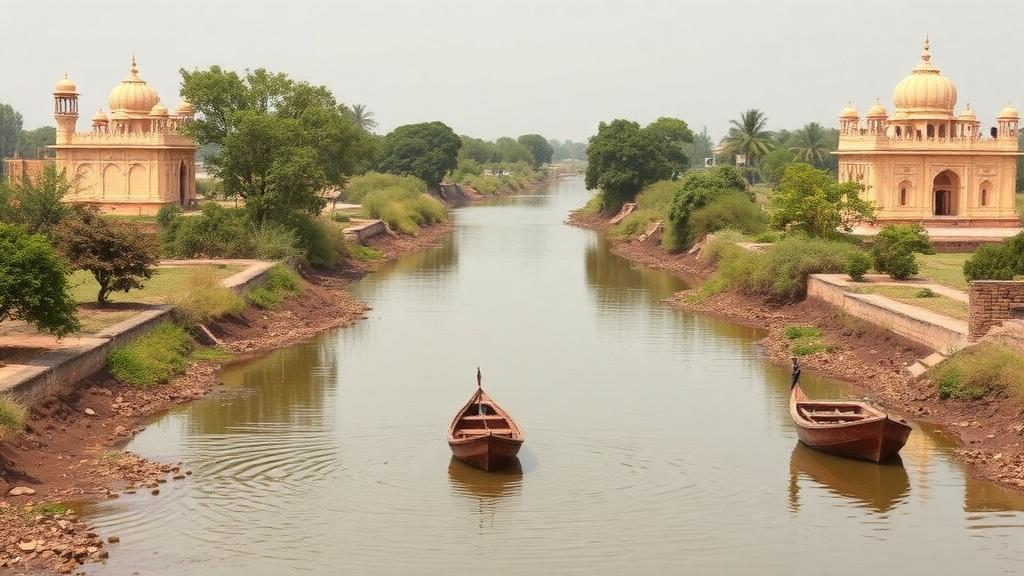
A new historical study argues that the building of colonial authority in Punjab between 1885 and 1932 rested in part on the control of nature itself. The research, published in SN Social Sciences, examines how the regulation of canal irrigation and the governance of wild animals, usually treated by historians as two separate stories, were in fact intertwined administrative projects within a single province. Its central claim is that environmental governance was one of the processes through which the colonial state was made, not merely a backdrop to political and economic change.
The study, authored by Deepak Malik, uses a qualitative historical method based on close reading and source criticism of archival material. Its evidential core consists of twelve files and proceedings of the Government of India held at the National Archives of India, five of which are analysed as cases. These are supplemented by published census and administration reports and by the existing secondary literature. The research asks three questions: through which administrative mechanisms water, land and animals were governed; how irrigation and wildlife governance were connected in practice; and how cultivators, pastoralists, intermediaries and princely states experienced and contested these arrangements.
The findings point to a shared administrative toolkit across both domains. Water and wildlife were alike governed through classification, codified rules and monetary charges or rewards, meaning that the state’s reach over rivers, fields and animals ran through the same instruments of paperwork and payment. Canal administration, meanwhile, did not operate through officials alone but worked through local intermediaries, who carried the routines of colonial rule into villages and pastures. This reliance on go-betweens shaped how authority was exercised on the ground and how local actors could engage with, or push back against, it.
The most concrete point of connection between the two domains was physical. Canal colonisation converted the scrub commons of the western doabs, the interfluve tracts between rivers, into revenue-paying fields. Those scrublands had served simultaneously as pasture for herders and as habitat for wildlife, so the extension of irrigation transformed in one stroke the economics of land, the livelihoods of pastoralists and the ecological setting in which animals were governed. The study presents this overlap as the terrain on which irrigation policy and wildlife policy met, linking the political economy of canal agriculture to the control of animals within the same landscape.
The article also registers how these arrangements were experienced from below. Cultivators, pastoralists, intermediaries and princely states appear in the analysis not as passive recipients of policy but as groups who encountered, negotiated and contested colonial rules over water, land and animals. By treating their responses as part of the evidence, the study frames colonial-state formation as a process that unfolded through encounters in the field rather than through decrees issued from above alone.
The author is explicit about the limits of the evidence. The findings establish administrative priorities more firmly than they establish ecological causation, and the archival base consists largely of English-language official records, which inevitably filter the perspectives available to the historian. Within these constraints, the study makes its contribution by joining two historiographical threads that have run separately: the history of canal irrigation in colonial Punjab and the history of wildlife governance. Read together, they suggest that the classification of land, the levying of charges and rewards, and the conversion of commons into taxable fields were not incidental side effects of empire but active ingredients in the construction of colonial authority in the province.
Subject of Research: The role of canal irrigation and wildlife governance in colonial state formation in Punjab, 1885–1932
Article Title: Environmental governance and colonial-state formation in Punjab: canal irrigation, wildlife governance, and the political economy of empire, 1885–1932
Article References: Malik, D. (2026). Environmental governance and colonial-state formation in Punjab: canal irrigation, wildlife governance, and the political economy of empire, 1885–1932. SN Social Sciences, 6(11), 582. https://doi.org/10.1007/s43545-026-01889-5
Image Credits: AI Generated
DOI: 10.1007/s43545-026-01889-5
Keywords: colonial Punjab, environmental governance, canal irrigation, wildlife governance, colonial state formation, political economy of empire, scrub commons, pastoralists, National Archives of India, historical method, water administration, land classification
Cite Scienmag News
Margaret Porter. (October 24, 2026). How canals and wildlife rules built colonial authority in Punjab. Scienmag. https://scienmag.com/how-canals-and-wildlife-rules-built-colonial-authority-in-punjab/
Margaret Porter. "How canals and wildlife rules built colonial authority in Punjab." Scienmag, 24 October 2026, https://scienmag.com/how-canals-and-wildlife-rules-built-colonial-authority-in-punjab/. Accessed 24 October 2026.
Margaret Porter. "How canals and wildlife rules built colonial authority in Punjab." Scienmag. October 24, 2026. https://scienmag.com/how-canals-and-wildlife-rules-built-colonial-authority-in-punjab/


