


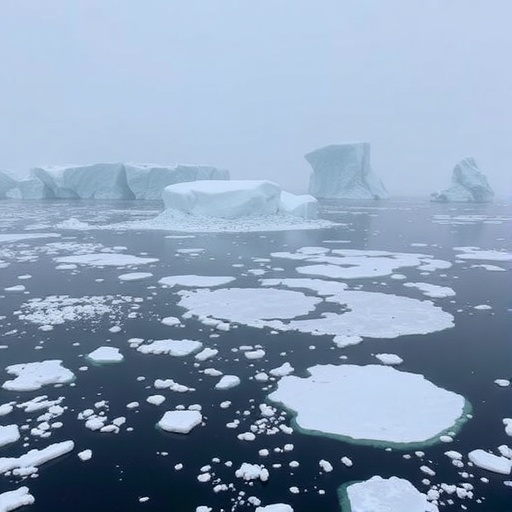
Beneath the iron-grey waters of Ryder Bay, on the western Antarctic Peninsula, one of the Southern Ocean’s most abundant large invertebrates is quietly failing a test it never evolved to take. Paraceradocus miersi, a giant amphipod and distant relative of the sandhoppers that flick across temperate beaches, has spent millions of years perfecting an internal chemistry almost identical to seawater itself. That chemistry is now being undone from the outside. Across parts of Antarctica, a combination of melting glaciers, increased rain and increasingly extreme weather events is diluting the salt out of coastal waters — a process scientists call freshening. A new study by researchers at the University of Plymouth and the British Antarctic Survey (BAS), published in the peer-reviewed journal Marine Environmental Research, warns that this slow-motion dilution may pose a significant threat to many of the region’s marine invertebrates, and that if it continues it could ultimately help change the nature of the global ocean itself.
Freshening may sound almost benign, but in the Southern Ocean it is one of the clearest physical fingerprints of a warming world. Ice that accumulated on Antarctica over millennia is now being released into the sea as glaciers melt and retreat, while shifting weather patterns deliver more rain and more violent storms to the coasts. Every unit of meltwater and rainfall that enters the coastal sea lowers its salinity, thinning the salty medium that Antarctic life has relied on for evolutionary time. For millions of years, the waters ringing the continent have been among the most chemically stable environments on the planet: cold, saline and remarkably constant from one century to the next. The creatures evolving inside that stability never needed the elaborate salinity-defence machinery that animals in estuaries or rock pools depend on. The result is a community of species exquisitely tuned to conditions that are now changing faster than evolution can answer — and the question that has increasingly troubled scientists is what happens to those species when the stability finally breaks.
The new research, conducted by scientists at the University of Plymouth and the British Antarctic Survey, was designed to find out precisely what freshening is doing to the animals themselves. It builds on years of collaboration between the two organisations assessing how changing ocean conditions bear down on some of the planet’s smallest, but most important, inhabitants. The team focused on Paraceradocus miersi, a giant amphipod found in abundance in Antarctic waters, collecting living specimens from Ryder Bay, the inlet beside the BAS’s Rothera Research Station on the Antarctic Peninsula. In the laboratory, the researchers ran a simulated freshening experiment, exposing the animals to reduced salt levels while tracking how their body fluids and internal organs responded. The results were stark, and unexpectedly nuanced: even in noticeably diluted water, the amphipods hung on to their ability to regulate some individual chemicals critical to their bodily functions, calcium among them. What collapsed was the bigger picture — the amphipods’ overall regulation of the ions that together make up the full concentration of seawater.
For the study’s lead author, Professor John Spicer, Professor of Marine Zoology at the University of Plymouth, the question is anything but hypothetical. Spicer has spent almost 40 years examining the effects of climate change on marine organisms, and in 2017 he was working at the Rothera Research Station when an extreme freshening event struck the peninsula. “I was working at the Rothera Research Station on the Antarctic peninsula in 2017 when there was an extreme freshening event. I was interested in the effect this would have on one of the region’s largest amphipods, and we found that even if the water is diluted fractionally, the amphipods lose their salts, gain water and their gills are damaged,” he said. That is the detail that should stop any reader cold: the animal does not need a catastrophic salinity crash to be pushed into crisis. A fractional dilution — a change so small that a swimmer would never notice it — is enough to begin breaking one of Antarctica’s most successful invertebrates down from the inside.
To understand why a small drop in salinity can be so devastating, it helps to look at how these animals are built. Many marine invertebrates, amphipods included, are osmoconformers: rather than actively pumping salts in or out to hold their internal chemistry constant the way fish do, they let their body fluids match the sea around them. Over evolutionary time their tissues, enzymes and nerves have been calibrated to seawater’s precise ionic recipe, and in the stable Antarctic this strategy costs almost nothing. Conforming, however, is not the same as surrendering. Many osmoconformers still fine-tune individual ions, keeping certain chemicals at levels that differ from seawater because their physiology demands it. The Plymouth and BAS team found that P. miersi had retained exactly this selective control, continuing to regulate calcium even as the water around it grew fresher. What failed was bulk control of the full ionic concentration. And when that control fails, osmotic physics turns hostile: water floods into the body across its permeable surfaces, salts stream out, and the internal balance that millions of years assembled simply drains away.
Nowhere is that balance more fragile than in the gills. Amphipod gills are thin, richly folded sheets of living tissue that must perform two jobs at once: drawing oxygen from the water and releasing carbon dioxide, while simultaneously managing the two-way traffic of ions between the animal’s body fluids and the sea. That dual role makes them exquisitely sensitive to salinity swings — and the first casualty when the chemistry shifts. In the freshened water, the researchers found, the gills of P. miersi were damaged, leaving the animal in a devastating double bind: it loses the salts it cannot spare, takes on water it cannot expel, and the very tissue it depends on to breathe begins to break down. The team says that impairment of this kind could have led to significant deaths among shallow-dwelling individuals during the 2017 freshening event, and during other similar events before and after it.
The implications radiate outward from the sea floor. Amphipods are among the most ecologically important crustaceans in the Southern Ocean, and in Antarctic shallows species such as P. miersi occur in abundance, occupying ecological roles that in warmer seas are spread across many different animals — scavenging carcasses, grazing algae and detritus, recycling nutrients through the sediment and forming a substantial link in food webs that ultimately sustain fish, seals, penguins and other seabirds. Communities of Antarctic benthic invertebrates are also famously vulnerable to shocks of this kind: many species are endemic, found nowhere else on Earth, and they grow and reproduce slowly in the perpetual cold, which leaves them little capacity to recover from mass mortality. Unlike a whale or a wandering fish, much of the sea-floor community cannot simply swim away from a patch of freshened water; the chemistry that arrives is the chemistry it must endure.
Dr Simon Morley, an ecophysiologist at the British Antarctic Survey and a co-author of the study, frames the findings as a preview of what a warming ocean has in store for the continent’s sea floor. “As climate change continues, environments will change beyond the conditions that animals living there can cope with,” he said. “In the seas around Antarctica, the biggest signal of climate change is the melting of ice and this is adding large quantities of freshwater into the oceans. This lowering of salinity could have dramatic impacts, reshaping the communities on the sea floor. Our study provides critical evidence of what could happen to different species in the future.” The most important phrase in that warning is “beyond the conditions that animals can cope with.” Freshening is not a stress the animals can escape by moving or hiding; it is a chemical assault on the internal environment of the body itself, and the new data show exactly where that assault begins to do its damage.
The researchers’ warning does not stop at the Antarctic shelf, and this is where the story stops being a local one. The Southern Ocean is not a remote aquarium; it is a working component of the planetary machine. Its cold waters absorb and store enormous quantities of heat and carbon dioxide, and the dense water formed off Antarctica sinks and spreads through the deep basins of the world, helping to drive the global overturning circulation that steers climate far beyond the poles. Freshening strikes at the foundations of that machinery, because it is salt content, together with temperature, that gives seawater its density and drives the sinking that feeds the deep ocean. The team behind the new study warns that continued coastal freshening may threaten many marine invertebrates across the region, but that it could also, in time, change the nature of the global ocean. Spicer put the stakes in the bluntest possible terms: “This is important for the whole planet as while Antarctica and its wildlife are wonderful, they are also essential to a functioning environment. Damaging the Antarctic damages us all, and if there is freshening it will not have to be very strong before the health of many invertebrate species will be severely impacted.”
For now, Paraceradocus miersi still abounds in the shallow waters around Antarctica, and the researchers are careful not to forecast its disappearance. But the study reads like a warning written in chemistry: a species that endured millions of years of stability in one of Earth’s most constant environments begins to fail at the very first fractional dilution of the medium its body is built from. If meltwater keeps arriving as the climate warms, the salinity of Antarctic coastal seas will keep falling, and the margin between survival and collapse for many invertebrate species will keep shrinking with it. The amphipods of Ryder Bay are not simply casualties in waiting; they are sentinels. And their message is as uncomfortable as it is clear — the Antarctic is already changing, from its smallest inhabitants outward, and a change of that magnitude is never confined to the place where it begins.
Cite Scienmag News
Violet Maxwell. (August 29, 2026). Antarctic coastal freshening could harm the whole planet, scientists warn. Scienmag. https://scienmag.com/antarctic-coastal-freshening-could-harm-the-whole-planet-scientists-warn/
Violet Maxwell. "Antarctic coastal freshening could harm the whole planet, scientists warn." Scienmag, 29 August 2026, https://scienmag.com/antarctic-coastal-freshening-could-harm-the-whole-planet-scientists-warn/. Accessed 3 September 2026.
Violet Maxwell. "Antarctic coastal freshening could harm the whole planet, scientists warn." Scienmag. August 29, 2026. https://scienmag.com/antarctic-coastal-freshening-could-harm-the-whole-planet-scientists-warn/


