


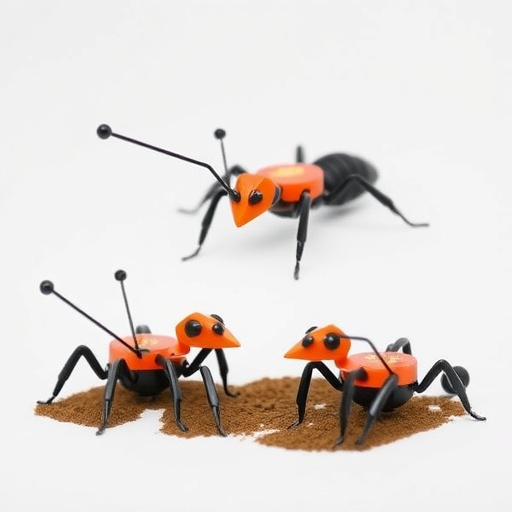
Inspired by the intricate and highly efficient construction behaviors observed in ant colonies, researchers at Harvard John A. Paulson School of Engineering and Applied Sciences (SEAS) have engineered a pioneering swarm of robotic agents, dubbed RAnts, that exhibit collective excavation and construction capabilities without any central control mechanism. This breakthrough study leverages principles of decentralized coordination to demonstrate how simple, local interactions among individual agents can give rise to robust and adaptive group behaviors. The swarm’s ability to fluidly transition between building and dismantling structures is modulated through the adjustment of just two key parameters, highlighting a minimalistic yet powerful approach to swarm robotics.
Ant colonies have long fascinated scientists due to their capacity to assemble vast, intricately engineered nests that regulate climate without the oversight of a singular leader or a detailed blueprint. The collective intelligence displayed by these relatively small-brained insects emerges from local interactions and environmental modifications, a process known as stigmergy. The Harvard research team has harnessed this concept by introducing the notion of “photormones”—light-based digital analogs to ant pheromones—which robots can both detect and deposit within their environment, forming dynamic communication fields that guide their behaviors.
Each RAnt is equipped to sense gradients in these photormone fields and respond by moving accordingly, carrying, depositing, or removing building blocks based on these cues. This feedback loop—where agents modify their environment and then react to the changes they instigated—creates a self-organizing system that promotes effective coordination across the swarm. Notably, despite the simplicity of individual agent rules, the collective behavior is remarkably sophisticated. Temporary confinement of robots by their own signalling, a phenomenon termed trapping instability, induces the formation of nucleation sites, where construction spontaneously initiates and propagates.
The research team’s experimental platform allows for real-time observation of excavation and construction processes, unveiling the fine balance between cooperation strength—how avidly robots follow signal gradients—and material deposition rates, which govern whether the swarm builds or dismantles structures. By tuning these parameters, the RAnts can switch behavioral modes, a feature with profound implications for adaptability in variable environments. This adaptability is particularly suited to scenarios where centralized control is impractical or impossible, such as extraterrestrial construction missions or disaster zone interventions.
To complement their experimental findings, the team developed an advanced theoretical framework encapsulating the dynamic interplay between agent density, environmental cues, and evolving physical structures. Extending classical aggregation theories from biology, their model accounts for the non-static nature of environments actively shaped by agent behaviors. This integrative perspective, termed “exbodied intelligence,” posits that collective cognition emerges not solely from the agents themselves but also from their continuous interaction with an evolving environment, broadening the conventional understanding of swarm intelligence.
The robotic swarms mimic essential features of social insect colonies by engaging in stigmergic communication, where environmental modifications serve as shared information repositories. Instead of chemical pheromones, photormone fields provide a controllable and observable means of communication, enabling precise experimental manipulation and measurement of emergent behaviors. This approach facilitates not only fundamental biological insights but also practical advancements in swarm robotics engineering.
The capability of swarms to morphologically adapt through aggregation and disaggregation is a critical step toward autonomous systems capable of both construction and deconstruction based on environmental demands. Such versatility promises to revolutionize fields ranging from autonomous infrastructure development in hazardous or inaccessible regions to planetary exploration, where robots must operate independently atop unfamiliar terrains. Additionally, these robotic swarms serve as valuable experimental proxies, offering new methodologies for probing the mechanisms underpinning collective animal behaviors.
Led by Professor L. Mahadevan, whose extensive work has bridged mathematics, physics, and evolutionary biology, the study embodies a multidisciplinary approach to unraveling complex natural and synthetic systems. The results validate previous work on robotic mimicking of ant behaviors, expanding scope from escape and excavation to full cycles of construction and dismantling. By distilling collective behaviors into foundational parameters and environment-agent feedback loops, this research offers scalable blueprints for designing future autonomous systems.
The emerging concept of exbodied intelligence introduced here may inspire reevaluations in robotics and biology alike. It challenges traditional views that intelligent behavior emanates predominately from internal computational processes within agents, instead emphasizing the critical role of continuous embodiment within and manipulation of physical environments. This paradigm shift could open new avenues in the design of distributed intelligent systems and deepen scientific understanding of collective phenomena across scales and species.
Funding for this research was provided by multiple grants from the National Science Foundation (NSF), including Physics of Living Systems and Emerging Frontiers programs, as well as support from the Simons Foundation and the Henri Seydoux Fund. Collaborative efforts among scientists Fabio Giardina, S. Ganga Prasath, and others have made this integrative project possible, which stands at the intersection of applied mathematics, engineering, ecology, and evolutionary biology.
As autonomous robotic swarms gain prominence, insights derived from such bio-inspired frameworks may reshape how machines interact with their surroundings and each other, fostering unprecedented levels of resilience and efficiency. This study exemplifies how simple instructions embedded within individual agents can yield complex, goal-directed collective outcomes, reinforcing the ancient wisdom that in unity—and interaction with the environment—lies formidable power.
News Publication Date: 10-Apr-2026
Web References:
- https://seas.harvard.edu/
- https://journals.aps.org/prxlife/abstract/10.1103/cx3h-bwhc
- https://www.quantamagazine.org/does-form-really-shape-function-20250612/
- https://seas.harvard.edu/news/curiosity-driven-journey-toward-understanding-brain-folding
- https://news.harvard.edu/gazette/story/2024/10/the-making-of-the-gut/
References:
- Mahadevan, L., Giardina, F., Prasath, S. G. (2026). “Robotectonics: Emergent Phototactic Aggregation-Disaggregation in Swarms.” PRX Life. DOI: 10.1103/cx3h-bwhc
- Previous work on robotic ant excavation and escape behavior
Cite Scienmag News
Denise Maddox. (April 28, 2026). Ant-Inspired Simple Robots Collaborate to Build and Dig. Scienmag. https://scienmag.com/ant-inspired-simple-robots-collaborate-to-build-and-dig/
Denise Maddox. "Ant-Inspired Simple Robots Collaborate to Build and Dig." Scienmag, 28 April 2026, https://scienmag.com/ant-inspired-simple-robots-collaborate-to-build-and-dig/. Accessed 3 September 2026.
Denise Maddox. "Ant-Inspired Simple Robots Collaborate to Build and Dig." Scienmag. April 28, 2026. https://scienmag.com/ant-inspired-simple-robots-collaborate-to-build-and-dig/


