


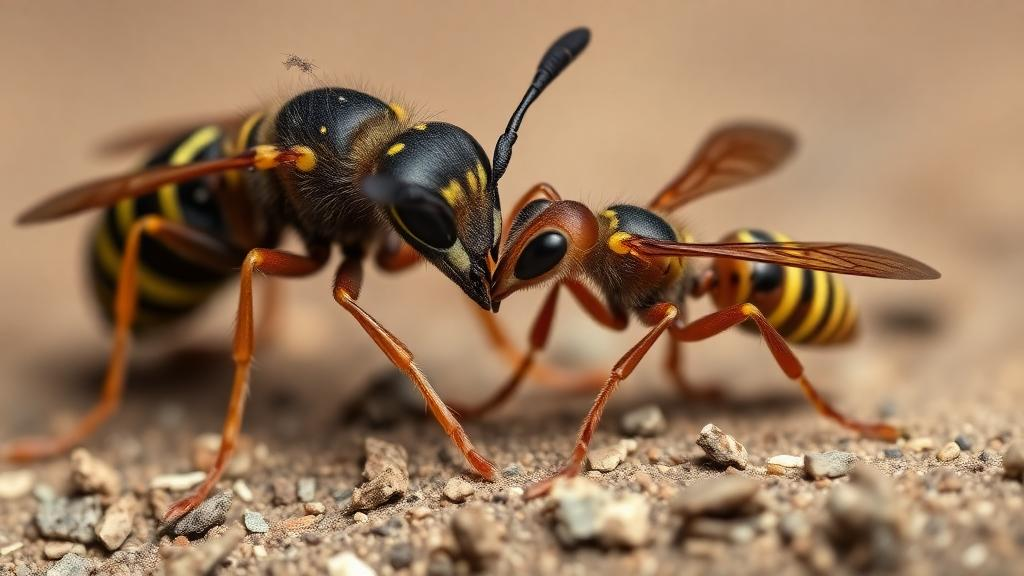
A tiny parasitoid wasp that lives among ants has provided an unusually detailed view of the intimate relationship between predators and their hosts. A review of the genus Tetramopria in the Eastern Palaearctic describes the previously unknown female of Tetramopria turbinata, records T. tortilis from South Korea and T. turbinata from Japan, and presents an updated identification key for all five undisputed Palaearctic species of the genus. The study also documents courtship in both Eastern Palaearctic species and records a striking range of interactions between the wasps and their host ants, including mouth-to-mouth contact, grooming, biting, wing removal and transport.
The wasps belong to the family Diapriidae and subfamily Diapriinae, a group in which small size and reduced features such as eyes and pigmentation often accompany life inside ant colonies. Tetramopria was named by the entomologist Erich Wasmann in 1899. Its members are around 2 millimetres long and possess a dense golden cushion of hairs on the occiput and pronotal collar. The genus is divided into two species groups, the aurocincta and cincticollis groups, whose members can be separated by traits including the shape and sculpture of the scutellum, the anterior scutellar pit, the female antenna and, in males, the first antennal segment and middle legs. Although five Palaearctic species are regarded as valid, three additional Australian species have been considered doubtful because their anatomy does not fit the established classification.
Only two Tetramopria species had previously been described from the Eastern Palaearctic. T. tortilis was known from Japan through the original male and female specimens and a later rediscovery, while T. turbinata had been represented by a single male from Korea. The new work brought together museum material collected in Japan and South Korea, including specimens recovered with yellow pan and Malaise traps, ants gathered during a field survey, and adults maintained in captivity for behavioral observation. The newly described female of T. turbinata measures 2.3–2.8 millimetres, excluding the ovipositor, and has a four-segmented antennal club, a sharply keeled scutellar disc, deeply foveate dorsal propodeum and two shallow foveae near the base of the second tergite.
Close examination of T. turbinata also corrected a long-standing identification problem. The species resembles T. aurocincta, but its scutellar disc is broadly emarginate at the rear, the propodeum is more deeply foveate, the frons is more convex and the female antenna is more robust. The base of its second tergite bears an undulate margin and two oblique carinae, with fine striation inside its basal foveae. These differences support the revised key to the five Palaearctic species. In the cincticollis group, T. tortilis is distinguished from T. cincticollis by a subapical tooth on the inner side of the male’s first antennal segment, a domed and weakly sculptured scutellar disc and a pronounced ventral concavity of the mesopleuron in front of the middle coxae.
The new distribution records strengthen the link between these wasps and the ant Tetramorium tsushimae. T. tortilis was collected from its nests in both Japan and South Korea, while T. turbinata was found with the same ant in South Korea. The Japanese association of T. tortilis had previously been inferred from unidentified wasps taken from T. tsushimae nests, and those specimens were reassigned after detailed examination. A Japanese specimen labeled as coming from a nest of Pristomyrmex punctatus was also considered more likely to have encountered T. tsushimae because of the ecological characteristics of Tetramopria and the circumstances of collection. The actual parasitoid hosts remain unknown, although the authors consider a dipteran host probable.
Courtship in T. tortilis begins when the male mounts the female from behind, with both insects facing in the same direction. The male uses the tibiae and tarsi of his middle legs to grip the base of the female’s wings, extends his forelegs sideways and stretches his hind legs backward. A female can reject the attempt by walking away while holding her antennae forward, out of reach, or by pushing against the male with her hind legs. If receptive, she remains still and raises her antennae. The male then strokes them alternately with his own antennae, bringing a specialized sensory structure on the second antennal segment into contact with the female. She appears to signal acceptance by bending both antennae backward, after which the male moves into position and inserts his genitalia into the female genital pore while gripping her metasoma with the front and middle legs.
T. turbinata follows a broadly similar antennal routine, although successful copulation was not observed. Its male also mounts the female while facing forward and gripping the wing bases with the middle legs, but he additionally catches the female’s face or antennal scapes with his forefeet and positions his hind legs either behind him or on her abdomen. A receptive female stands still and raises her antennae slightly for antennation. The contrasts between the species are striking: the male T. tortilis appears to support much of his mounted position with his modified middle legs alone, whereas the male T. turbinata uses a broader stance. The expanded triangular trochanter and strongly twisted tibia of T. tortilis may help it maintain a firm grip, potentially useful in the crowded confines of an ant nest.
Captive observations revealed interactions that go well beyond simple coexistence. Both species exchanged mouth-to-mouth contact with worker T. tsushimae, providing the first evidence of trophallaxis, or food exchange, recorded in Tetramopria. Workers also licked the pronotum of male T. tortilis, while female wasps licked the petioles of ants and males licked the heads of workers. The reciprocal grooming may be ordinary maintenance, but it could also reflect substances secreted by the wasps that attract ants or alter their behavior. The study does not resolve that question, and more observations are needed to distinguish simple grooming from a more structured exchange of chemical signals.
Some encounters were more physical and potentially more consequential. Workers bit the antennae and petiole of T. tortilis and carried the wasps through the nest. It remains unclear whether this represents aggression or resembles the handling of ant brood. Workers also bit the bases of the fore wings of both male and female T. turbinata, the first direct observation of wing biting by ants in the family Diapriidae. In one experiment, a fully winged wasp placed in an observation nest had its wings bitten away after about ten days. The behavior resembles secondary wing reduction, or dealation, reported in other ant-associated diapriine wasps and could help render parasites flightless while they remain within the host colony.
These observations establish Tetramopria as a group of well-adapted myrmecophiles, animals that live closely with ants and exploit their colonies, even though the precise nature of the relationship remains unresolved. The genus belongs to a lineage in which reduced eyes, reduced pigmentation, unusual setation and wing loss are common signs of intimacy with ants. Its courtship also differs from that of the related genera Trichopria. Tetramopria males lack the pre-mating wing fanning seen in T. drosophilae, and they grip the female’s wings rather than the propodeum as described for T. sociabilis. Whether these differences reflect myrmecophily, confined nest environments or broader variation within the tribe will require more behavioral and comparative work. For now, the wasps demonstrate that even a few millimetres of an ant nest can conceal a crowded social world of courtship signals, grooming, transport and negotiated control over wings.
Subject of Research: Biology and behavior of Eastern Palaearctic Tetramopria parasitoid wasps living with Tetramorium ants
Article Title: A review of Tetramopria ( Hymenoptera , Diapriidae , Diapriinae ) of the Eastern Palaearctic with notes on mating behaviour and interactions with host ants
Article References: Kawai, R., Yoon, S., & Notton, D. G. (2025). A review of Tetramopria (Hymenoptera, Diapriidae, Diapriinae) of the Eastern Palaearctic with notes on mating behaviour and interactions with host ants. Journal of Hymenoptera Research, 98, 621-636. https://doi.org/10.3897/jhr.98.148115
Image Credits: AI Generated
Keywords: Tetramopria, ant parasitoid wasps, myrmecophily, trophallaxis, courtship behavior, host ants, Diapriidae, Tetramorium tsushimae, wing dealation, Eastern Palaearctic, review, Hymenoptera
Cite Scienmag News
Gavin Prescott. (October 19, 2026). Ant-associated wasps reveal courtship tricks and host encounters. Scienmag. https://scienmag.com/ant-associated-wasps-reveal-courtship-tricks-and-host-encounters/
Gavin Prescott. "Ant-associated wasps reveal courtship tricks and host encounters." Scienmag, 19 October 2026, https://scienmag.com/ant-associated-wasps-reveal-courtship-tricks-and-host-encounters/. Accessed 19 October 2026.
Gavin Prescott. "Ant-associated wasps reveal courtship tricks and host encounters." Scienmag. October 19, 2026. https://scienmag.com/ant-associated-wasps-reveal-courtship-tricks-and-host-encounters/


