


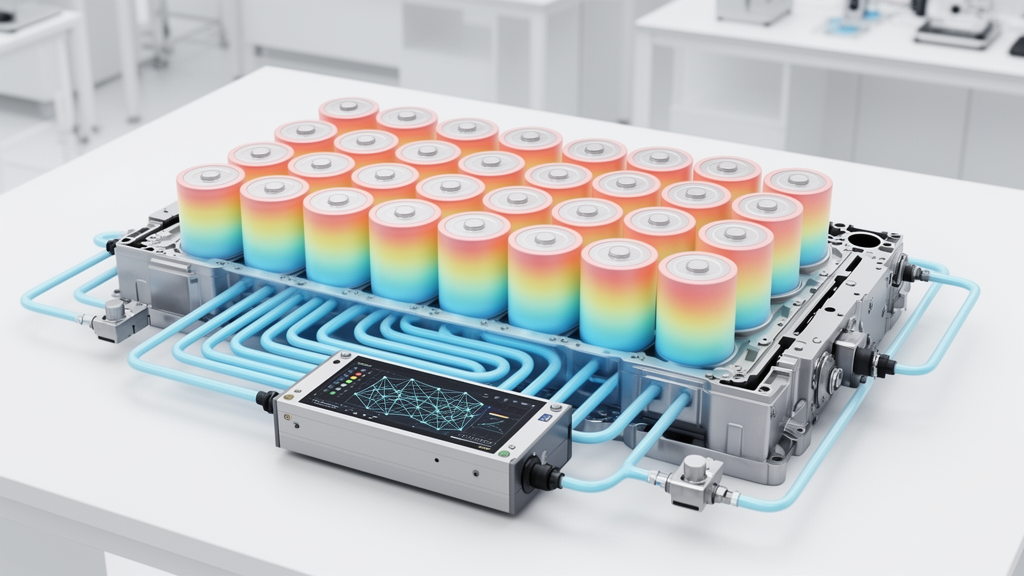
A neural-network-guided controller for electric-vehicle battery cooling reduced a model-predicted thermal-runaway screening index by 94.8% compared with an uncontrolled system across charging rates from 0.5C to 5C. The study combined a multilayer perceptron surrogate with differential-evolution optimization, reducing average peak temperature by 37.1% and average cell-to-cell temperature variation by 43.7%. These results come from analytical simulations rather than tests with physical battery modules, so they demonstrate performance within the authors’ reduced thermal model, not verified safety gains on real vehicles.
The proposed pipeline targets two coupled controls in a battery thermal management system: coolant flow rate and coolant inlet temperature. Higher flow generally improves heat removal, while a colder inlet creates a larger temperature difference between the coolant and cells. The neural network predicts peak battery temperature, temperature non-uniformity and a dimensionless thermal-runaway risk index in a single forward pass. Differential Evolution then searches for coolant settings that balance peak temperature against spatial uniformity, which matters because hot cells in a module can age faster than cooler cells even when the absolute temperature remains within a broader acceptable range.
To build the training data, the researchers used a reduced heat-generation formulation inspired by the Bernardi model and a calibrated cooling-conductance expression based on the Dittus–Boelter correlation. They generated 3,000 samples for each of two cell formats, Tesla 21,700 and Tesla 4680, for a total of 6,000 synthetic cases. Each case varied charge or discharge rate from 0.5C to 5C, coolant flow from 0.01 to 0.15 litres per minute and inlet temperature from 20 to 35 degrees Celsius. Gaussian noise was added to emulate measurement or discretization uncertainty, and a fixed random seed was used for reproducibility.
The thermal-runaway risk measure is not a probability of a battery fire. It is a relative screening index that becomes positive only when both peak temperature exceeds 45 degrees Celsius and temperature non-uniformity exceeds 3 degrees Celsius. The index then grows with both exceedances. Its double-threshold construction reflects the model’s assumption that a high absolute temperature combined with localized thermal gradients is more concerning than either condition alone. However, the index has not been calibrated against observed thermal-runaway events, and a percentage reduction describes the model-predicted joint threshold exceedance rather than a measured reduction in real-world failure probability.
The neural network used three inputs, three outputs and hidden layers containing 128, 64 and 32 neurons, with hyperbolic-tangent activations, L2 regularization and early stopping. On a held-out set of 1,200 samples, it achieved an R-squared value of 0.9068 for peak temperature, with a root-mean-square error of 3.87 degrees Celsius, and 0.9972 for temperature non-uniformity, with an error of 0.0966 degrees Celsius. Its risk-index R-squared was 0.8854. A five-fold cross-validation of peak-temperature prediction produced an R-squared of 0.9014 plus or minus 0.0029, broadly consistent with the single test result. The model also substantially outperformed a linear-regression baseline for the risk index, whose R-squared was 0.4128.
Those accuracy figures describe how closely the network reproduces the equations that generated its training data. They do not establish how accurately those equations represent real batteries. The temperature calculation is a calibrated, lumped mapping whose numerical coefficients combine several physical effects without strict dimensional consistency, while the cooling relation uses an effective square-root dependence on flow in a regime where fully turbulent Dittus–Boelter scaling may not strictly apply. The dataset was neither produced by computational fluid dynamics nor measured experimentally. Consequently, systematic errors in the underlying reduced-order model would be inherited by the surrogate and its optimization results.
Across 20 charging conditions, the uncontrolled baseline used constant flow of 0.05 litres per minute and a 30-degree inlet temperature. It produced an average peak temperature of 45.23 degrees Celsius, average non-uniformity of 3.35 degrees Celsius and an average screening index of 0.1690. A threshold controller switched to 0.10 litres per minute and a 20-degree inlet when temperature exceeded a preset limit, improving the three averages to 30.61 degrees Celsius, 2.33 degrees Celsius and 0.0227. The optimized strategy, based on a weighted objective assigning 0.6 to peak temperature and 0.4 to non-uniformity, achieved averages of 28.46 degrees Celsius, 1.89 degrees Celsius and 0.0087. These are model-based controller comparisons, and the benchmark did not account for all practical costs of varying coolant settings.
A weight sweep at a charging rate of 3C revealed that the competing thermal objectives were only weakly conflicting within the assumed hardware limits. Across nine weight combinations, predicted peak temperatures ranged from 25.21 to 25.54 degrees Celsius, while non-uniformity ranged from 1.24 to 1.68 degrees Celsius. Extreme weighting of temperature uniformity selected maximum flow and the minimum inlet temperature, whereas strong weighting of peak temperature chose about 0.115 litres per minute at the minimum inlet because additional flow produced little further reduction. Retraining five networks with different initialization seeds produced optimized flow rates between 0.137 and 0.150 litres per minute, indicating that the flat temperature response leaves the precise flow optimum weakly determined.
The clearest hardware limitation appeared during extreme charging. At 1C to 3C, optimized peak temperatures remained near 25 degrees Celsius and the screening index was close to zero. At 4C, the optimizer reached the assumed limits of 0.15 litres per minute and a 20-degree inlet while keeping peak temperature below the critical threshold. At 5C, however, predicted peak temperature rose to 46.45 degrees Celsius and non-uniformity to 4.49 degrees Celsius, with a screening index of 0.085. In the calibrated model, the 5C heat-generation term exceeded the maximum available cooling term for both cell formats. The authors therefore conclude that safe 5C operation would require more pump capacity, colder coolant or another cooling-system upgrade rather than better set-point tuning alone.
Several safety and deployment qualifications remain. In the safety-relevant 40-to-45-degree band, the network’s local root-mean-square error was about 4.89 degrees Celsius and it showed a 0.72-degree tendency to underpredict temperature. The reported 0.125-millisecond inference time covers only the neural-network forward pass on a general-purpose processor, excluding sensing, communications and actuator response. Before safety-critical use, the authors propose conservative margins, an independent hardware over-temperature cutoff, validation against representative computational fluid-dynamics cases and hardware-in-the-loop testing with an instrumented battery module. The study therefore offers a promising computationally efficient control strategy and a clear 5C hardware benchmark, but its quantitative safety implications remain model-based until those validation steps are completed.
Subject of Research: Neural-network surrogate modeling and evolutionary optimization for multi-objective electric-vehicle battery thermal management
Article Title: Artificial neural network surrogate modeling and evolutionary optimization for multi-objective control of electric vehicle battery Thermal Management Systems
Article References: Tabeshmoghaddam, M., Zadehbagheri, M., Nejatian, S., & Kiani, M. J. (2026). Artificial neural network surrogate modeling and evolutionary optimization for multi-objective control of electric vehicle battery Thermal Management Systems. Results in Engineering, 32, Article 113618. https://doi.org/10.1016/j.rineng.2026.113618
Image Credits: AI Generated
DOI: 10.1016/j.rineng.2026.113618
Keywords: electric vehicles, lithium-ion batteries, battery thermal management, artificial neural networks, surrogate modeling, differential evolution, fast charging, thermal runaway, multi-objective optimization, model validation, Artificial, neural
Cite Scienmag News
Faith Mcneil. (October 20, 2026). ANN-guided cooling cuts model-predicted EV battery thermal risk. Scienmag. https://scienmag.com/ann-guided-cooling-cuts-model-predicted-ev-battery-thermal-risk/
Faith Mcneil. "ANN-guided cooling cuts model-predicted EV battery thermal risk." Scienmag, 20 October 2026, https://scienmag.com/ann-guided-cooling-cuts-model-predicted-ev-battery-thermal-risk/. Accessed 20 October 2026.
Faith Mcneil. "ANN-guided cooling cuts model-predicted EV battery thermal risk." Scienmag. October 20, 2026. https://scienmag.com/ann-guided-cooling-cuts-model-predicted-ev-battery-thermal-risk/


