


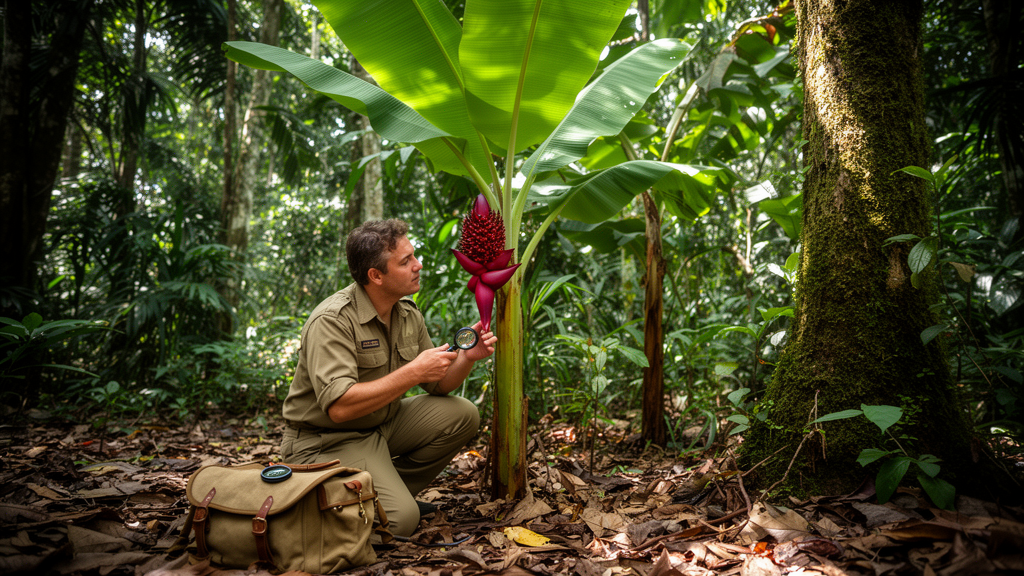
A morphological field study of wild Musa acuminata in Thailand supports recognition of four subspecies—subsp. siamea, subsp. malaccensis, subsp. truncata and the newly described subsp. kraburiensis—and describes three unusual forms. The study also reduces subsp. burmannica to synonymy with subsp. siamea, finds no accessions matching the traditional description of subsp. microcarpa and extends the documented distribution of subsp. malaccensis into northern Thailand.
Researchers collected 211 wild M. acuminata accessions from natural habitats during campaigns conducted from 2005 through 2010. The sample was supplemented with three accessions of wild M. itinerans and six of M. rubra as outgroups. Voucher material included male-phase inflorescences, preserved fruits and portions of mature leaves, and the specimens were deposited at the SLR Herbarium in Bangkok. Every accession was georeferenced with a handheld GPS tracker, while colors were recorded using the IPGRI-INABAP/CIRAD chart for bananas.
For 195 accessions, the investigators scored 16 morphological characters covering leaf-base shape, petiolar canal structure, peduncle and rachis color and direction, fruit-hand arrangement, rachis diameter, male-phase inflorescence orientation and number, bud shape, bract overlap and coloration, free-tepal margins, fruit shape and seed-surface texture. They calculated similarity coefficients, combined Gower’s distance with unweighted pair-group analysis using arithmetic averages, and mapped character states onto the resulting dendrogram by maximum parsimony. The final cluster analysis represented 186 M. acuminata accessions and nine outgroup accessions.
The clusters were separated primarily by rachis orientation. The newly described subsp. kraburiensis had a horizontal to upward-curving rachis, whereas accessions assigned to subsp. siamea, subsp. malaccensis and subsp. truncata had rachises that were curved or drooping downward. Within the latter group, leaf-base shape, bract overlap and bract color distinguished the taxa. Subsp. siamea generally had cuneate or oblique leaf bases and strongly imbricate bracts, while malaccensis and truncata had round, cordate or auriculate bases and bracts that overlapped only slightly or not at all.
Subsp. truncata was distinguished from sympatric malaccensis by its male-phase bracts: truncata had dark-purple outer surfaces and purplish-red or ivory inner surfaces, sometimes with a pale-red tinge, whereas malaccensis had red, purplish-red or pinkish-purple bracts on both surfaces. The newly recorded truncata occurred in the Sankalakhiri and Titiwangsa mountain ranges in Narathiwat and Yala provinces, at 90–750 metres altitude. Putative hybrids with intensely red inner bracts were observed where the two subspecies grew together.
Subsp. kraburiensis was recorded from sea level to 300 metres in a restricted area between approximately 9° and 11° north latitude in Chumphon and Ranong provinces, around the transition between the Tanao Si/Tenasserim and Phuket mountain ranges. Its rachis was horizontal or angled upward, exceeded 3 cm in diameter, and carried male-phase bracts in shades including purple, red-purple, pink-purple and orange-red. The authors proposed that it might be a natural fertile hybrid between siamea and malaccensis, although that interpretation remains a hypothesis and hybrid-like plants were observed at one boundary in Tha Sae district.
Subsp. siamea was the most widely distributed member of the complex, occurring across much of Thailand, while malaccensis was widespread in Peninsular Thailand and was also found in the northwest at elevations of 200–1,000 metres, well above its previously reported upper limit of 300 metres. The authors hypothesized that malaccensis may once have extended along the mountain chain during a cooler, wetter climate and persisted in isolated cool and moist areas after the climate became warmer and drier. The study did not establish that historical pathway directly.
Three new forms were described. Forma byssina of siamea has yellow rachis bracts and was found rarely in Chanthaburi, Nakhon Ratchasima and Kamphaeng Phet. Forma luteola of kraburiensis, also yellow-bracted, was known from a single hillside in Ranong where the authors estimated no more than 30 clumps occupied an area of about 10 km². The authors described luteola as possibly a natural mutant and cited prior reports of reduced or absent flavonols and anthocyanins in that form, but they did not directly establish the genetic cause of its yellow coloration. Forma nanakornii, cultivated by Hmong hill-tribe communities in northern and northeastern Thailand, produces numerous lateral male-phase inflorescences on the main inflorescence axis, giving it a chandelier-like form. Its female flowers are mostly infertile, although one accession produced a few seeded fruits.
The authors identified leaf-base shape, rachis position, male-bract imbrication and bract color as the principal identification characters, while pseudostem waxiness, young-sucker blotches and free-tepal shape proved variable or unhelpful. The survey provided extensive coverage across Thailand but remained geographically incomplete, and the proposed hybrid zones and broader population history require further genetic and field examination.
Subject of Research: Morphological delimitation of wild Musa acuminata subspecies and forms in Thailand
Article Title: Delimitation of the wild banana Musa acuminata subspecific complex ( Musaceae ) in Thailand
Article References: Inta, W., Swangpol, S. C., Athawongsa, K., Wongniam, S., Sukkaewmanee, N., Seelanan, T., Srikrainoon, P., Nilapaka, W., Rotchanapreeda, T., & Somana, J. (2026). Delimitation of the wild banana Musa acuminata subspecific complex (Musaceae) in Thailand. PhytoKeys, 278, 127-156. https://doi.org/10.3897/phytokeys.278.165557
Image Credits: AI Generated
DOI: 10.3897/phytokeys.278.165557
Keywords: Musa acuminata, wild banana, plant taxonomy, subspecies delimitation, morphological analysis, Thailand flora, Musa kraburiensis, Musa truncata, Musa siamea, Musa malaccensis, Delimitation, wild
Cite Scienmag News
Juliet Wilcox. (October 20, 2026). Morphological field study delineates four wild Musa acuminata subspecies in Thailand. Scienmag. https://scienmag.com/morphological-field-study-delineates-four-wild-musa-acuminata-subspecies-in-thailand/
Juliet Wilcox. "Morphological field study delineates four wild Musa acuminata subspecies in Thailand." Scienmag, 20 October 2026, https://scienmag.com/morphological-field-study-delineates-four-wild-musa-acuminata-subspecies-in-thailand/. Accessed 20 October 2026.
Juliet Wilcox. "Morphological field study delineates four wild Musa acuminata subspecies in Thailand." Scienmag. October 20, 2026. https://scienmag.com/morphological-field-study-delineates-four-wild-musa-acuminata-subspecies-in-thailand/


