


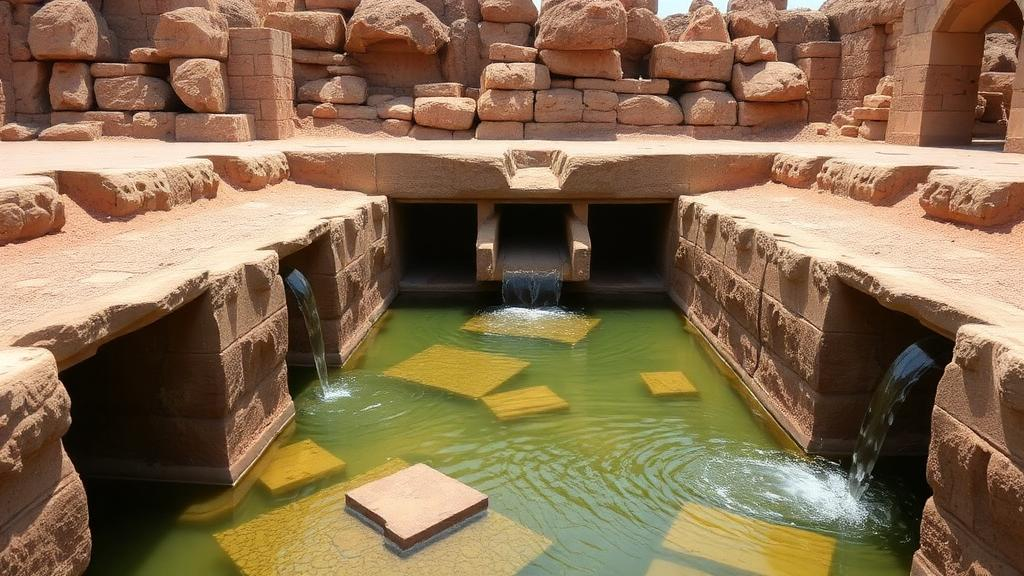
Modern engineers spend careers worrying about how infrastructure degrades over decades. Bridges are designed for a century, pipelines for fifty years, and concrete dams for perhaps twice that. But a team of researchers argues that the most valuable data on long-term material survival may already exist, buried beneath some of the world’s oldest cities. In a Comment published in Nature Water, Chenyang Duan of ShanghaiTech University, Qian Cheng of the National Centre for Archaeology and The Cyprus Institute, and Zhu-Jun Wang of ShanghaiTech University propose that ancient water infrastructure should be reimagined as a natural long-term laboratory, one that has been running experiments on material degradation for not decades but millennia.
The core idea is deceptively simple. Laboratory studies of corrosion, weathering and structural fatigue are constrained by time. Accelerated aging tests compress years of exposure into weeks, but the compression itself introduces artifacts: reaction rates that do not scale linearly, environmental cycles that are unrealistically regular, and boundary conditions that no real structure ever experiences. Archaeological water systems, by contrast, have endured genuine fluctuations in water chemistry, temperature, biological colonization, seismic shaking and human use across hundreds or thousands of years. Every mineral crust, every recrystallized ceramic surface, every patched section of an ancient channel is a data point in an experiment no modern facility could replicate.
The authors anchor their argument in the water infrastructure of the early Nanyue Kingdom, the ancient polity centered on what is now Guangzhou in southern China. The Nanyue remains, curated by the Nanyue King Museum, include sophisticated hydraulic works that reveal what the researchers describe as morphological engineering and multiscale system adaptation logic. Rather than a single static structure, the ancient water network appears to have been designed and repeatedly modified as an integrated system, with components at different scales responding to different stresses. This layered history of construction, adaptation and repair is precisely what makes the site scientifically valuable: it records not just how materials fail, but how builders observed failure and responded to it across generations.
One of the most striking aspects of the proposal is its attention to material evolution at the microscale. The authors point to cross-scale structural upgrades in the ancient infrastructure, suggesting that the materials themselves, from fired ceramics to early glazes and mortars, underwent measurable transformation over centuries of contact with flowing water. Techniques such as scanning electron microscopy, which appears among the article’s listed subjects, can resolve these changes down to the nanometer scale, revealing reaction fronts, dissolution textures and secondary mineral growth that encode the environmental history of the structure. In effect, the fabric of an ancient pipe or cistern functions as a slow-motion recording of its own degradation.
The analytical challenge is that archaeological remains are discontinuous. Excavation exposes fragments of a system that once operated continuously, and the intervening centuries of burial, disturbance and decay blur the record. To address this, the researchers propose what they call a dynamic-static complementary full-spatiotemporal analytical framework, a method designed to transform fragmented archaeological evidence into continuous engineering datasets. The dynamic component captures how the water system behaved while in operation, drawing on sediment records, flow-path reconstruction and morphological evidence of erosion and deposition. The static component characterizes the surviving materials themselves, their mineralogy, microstructure and mechanical state. Combining the two allows researchers to bridge the gap between a ruin in the ground and a functioning hydraulic network in the past.
This framing resonates with a growing body of work on long-lived materials. Recent studies of ancient Roman concrete, for instance, have shown that some formulations gain strength over centuries as seawater percolating through the matrix triggers the growth of interlocking mineral crystals, a self-healing behavior that modern cement chemistry is only beginning to emulate. Research published in npj Materials Degradation has similarly examined how glass and ceramic artifacts weather over archaeological timescales, providing calibration data for predicting the durability of modern waste forms, including nuclear waste ceramics. The Nanyue proposal extends this logic from individual materials to entire engineered systems, asking not only why a substance survives but how a network of channels, reservoirs and settlement structures co-adapts with its environment.
The implications for contemporary urban water systems are considerable. Cities worldwide face a quiet crisis of aging pipes, many of which were installed in the nineteenth and twentieth centuries and are now failing at accelerating rates. Studies of pipeline systems have documented how corrosion, soil movement and hydraulic transients combine in ways that are difficult to predict from short-term testing. Meanwhile, climate change is altering rainfall intensity, groundwater chemistry and flood frequency, exposing infrastructure to conditions outside the envelope for which it was designed. The authors argue that lifecycle design of resilient urban water systems should be informed by evidence of how materials and structures actually behave over millennial spans, including the feedback loops between degradation, maintenance and adaptation that conventional engineering models tend to ignore.
There is also a conceptual shift embedded in the proposal. Treating archaeological remains as laboratories requires a change in how heritage and engineering communities interact. Conservation practice has traditionally focused on preserving artifacts in their excavated state, while engineering has traditionally focused on extracting design principles from functional systems. The millennial-laboratory framework asks both communities to treat the site as a scientific instrument: the artifacts are samples, the stratigraphy is the experimental log, and the surrounding geology and hydrology define the boundary conditions. The authors acknowledge the Nanyue King Museum’s role in providing access to the site and permission to use images of the excavated artifacts, underscoring that such research depends on sustained collaboration between museums, archaeologists and materials scientists.
The methodological toolkit implied by the framework is broad. Multiscale imaging, from hand-sample petrography down to electron microscopy, can map degradation gradients across ceramic and mineral surfaces. Geochemical analysis of precipitated crusts can reconstruct the chemistry of the water that flowed through the system centuries ago. Sediment cores and geomorphological studies of the Pearl River delta, which have been used to reconstruct Holocene environmental change in the region, provide the climatic backdrop against which the infrastructure operated. Numerical models calibrated against these observations could then extrapolate degradation behavior to future scenarios, testing whether ancient adaptation strategies, such as redundant flow paths, staged construction or the use of locally sourced, chemically compatible materials, offer lessons for modern design.
Whether ancient systems can truly serve as quantitative benchmarks remains an open question, and the authors are careful to frame their piece as a Comment, a call for a research program rather than a completed demonstration. Archaeological contexts are noisy, materials are heterogeneous, and the original construction details are often irrecoverable. Yet the promise is real. If even a fraction of the world’s surviving ancient hydraulic works, from Chinese kingdom canals to Roman aqueducts to Indus Valley drainage networks, were systematically characterized with modern analytical techniques, the resulting dataset would span environmental conditions and timescales far beyond any accelerated testing regime. In an era when the durability of critical infrastructure is increasingly uncertain, the deepest archives of material performance may lie not in databases but in the ground, waiting to be read with the tools of twenty-first-century science.
Subject of Research: Millennial-scale material degradation in ancient water infrastructure as a natural laboratory for resilient urban water system design
Article Title: Ancient water infrastructure as a millennial-scale laboratory for material degradation
Article References: Duan, C., Cheng, Q., & Wang, Z.-J. (2026). Ancient water infrastructure as a millennial-scale laboratory for material degradation. Nature Water. https://doi.org/10.1038/s44221-026-00719-5
Image Credits: AI Generated
DOI: 10.1038/s44221-026-00719-5
Keywords: ancient water infrastructure, material degradation, Nanyue Kingdom, Nature Water, archaeological materials, scanning electron microscopy, urban water systems, lifecycle design, resilience, ceramics, hydraulic engineering, long-term durability
Cite Scienmag News
Beatrice Stafford. (September 30, 2026). Ancient Water Systems Offer a Millennium-Long Test Bed for Material Durability. Scienmag. https://scienmag.com/ancient-water-systems-offer-a-millennium-long-test-bed-for-material-durability/
Beatrice Stafford. "Ancient Water Systems Offer a Millennium-Long Test Bed for Material Durability." Scienmag, 30 September 2026, https://scienmag.com/ancient-water-systems-offer-a-millennium-long-test-bed-for-material-durability/. Accessed 4 October 2026.
Beatrice Stafford. "Ancient Water Systems Offer a Millennium-Long Test Bed for Material Durability." Scienmag. September 30, 2026. https://scienmag.com/ancient-water-systems-offer-a-millennium-long-test-bed-for-material-durability/


