


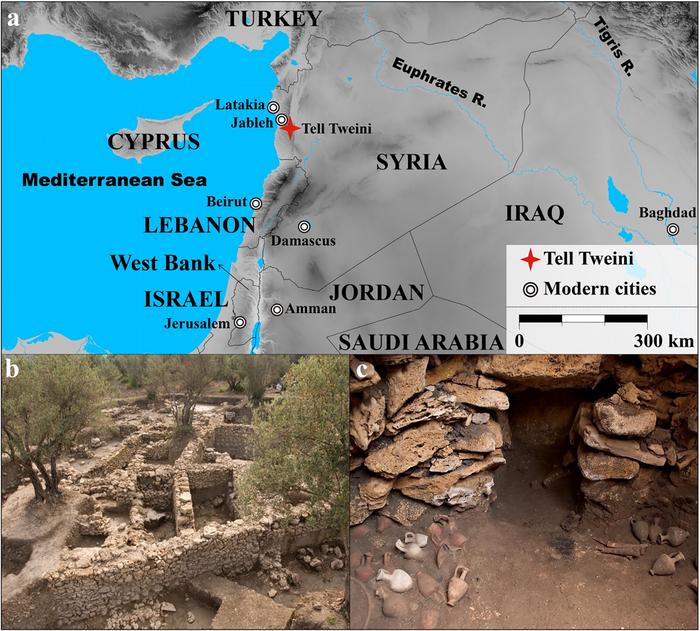
Thousands of years ago, people in ancient Syria likely ate mostly grains, grapes, olives and a small amount of dairy and meat — similar to today’s “Mediterranean diet,” according to a study published June 12 in the open-access journal PLOS ONE by Benjamin T. Fuller from the University of Leuven, Belgium, Simone Riehl from the University of Tübingen, Germany, and colleagues.

Credit: Fuller et al., 2024, PLOS ONE, CC-BY 4.0 (
Thousands of years ago, people in ancient Syria likely ate mostly grains, grapes, olives and a small amount of dairy and meat — similar to today’s “Mediterranean diet,” according to a study published June 12 in the open-access journal PLOS ONE by Benjamin T. Fuller from the University of Leuven, Belgium, Simone Riehl from the University of Tübingen, Germany, and colleagues.
Tell Tweini, an archeological site located near the Syrian coastal city of Jableh, contains relics dating back to the early Bronze Age (around 2,600 BCE) and stretching all the way into the Iron Age, nearly 2,300 years later. For the new study, researchers used isotopic analyses of plant, animal and human remains from the site to map how nutrients flowed through the food chain and agricultural systems on this land over time.
Some of the most interesting results came from the Middle Bronze Age (between 2000 and 1600 BCE). Human remains from this period showed a relatively low level of δ15N — a nitrogen isotope — which indicates a diet mostly based on plants, such as grains and olives. But archaeologists have also found the remains of sheep, goats and cattle from Tell Tweini that suggest that these animals were occasionally eaten and used for milking, meaning the local residents were likely consuming some animal-based protein as well. This diet is similar to the modern day “Mediterranean diet” that highlights grains, fruits and vegetables with fewer animal products, often touted for its health benefits.
Other isotopic analyses from Tell Tweini may shed light on some of the climate and agricultural practices of the people who lived there. For example, all of the grapes found at Tell Tweini have relatively high levels of the Δ13 isotope of carbon, which suggests that the fruits received enough water and were well looked after throughout the site’s history.
The authors add: “Thanks to the interdisciplinary and technical progress of archaeological science, we can not only speculate on the existence of a long cultural tradition of the Mediterranean diet through taxonomic and typological determinations, but also extend these findings through additional analyses, e.g. of stable isotopes in human, animal and plant remains, and thus contribute to a better understanding of the emergence of cultural traditions in their anchoring in environmental and social dynamics.”
#####
In your coverage please use this URL to provide access to the freely available article in PLOS ONE:
Citation: Fuller BT, Riehl S, Linseele V, Marinova E, De Cupere B, Bretschneider J, et al. (2024) Agropastoral and dietary practices of the northern Levant facing Late Holocene climate and environmental change: Isotopic analysis of plants, animals and humans from Bronze to Iron Age Tell Tweini. PLoS ONE 19(6): e0301775.
Author Countries: Belgium, Germany, Canada
Funding: SR acknowledges that part of the stable carbon isotope measurements on barley was conducted with funds from the Deutsche Forschungsgemeinschaft (DFG; project RI 1193/6-2; www.dfg.de; Project website: https://gepris.dfg.de/gepris/OCTOPUS; Grant #163597005). We acknowledge support by Open Access Publishing Fund of University of Tübingen. The funders had no role in study design, data collection and analysis, decision to publish, or preparation of the manuscript.
Journal
PLoS ONE
Method of Research
Observational study
Subject of Research
People
Article Title
Agropastoral and dietary practices of the northern Levant facing Late Holocene climate and environmental change: Isotopic analysis of plants, animals and humans from Bronze to Iron Age Tell Tweini
Article Publication Date
12-Jun-2024
COI Statement
The authors have declared that no competing interests exist.
Cite Scienmag News
Daisy Hatcher. (June 12, 2024). Ancient Syrian diets resembled the modern “Mediterranean diet”. Scienmag. https://scienmag.com/ancient-syrian-diets-resembled-the-modern-mediterranean-diet/
Daisy Hatcher. "Ancient Syrian diets resembled the modern “Mediterranean diet”." Scienmag, 12 June 2024, https://scienmag.com/ancient-syrian-diets-resembled-the-modern-mediterranean-diet/. Accessed 3 September 2026.
Daisy Hatcher. "Ancient Syrian diets resembled the modern “Mediterranean diet”." Scienmag. June 12, 2024. https://scienmag.com/ancient-syrian-diets-resembled-the-modern-mediterranean-diet/

