


More than a thousand years before industrial plaster factories existed, craftsmen at Ctesiphon, the magnificent capital of the Sasanian Empire, were running what amounts to a serial production line for architectural decoration. A new archaeometric study of stucco reliefs held at the Metropolitan Museum of Art has now revealed, at the microscopic level, how these celebrated panels were made, and how the technology changed after the fall of the empire that commissioned them. The findings, published in Archaeological and Anthropological Sciences, combine optical microscopy, petrographic thin-section analysis, micro-X-ray diffraction and scanning electron microscopy with energy-dispersive spectroscopy to reconstruct the entire production chain, from quarry to wall.
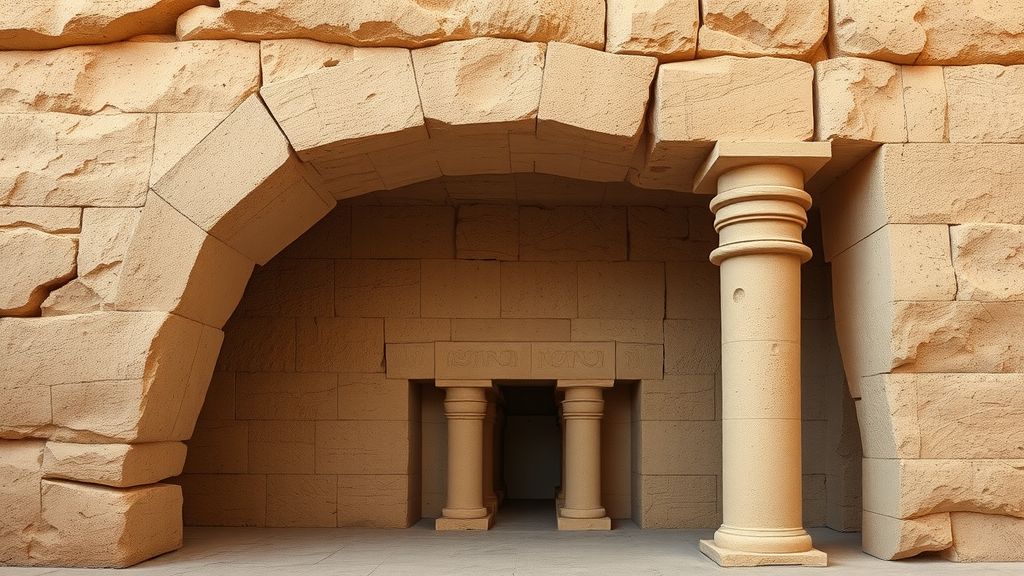
Ctesiphon, located on the eastern bank of the Tigris River roughly 35 kilometers southeast of modern Baghdad, served for nearly eight centuries as the royal capital of the Parthian and then Sasanian dynasties, the last pre-Islamic empires to rule much of ancient West Asia. Excavations in the late 1920s and early 1930s by the Staatliche Museen zu Berlin and the Metropolitan Museum of Art uncovered vast quantities of decorated stucco in elite residential buildings and around the great imperial palace of Taq-i Kisra. The panels, mostly square or rectangular plaques and large roundels, bear floral and geometric motifs as well as figural scenes of rams, boars, birds, nude female dancers and musicians drinking and playing harps. These decorations once embellished iwans, the vaulted, open-fronted reception halls that defined Sasanian palatial architecture.
The research team, led by Atefeh Shekofteh of the University of Gothenburg and Uppsala University together with colleagues at the Metropolitan Museum of Art, analyzed sixteen stucco objects, ten from Sasanian contexts and six from an Early Islamic settlement near the modern village of Selman Pak within the broader al-Mada’in archaeological zone. Sampling was deliberately minimally invasive: each fragment taken measured less than three millimeters. In one case, samples were collected from both the decorative surface and the underlying preparation layer, allowing the first direct comparison of functionally distinct strata within a single stucco element.
The mineralogical results show that all the Ctesiphon stuccos are gypsum-based, with calcium sulfate dihydrate dominating every sample. But the material was far from pure. Calcite, quartz, feldspar, clay minerals, muscovite, celestine and accessory calcium sulfate phases such as bassanite and anhydrite all appear in varying amounts. Crucially, the study demonstrates that these impurities were not deliberate additives. The silicate particles show no systematic arrangement, no grain-size sorting and no consistent pattern across samples, and the compositional data cluster along the calcium oxide-sulfur trioxide join with only limited displacement toward the silicate apex. The evidence points instead to naturally impure gypsum, quarried from evaporitic deposits whose detrital inclusions were simply carried along into the finished plaster.
The geological detective work goes further. The presence of pyroxenes, amphiboles and other magnesium-rich silicates in the stucco matrix is telling, because no igneous or metamorphic rocks are exposed near Ctesiphon itself. Such minerals are abundant, however, in the Zagros orogenic belt to the northeast, from which fluvial systems transported detrital material into the Mesopotamian foreland basin. The researchers conclude that the raw gypsum, most plausibly drawn from the Middle Miocene Fatha Formation, one of the principal gypsum-bearing units in central Iraq, inherited these minerals from its sedimentary environment, providing a geochemical fingerprint of local resource exploitation.
Perhaps the most striking results concern the firing process. Traditional gypsum calcination in West Asia relied on methods with no temperature regulation at all, either surface or pit firing with fuels such as dung and chaff, or dome-shaped mound kilns stacked over a wood or shrub fire. The Ctesiphon samples preserve the fingerprints of exactly such conditions. Relict lenticular and tabular raw gypsum crystals testify to incomplete dehydration, while isolated anhydrite phenocrysts, trace bassanite, charcoal fragments, biomass ash particles and spherical aluminosilicate fly-ash spheres, some with incipient devitrification microcrystals, all record heterogeneous, partially uncontrolled kiln environments. The coexistence of under-burnt and over-burnt material in the same samples is the signature of uneven heat distribution, hotter near the fire at the kiln base and cooler toward the crown of the dome.
The study also settles a long-standing question about execution technique. Spherical voids, formed by air trapped between gypsum paste and a mold surface during casting, were found both within the stucco bodies and on their surfaces, a diagnostic feature of molded gypsum that hand carving would have destroyed. Combined with the repetition of identical decorative elements, the absence of tool marks, consistent panel thickness and ridge marks on the reverse sides of some fragments designed to improve wall adhesion, the evidence shows that most Sasanian stuccos were produced as prefabricated, single-piece molded elements, followed by limited hand finishing such as surface leveling and polishing. Identical imperfections replicated across panels in both New York and Berlin’s Pergamon Museum confirm serial mold-based production.
The Early Islamic stuccos from Selman Pak tell a different story. These decorations continue Sasanian ornamental traditions, with vines, leaves and rosettes echoing Umayyad and Abbasid styles known from sites such as Nishapur, but they lack standardized shapes and show clear evidence of hand carving, visible tool marks and irregular surface textures. Only one Selman Pak sample shows diagnostic evidence of molding. The Early Islamic samples also display broader compositional dispersion, higher calcite and lower feldspar contents, and lower bassanite abundance, consistent with higher firing temperatures but reduced control over kiln conditions. The researchers interpret this as a shift toward less centralized, more variable production following the collapse of Sasanian imperial authority.
One object, a two-layered fragment from Selman Pak, revealed an additional layer of craft knowledge. Its coarse substrate contains substantially more quartz, clay and fuel-derived phases than its comparatively pure gypsum decorative layer, indicating that craftsmen deliberately sorted fired gypsum by quality, reserving well-setting material from the kiln’s central zones for visible surfaces while relegating over-burnt, ash-laden material to preparatory layers. This experience-based categorization of material quality reveals a sophisticated, if empirically grounded, understanding of the relationship between firing position, plaster performance and architectural function.
Beyond rewriting the technological history of one of antiquity’s great capitals, the findings have a practical legacy. The combustion residues, amorphous aluminosilicate phases and heterogeneous firing signatures characteristic of traditional gypsum production are rarely formed in modern industrial plaster manufacture, making them valuable markers for assessing the authenticity of stucco objects in museum collections worldwide. The study also demonstrates how integrated archaeometric analysis can reconstruct craft organization, resource procurement and technological change across one of the most turbulent transitions in West Asian history, the passage from the Sasanian Empire to the Early Islamic caliphates, as recorded in something as humble, and as beautiful, as wall plaster.
Subject of Research: Archaeometric characterization of gypsum stucco architectural decoration from Sasanian and Early Islamic Ctesiphon to reconstruct production techniques and craft organization
Article Title: Behind the facades of Ctesiphon: an archaeometric study of stucco architectural decoration from the Sasanian and Early Islamic periods
Article References: Shekofteh, A., de Lapérouse, J.-F., Seymour, M., & Carò, F. (2026). Behind the facades of Ctesiphon: an archaeometric study of stucco architectural decoration from the Sasanian and Early Islamic periods. Archaeological and Anthropological Sciences, 18(10), Article 199. https://doi.org/10.1007/s12520-026-02556-9
Image Credits: AI Generated
DOI: 10.1007/s12520-026-02556-9
Keywords: Ctesiphon, Sasanian stucco, Early Islamic stucco, gypsum plaster, archaeometry, µXRD, SEM–EDS, traditional gypsum kilns, mold casting, Selman Pak, Taq-i Kisra, craft technology
Cite Scienmag News
Courtney Benton. (September 21, 2026). Ancient Stucco Secrets of Ctesiphon Revealed by Modern Archaeometric Analysis. Scienmag. https://scienmag.com/ancient-stucco-secrets-of-ctesiphon-revealed-by-modern-archaeometric-analysis/
Courtney Benton. "Ancient Stucco Secrets of Ctesiphon Revealed by Modern Archaeometric Analysis." Scienmag, 21 September 2026, https://scienmag.com/ancient-stucco-secrets-of-ctesiphon-revealed-by-modern-archaeometric-analysis/. Accessed 4 October 2026.
Courtney Benton. "Ancient Stucco Secrets of Ctesiphon Revealed by Modern Archaeometric Analysis." Scienmag. September 21, 2026. https://scienmag.com/ancient-stucco-secrets-of-ctesiphon-revealed-by-modern-archaeometric-analysis/


