


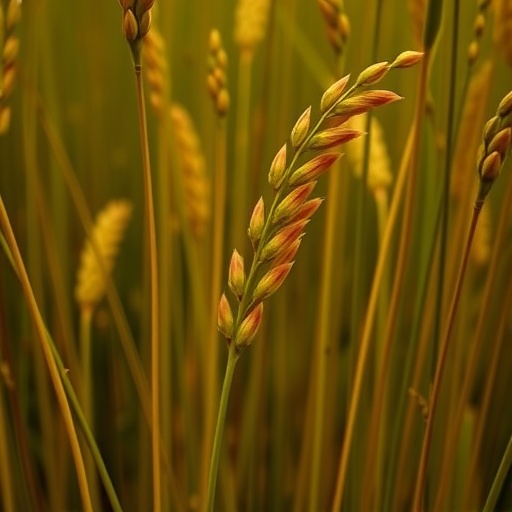
An international consortium of scientists, spearheaded by the IPK Leibniz Institute, has unveiled a transformative model for understanding the domestication and evolutionary history of barley (Hordeum vulgare). Their groundbreaking research challenges the long-held notion of a singular origin for cultivated barley, proposing instead a complex “mosaic origin” arising from multiple wild populations dispersed throughout the Fertile Crescent and adjacent regions. This revelation not only reshapes our conception of cereal domestication but also sheds light on the intricate interplay between genetics, human migration, and early agriculture.
At the heart of the study lies a detailed haplotype analysis—an approach that examines blocks of DNA sequences inherited together. By focusing on these genetic “building blocks,” the team could disentangle the contributions of diverse wild barley populations to the modern barley genome. They analyzed a substantial dataset comprising 682 barley accessions preserved in the IPK genebank alongside 23 archaeological barley samples, some of which date back 6,000 years. This comprehensive genetic survey enabled the researchers to chart the introduction and distribution of crucial haplotypes across geographical and temporal scales.
The five wild barley populations examined originate from key zones within western and central Asia, encompassing territories stretching from Iraq and Syria through Turkey and into Israel. These regions, collectively known as the Fertile Crescent, have long been recognized as the cradle of agriculture. However, the study’s findings emphasize that barley’s domestication did not emanate from a singular locus. Instead, it resulted from the amalgamation of genetic information from these distinct populations, shaping a mosaic genome characteristic of today’s cultivated barley varieties.
One of the landmark discoveries involved dating domestication-related haplotypes. Certain genetic traits, such as those regulating the non-brittle ear—a pivotal feature preventing grain shattering and facilitating harvest—predate the archaeological evidence of barley cultivation by millennia. Specifically, haplotypes associated with this trait were traced back approximately 27,000 years, revealing that key adaptations essential for domestication existed in wild populations long before deliberate human cultivation began around 10,000 years ago during the Neolithic Revolution.
Moreover, the spread of barley beyond its Fertile Crescent origins was far from a linear process. Instead, it involved recurrent gene flow between domesticated plants and local wild relatives as barley cultivation expanded geographically. This admixture was catalyzed by human practices including migration, trade, and seed exchange. The resulting genetic confluence shaped the remarkable diversity observed in barley today. Notably, contributions from all five wild populations varied in magnitude, illustrating a dynamic evolutionary landscape punctuated by regional specialization and hybridization.
Following the initial domestication events, the study identifies three major geographic lineages into which cultivated barley differentiated. The western lineage spread through the Middle East and Europe, the eastern lineage moved into Central and East Asia, while a distinct Ethiopian lineage emerged in northeast Africa. The emergence of key domestication genes correlated with these lineages, each evolving independently to confer advantageous traits. For example, the allele responsible for naked barley—grain devoid of husk—arose approximately 16,000 years ago, underscoring the protracted and multifaceted timeline over which barley traits evolved.
Ancient DNA retrieved from archaeological excavations in Israel has added an extra dimension to these findings. Grains from sites such as Yoram Cave (6,000 years old), Abi’or Cave (2,000 years old), and a copper mine near Timna (3,000 years old) exhibit increasing genetic diversity over time. This trend is interpreted as evidence for continuous gene flow, likely arising from sustained trade routes and human mobility that facilitated the introduction of new genetic variants into local barley populations. Such data illuminate the dynamic and interconnected nature of early agricultural societies.
Significantly, this study reaffirms findings from botanical and archaeogenetic analyses conducted at the Ohalo site on the Sea of Galilee’s shores, where evidence for imprints of cereal agriculture date back 23,000 years. The convergence of these records underscores the Fertile Crescent’s central role in shaping the trajectory of plant domestication, highlighting the value of archaeological contexts rich in well-preserved plant remains. The comprehensive integration of ancient DNA analyses with archaeological data exemplifies a powerful new frontier in evolutionary biology and crop science.
Researchers emphasize the evolutionary plasticity of barley, noting that critical domestication traits such as ear shape and grain retention have evolved multiple times independently across distinct populations. This convergent evolution highlights the adaptive flexibility of plant genomes in response to both natural selection and human-mediated pressures. Understanding these patterns offers insights not only into barley’s past but also into strategies for crop improvement and adaptation in the face of climate change and evolving agricultural demands.
Furthermore, this genomic mosaic resonates with human history itself, tracing the patterns of settlement, trade, and culture. “Reading the DNA of barley is akin to reading thousands of years of human civilization,” remarks Dr. Martin Mascher, the study’s senior author. The intimate relationship between human societies and their staple crops is laid bare through these genetic narratives, illustrating how domestication is intrinsically linked to human ingenuity and environmental interactions.
This seminal work, published in the prestigious journal Nature, leverages advanced molecular genetics and bioinformatics tools to unravel a narrative long hidden beneath layers of sediment and time. It challenges researchers to rethink classical models of domestication, inviting new questions about how early human communities shaped the diversity of life that sustains us today. The study’s depth and scale set a new benchmark for research on crop evolution, opening avenues for exploring genetic resilience and vulnerability in ancient and modern agriculture.
In summary, the evolutionary saga of barley is far richer and more intricate than previously assumed. By revealing a genomic patchwork woven from multiple wild populations and shaped by millennia of human interaction, this research provides a vivid portrait of domestication as a dynamic, multidimensional process. These findings have profound implications for understanding crop origins, guiding breeding programs, and preserving genetic diversity critical for future food security.
News Publication Date: 24-Sep-2025
Web References: 10.1038/s41586-025-09533-7
Cite Scienmag News
Alan Morgan. (September 24, 2025). Ancient Plant Uncovered: IPK Team Illuminates Barley’s Mosaic Origins. Scienmag. https://scienmag.com/ancient-plant-uncovered-ipk-team-illuminates-barleys-mosaic-origins/
Alan Morgan. "Ancient Plant Uncovered: IPK Team Illuminates Barley’s Mosaic Origins." Scienmag, 24 September 2025, https://scienmag.com/ancient-plant-uncovered-ipk-team-illuminates-barleys-mosaic-origins/. Accessed 4 September 2026.
Alan Morgan. "Ancient Plant Uncovered: IPK Team Illuminates Barley’s Mosaic Origins." Scienmag. September 24, 2025. https://scienmag.com/ancient-plant-uncovered-ipk-team-illuminates-barleys-mosaic-origins/


