


When it comes to the ocean’s response to global warming, we’re not in entirely uncharted waters. A UC Riverside study shows that episodes of extreme heat in Earth’s past caused the exchange of waters from the surface to the deep ocean to decline.

Credit: Marci Robinson, USGS
When it comes to the ocean’s response to global warming, we’re not in entirely uncharted waters. A UC Riverside study shows that episodes of extreme heat in Earth’s past caused the exchange of waters from the surface to the deep ocean to decline.
This system has been described as the “global conveyer belt,” because it redistributes heat around the globe through the movement of the ocean waters, making large portions of the planet habitable.
Using tiny, fossilized shells recovered from ancient deep-sea sediments, the study in the Proceedings of the National Academy of Sciences demonstrates how the conveyor belt responded around 50 million years ago. At that time, Earth’s climate resembled conditions predicted by the end of this century, if significant action is not taken to reduce carbon emissions.
Oceans play a crucial role in regulating Earth’s climate. They move warm water from the equator toward the north and south poles, balancing the planet’s temperatures. Without this circulation system, the tropics would be much hotter and the poles much colder. Changes in this system are linked to significant and abrupt climate change.
Furthermore, the oceans serve a critical role in removing anthropogenic carbon dioxide from the atmosphere. “The oceans are by far the largest standing pool of carbon on Earth’s surface today,” said Sandra Kirtland Turner, vice-chair of UCR’s Department of Earth and Planetary Sciences and first author of the study.
“Today, the oceans contain nearly 40,000 billion tons of carbon — more than 40 times the amount of carbon in the atmosphere. Oceans also take up about a quarter of anthropogenic CO2 emissions,” Kirtland Turner said. “If ocean circulation slows, absorption of carbon into the ocean may also slow, amplifying the amount of CO2 that stays in the atmosphere.”
Previous studies have measured changes in ocean circulation in Earth’s more recent geologic past, such as coming out of the last ice age; however, those do not approximate the levels of atmospheric CO2 or warming happening to the planet today. Other studies provide the first evidence that deep ocean circulation, particularly in the North Atlantic, is already starting to slow.
To better predict how ocean circulation responds to greenhouse gas-driven global warming, the research team looked to the early Eocene epoch, between roughly 49 and 53 million years ago. Earth then was much warmer than today, and that high-heat baseline was punctuated by spikes in CO2 and temperature called hyperthermals.
During that period, the deep ocean was up to 12 degrees Celsius warmer than it is today. During the hyperthermals, the oceans warmed an additional 3 degrees Celsius.
“Though the exact cause of the hyperthermal events is debated, and they occurred long before the existence of humans, these hyperthermals are the best analogs we have for future climate change,” Kirtland Turner said.
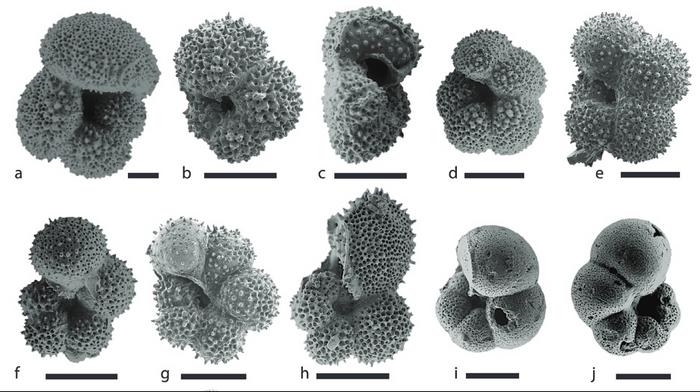
By analyzing tiny fossil shells from different sea floor locations around the globe, the researchers reconstructed patterns of deep ocean circulation during these hyperthermal events. The shells are from microorganisms called foraminifera, which can be found living throughout the world’s oceans, both on the surface and on the sea floor. They are about the size of a period at the end of a sentence.
“As the creatures are building their shells, they incorporate elements from the oceans, and we can measure the differences in the chemistry of these shells to broadly reconstruct information about ancient ocean temperatures and circulation patterns,” Kirtland Turner said.
The shells themselves are made of calcium carbonate. Oxygen isotopes in the calcium carbonate are indicators of temperatures in the water the organisms grew in, and the amount of ice on the planet at the time.
The researchers also examined carbon isotopes in the shells, which reflect the age of the water where the shells were collected, or how long water has been isolated from the ocean surface. In this way, they can reconstruct patterns of deep ocean water movement.
Foraminifera can’t photosynthesize, but their shells indicate the impact of photosynthesis of other organisms nearby, like phytoplankton. “Photosynthesis occurs in the surface ocean only, so water that has recently been at the surface has a carbon-13 rich signal that is reflected in the shells when that water sinks to the deep ocean,” Kirtland Turner said.
“Conversely, water that has been isolated from the surface for a long time has built up relatively more carbon-12 as the remains of photosynthetic organisms sink and decay. So, older water has relatively more carbon-12 compared to ‘young’ water.”
Scientists often make predictions about ocean circulation today using computer climate models. They use these models to answer the question: ‘how is the ocean going to change as the planet keeps warming?’ This team similarly used models to simulate the ancient ocean’s response to warming. They then used the foraminifera shell analysis to help test results from their climate models.
During the Eocene, there were about 1,000 parts per million (ppm) of carbon dioxide in the atmosphere, which contributed to that era’s high temperatures. Today, the atmosphere holds about 425 ppm.
However, humans emit nearly 37 billion tons of CO2 into the atmosphere each year; if these emission levels continue, similar conditions to the Early Eocene could occur by the end of this century.
Therefore, Kirtland Turner argues it is imperative to make every effort to reduce emissions.
“It’s not an all-or-nothing situation,” she said. “Every incremental bit of change is important when it comes to carbon emissions. Even small reductions of CO2 correlate to less impacts, less loss of life, and less change to the natural world.”
Journal
Proceedings of the National Academy of Sciences
Article Title
Sensitivity of ocean circulation to warming during the Early Eocene greenhouse
Article Publication Date
3-Jun-2024
Cite Scienmag News
Violet Maxwell. (June 13, 2024). Ancient ocean slowdown warns of future climate chaos. Scienmag. https://scienmag.com/ancient-ocean-slowdown-warns-of-future-climate-chaos/
Violet Maxwell. "Ancient ocean slowdown warns of future climate chaos." Scienmag, 13 June 2024, https://scienmag.com/ancient-ocean-slowdown-warns-of-future-climate-chaos/. Accessed 5 September 2026.
Violet Maxwell. "Ancient ocean slowdown warns of future climate chaos." Scienmag. June 13, 2024. https://scienmag.com/ancient-ocean-slowdown-warns-of-future-climate-chaos/

