


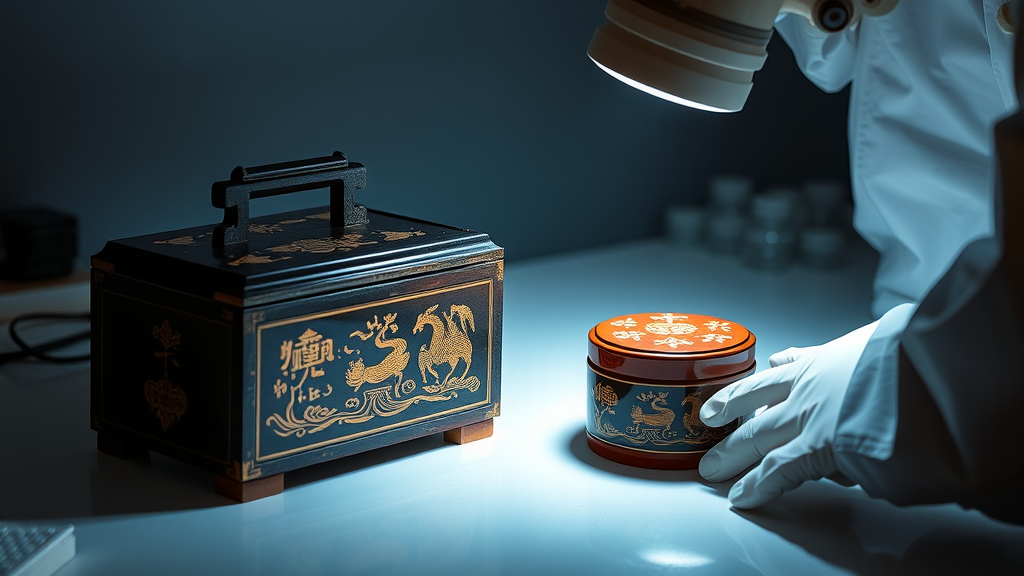
Lacquerware holds a special place in the material history of China. Among the most refined products of ancient Chinese craftsmanship, lacquered objects combined beauty, durability, and cultural meaning, and few periods exemplify this better than the early Western Han dynasty. A recent multi-analytical investigation of lacquer boxes excavated in Chongqing, China, has now offered researchers a rare, laboratory-grade look at how these remarkable objects were made, what materials the craftsmen used, and what their composition can tell us about technology and society more than two thousand years ago. The study, published in the journal Heritage, brings together a battery of modern scientific techniques to interrogate objects that have survived centuries of burial and degradation.
The lacquer boxes at the center of the research date to the early Western Han period, a formative era in Chinese history that followed the collapse of the Qin dynasty. Han lacquerware is celebrated for its glossy black and red surfaces, its lightweight wooden or fabric-reinforced cores, and its extraordinarily thin yet resilient coatings. These qualities were achieved through the repeated application of processed sap from the lacquer tree, Toxicodendron vernicifluum, a natural material that polymerizes into a hard, chemically resistant film under specific conditions of humidity and temperature. Understanding exactly how ancient workshops manipulated this material, and what pigments and additives they mixed into it, requires tools that go far beyond visual examination.
That is precisely where the multi-analytical approach comes in. Rather than relying on a single technique, the research team combined complementary analytical methods, each of which interrogates a different aspect of the lacquer structure. Optical microscopy allowed the researchers to document the layered construction of the boxes at high magnification, revealing the sequence of ground layers, priming coats, and decorative finishes that together give lacquerware its depth. Microscopic examination of cross sections is a cornerstone of heritage science because it preserves the stratigraphic story of an object’s manufacture, layer by layer, in a way no surface inspection can match.
To identify the organic components of the lacquer itself, the researchers turned to spectroscopic and chromatographic methods. Fourier-transform infrared spectroscopy, commonly abbreviated FTIR, provides a molecular fingerprint of the materials present by measuring how chemical bonds absorb infrared light. This technique is particularly well suited to distinguishing urushiol-based Asian lacquer from other binding media such as oils, resins, or animal glues. Thermally assisted methods, which gently break down and separate the molecular components of the lacquer film, can further confirm the presence of the characteristic catechol compounds of urushiol and detect markers of heat processing, which ancient craftsmen used to control the viscosity and curing behavior of raw lacquer.
The inorganic side of the story is equally revealing. The striking red and black decoration of Han lacquerware depended on mineral pigments, and identifying them requires elemental and structural analysis. Scanning electron microscopy coupled with energy-dispersive X-ray spectroscopy, or SEM-EDS, maps the elemental composition of individual pigment particles, revealing the presence of mercury and sulfur for cinnabar, or iron compounds for earth-based reds and browns. Raman spectroscopy and X-ray diffraction then confirm the crystalline phases of those pigments, distinguishing, for example, natural cinnabar from synthetic forms or identifying degradation products that formed during burial. Together these methods allow researchers to reconstruct not just what is on the surface, but how the paint layers were formulated and applied.
The findings from such an integrated study speak to several overlapping questions. First, they illuminate workshop technology: which materials were selected, how they were combined, and how sophisticated the production process was. The consistent use of urushiol lacquer over prepared substrates, with carefully formulated pigment layers, indicates a mature craft tradition with specialized knowledge passed down through generations of artisans. Second, they speak to trade and economy. Lacquer production was labor intensive and resource dependent, requiring access to lacquer trees, mineral pigments, and skilled labor, so the composition of lacquered goods can indicate whether objects were produced locally or traded over long distances along the expanding networks of Han China.
Third, and perhaps most evocatively, the analysis touches on cultural meaning. Lacquerware in the early Western Han was not merely functional; it was a marker of status and taste, buried with the dead and exchanged among elites. The boxes studied in Chongqing, a region rich in Han-era archaeology, form part of this broader picture of how material culture expressed identity and hierarchy. Scientific analysis adds a concrete dimension to that picture, grounding interpretations of status and symbolism in the physical chemistry of the objects themselves.
The study also underscores why multi-analytical characterization has become the gold standard in archaeological conservation. Each technique has blind spots: spectroscopy may miss minor additives, chromatography requires sampling and careful interpretation, and elemental analysis says little about molecular structure. Only by layering the results of several independent methods can researchers build conclusions robust enough to guide conservation decisions. For lacquerware, those decisions are particularly urgent, because archaeological lacquer is notoriously fragile. After centuries underground, the moisture balance of the lacquer film can be destabilized, leading to cracking, flaking, and warping once objects are excavated. Knowing the exact chemical composition and degradation state of a lacquer object informs how conservators control humidity, light exposure, and handling.
Beyond the immediate conservation implications, the research contributes to a growing comparative database of ancient lacquer chemistry. As more Han-period lacquer objects from different regions are analyzed with comparable protocols, patterns will emerge that allow archaeologists to trace the movement of materials, technologies, and even individual workshop traditions across the Han empire. Chongqing, situated in the upper Yangtze region, occupies an interesting position in that geography, and studies of this kind help situate local production within wider networks of craft specialization.
The work also demonstrates the continued value of collaboration between archaeologists, conservators, and analytical chemists. Instruments alone do not answer historical questions; it is the careful integration of scientific data with archaeological context, typology, and historical records that turns a set of spectra into an account of ancient technology. In that sense, the lacquer boxes of early Western Han Chongqing are both artifacts and documents, and modern analytical science is learning to read them with unprecedented precision. As heritage science continues to advance, more objects once considered too fragile or too degraded for study will yield their secrets, enriching our understanding of one of the world’s great craft traditions and the society that sustained it.
Subject of Research: Multi-analytical characterization of early Western Han dynasty lacquer boxes from Chongqing, China
Article Title: Multi-analytical study of early Western Han lacquer boxes from Chongqing, China
Article References: Gu, L., Xiao, L., Huang, W., Ye, L., Bai, J., & Tang, H. (2026). Multi-analytical study of early Western Han lacquer boxes from Chongqing, China. npj Heritage Science. https://doi.org/10.1038/s40494-026-02976-9
Image Credits: AI Generated
DOI: 10.1038/s40494-026-02976-9
Keywords: Han dynasty, lacquerware, Chongqing, urushiol, heritage science, archaeometry, FTIR, SEM-EDS, Raman spectroscopy, pigments, conservation, ancient craftsmanship
Cite Scienmag News
Courtney Benton. (September 20, 2026). Ancient Lacquer Boxes From China’s Early Han Dynasty Reveal Their Secrets Under the Laboratory Spotlight. Scienmag. https://scienmag.com/ancient-lacquer-boxes-from-chinas-early-han-dynasty-reveal-their-secrets-under-the-laboratory-spotlight/
Courtney Benton. "Ancient Lacquer Boxes From China’s Early Han Dynasty Reveal Their Secrets Under the Laboratory Spotlight." Scienmag, 20 September 2026, https://scienmag.com/ancient-lacquer-boxes-from-chinas-early-han-dynasty-reveal-their-secrets-under-the-laboratory-spotlight/. Accessed 4 October 2026.
Courtney Benton. "Ancient Lacquer Boxes From China’s Early Han Dynasty Reveal Their Secrets Under the Laboratory Spotlight." Scienmag. September 20, 2026. https://scienmag.com/ancient-lacquer-boxes-from-chinas-early-han-dynasty-reveal-their-secrets-under-the-laboratory-spotlight/


