


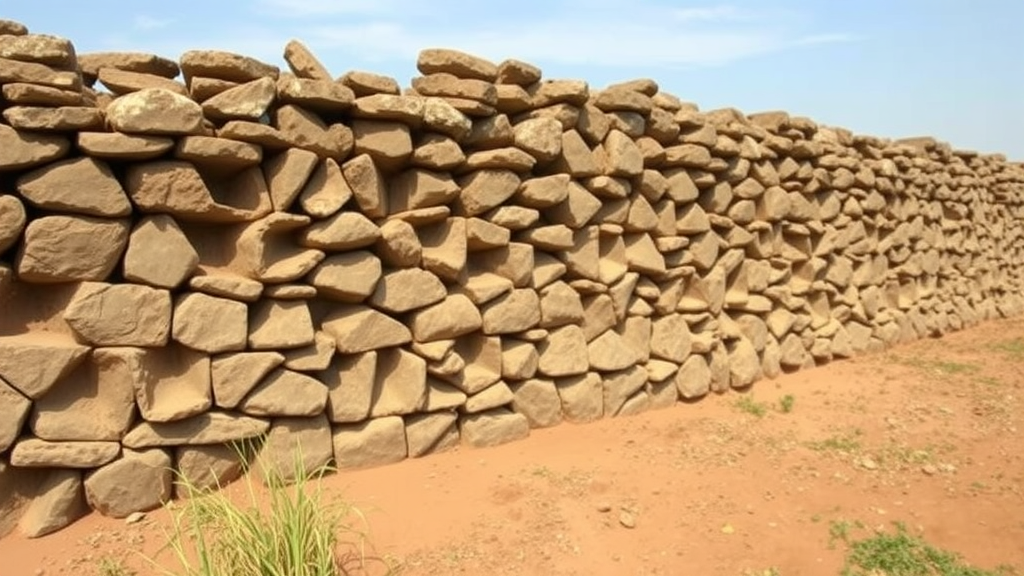
On the steep, rocky hillsides of Boukombé in northwestern Benin, farmers have spent generations arranging stones into patterns that resemble the cells of a beehive. Now, a rigorous two-year field experiment has confirmed what these farmers long suspected: their indigenous honeycomb stone arrangements outperform the conventional contour stone rows that development projects have promoted for decades, cutting soil loss roughly in half and lifting sorghum grain yields by nearly 90 percent in the best configurations. The findings, published in Discover Soil, offer a rare quantitative validation of endogenous soil and water conservation knowledge in one of West Africa’s most erosion-prone agricultural landscapes.
The research team, led by Romaric Serge Lokossou of the National Institute of Agricultural Research of Benin and the University of Parakou, set up a rainfed field experiment on a hillside with a punishing 22 percent slope in the village of Koutagou. The region’s soils are thin, sandy, gravel-laden and notoriously erodible, products of the Atacora mountain chain where only about a third of the land is arable. Rainfall arrives in a five-month wet season totaling roughly 1,100 to 1,200 millimeters per year, and when it comes, it often arrives violently, sending water and topsoil cascading down the slopes. Despite decades of intervention by NGOs and government projects dating back to the 1960s, Boukombé still records some of the lowest crop yields in Benin and ranks among the country’s poorest districts.
The experiment compared three soil and water conservation techniques in a split-plot design with three replicates. The main treatments were rectangular honeycomb arrangements, circular honeycomb arrangements, and ordinary contour stone rows as the control. Honeycomb structures are built from stones gathered nearby and shaped into connected cells, or alveoli, that partition the field into small basins. Each cell acts as a miniature reservoir, slowing runoff, trapping sediment, and giving water time to infiltrate rather than race downhill. The researchers crossed these conservation structures with four fertilization regimes: the full recommended dose of NPK and urea, two reduced microdosing options at roughly 72 percent and 36 percent of the recommended dose, and an unfertilized control.
Over two growing seasons, 2012 and 2013, the team measured runoff and soil loss after every erosive rainfall event using bounded runoff plots, tracked soil moisture gravimetrically at two-week intervals, and harvested sorghum biomass and grain from central rows of each plot. The rainfall record itself told a story of climatic stress: 468.8 millimeters fell during the 2012 season and 483.35 millimeters in 2013, but 2012 was punctuated by dry spells lasting five to thirteen days during critical crop stages, while 2013 delivered rain more favorably distributed across the sorghum’s flowering period.
The hydrological results were unambiguous. Circular honeycomb arrangements reduced cumulative runoff by 25.05 percent compared with contour stone rows, while rectangular honeycombs achieved a 17.65 percent reduction. Soil loss told an even more dramatic story: the circular honeycomb plots lost 9,206 kilograms per hectare of sediment over the study period, against 19,580 kilograms per hectare under conventional stone rows, a reduction of just over 52 percent. Rectangular honeycombs cut soil loss by 38.55 percent. Event-by-event analysis showed the pattern held across most significant storms, and in several rainfall events the combination of honeycomb structures with fertilizer produced measurably less runoff and sediment than either factor alone.
Soil moisture, the lifeblood of rainfed farming in semi-arid zones, followed the same hierarchy. Circular honeycomb plots retained the most water in both seasons, averaging 13.63 percent moisture in 2012 and 15.53 percent in 2013, exceeding the other treatments by 8.52 to 10.52 percent. The authors attribute this advantage to the architecture of the honeycomb itself. Where a contour stone row is a single linear barrier, a honeycomb field is a dense network of intersecting stone walls enclosing many small catchment cells. More barriers mean more opportunities to interrupt flow, and more enclosed space means more residence time for water to soak into the root zone. The researchers note that honeycomb geometry echoes principles celebrated in engineering and mathematics, where the hexagonal honeycomb is recognized as the most stable structure in nature, and that similar cellular designs have proven superior in applications from mechanical engineering to solar thermal collectors.
The agronomic payoff was substantial. In 2012, circular honeycomb plots produced 2,086 kilograms per hectare of sorghum biomass, 52.38 percent more than the other conservation treatments, and grain yields of 451 kilograms per hectare against 240 under contour stone rows, an 87.42 percent advantage. In the wetter, better-distributed 2013 season, circular honeycomb grain yields reached 1,569 kilograms per hectare, 68.56 percent above the control. Fertilization amplified these gains. The recommended dose roughly tripled biomass relative to unfertilized plots, but critically, the microdosing options, which use far less fertilizer, performed nearly as well. Microdosing option 1 at 166.7 kilograms of NPK per hectare matched or exceeded the full recommended dose in several comparisons, confirming the technique’s promise for resource-poor farmers who cannot afford or access full fertilizer rates.
The synergy between conservation structures and nutrient management is central to the study’s message. Fertilized sorghum develops denser canopies and more extensive root systems, which shield the soil from raindrop impact and anchor it against scouring, further suppressing runoff and erosion. In turn, the honeycomb cells conserve the moisture that fertilizer needs to translate into grain. Sorghum, a drought-tolerant staple in Boukombé used for food and for the traditional beer known as Tchoucoutou, is ideally suited to exploit this combination, drawing water and nutrients from the soil with its dense, branched root architecture. The interaction between circular honeycombs and microdosed fertilizer produced the strongest plant development observed in the trial, suggesting a low-cost pathway to intensification on lands where conventional approaches have repeatedly failed.
The authors are careful to frame the results as a beginning rather than an endpoint. The circular honeycomb emerged as the most promising option for steep semi-arid hillsides, but they caution that its adoption hinges on questions the experiment did not address: the labor required to build and maintain cellular stone walls, the economics relative to linear stone rows, farmer acceptance, long-term performance, and water-use efficiency under different rainfall regimes. Still, in a region where water is the single most limiting factor for crop production and where erosion rates exceed the natural pace of soil formation, the study provides something rare and valuable: hard field evidence that a technique developed by local farmers, refined over centuries on the slopes of the Atacora chain, can beat the imported alternatives. As climate variability intensifies across the Sahelian margins, the humble honeycomb may prove to be one of the most elegant pieces of climate adaptation infrastructure already in the ground.
Subject of Research: Field evaluation of indigenous honeycomb stone arrangements for soil erosion control, soil moisture conservation, and sorghum productivity under fertilizer microdosing on steep hillsides in northwestern Benin
Article Title: Endogenous honeycomb stone arrangements reduce soil erosion, improve soil moisture, and sorghum productivity under fertilizer microdosing on steep lands of Boukombé in northwestern Benin
Article References: Lokossou, R. S., Akponikpè, P. B. I., Moutouama, F. T., Likpètè, D. D., Djènontin, J. A., Fatondji, D., & Baco, N. M. (2026). Endogenous honeycomb stone arrangements reduce soil erosion, improve soil moisture, and sorghum productivity under fertilizer microdosing on steep lands of Boukombé in northwestern Benin. Discover Soil, 3(1), Article 146. https://doi.org/10.1007/s44378-026-00301-1
Image Credits: AI Generated
DOI: 10.1007/s44378-026-00301-1
Keywords: honeycomb stone arrangements, soil and water conservation, soil erosion, runoff, soil moisture, sorghum, fertilizer microdosing, Benin, steep lands, rainfed agriculture, indigenous knowledge, semi-arid farming
Cite Scienmag News
Alan Morgan. (September 13, 2026). Ancient Honeycomb Stone Walls Slash Erosion and Boost Sorghum Yields in Benin. Scienmag. https://scienmag.com/ancient-honeycomb-stone-walls-slash-erosion-and-boost-sorghum-yields-in-benin/
Alan Morgan. "Ancient Honeycomb Stone Walls Slash Erosion and Boost Sorghum Yields in Benin." Scienmag, 13 September 2026, https://scienmag.com/ancient-honeycomb-stone-walls-slash-erosion-and-boost-sorghum-yields-in-benin/. Accessed 4 October 2026.
Alan Morgan. "Ancient Honeycomb Stone Walls Slash Erosion and Boost Sorghum Yields in Benin." Scienmag. September 13, 2026. https://scienmag.com/ancient-honeycomb-stone-walls-slash-erosion-and-boost-sorghum-yields-in-benin/


