


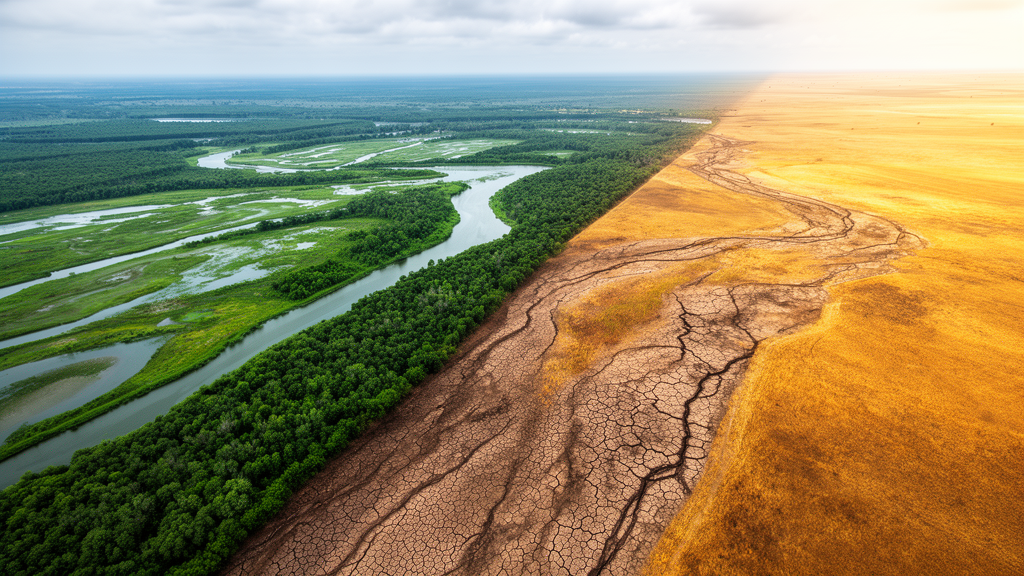
One of the most stubborn questions in climate science is not whether the planet is warming, but where the water is going. A new study published in Communications Earth & Environment by Zhansen Zhang, Yu Li, Mingjun Gao and colleagues at Lanzhou University, Xinyang Normal University and Jiangxi Normal University offers a strikingly clear answer: the answer depends on latitude. By combining global climate simulations with 191 archives of past environmental change, the team shows that terrestrial moisture over the past 21,000 years has followed a pronounced latitudinal pattern, one that modern observations echo and future models project to intensify. The work suggests that as greenhouse warming continues, the wet regions of the world and the dry ones are set to diverge further, sharpening a global geography of water stress that has been building since the ice sheets began to retreat.
The study reaches back to the Last Glacial Maximum, roughly 21,000 years ago, when vast ice sheets covered northern North America and Scandinavia, atmospheric carbon dioxide stood near 180 parts per million, and global sea level lay more than 100 meters below today’s shoreline. That interval is a natural laboratory for hydroclimate research. Because the drivers of climate then, ice sheets, greenhouse gases and orbital geometry, differed so dramatically from the present, comparing moisture conditions across the deglaciation allows scientists to separate the influence of temperature from that of atmospheric circulation. The researchers assembled 191 paleoclimate records spanning the globe, each encoding information about past wetness preserved in lake sediments, speleothems, peat deposits and similar natural archives, and confronted them with transient climate model simulations, including the TraCE-21ka experiment that tracks climate continuously from the glacial maximum to the pre-industrial era.
The reconstructed pattern is anything but uniform. At high northern latitudes, the record shows progressive wetting from the Last Glacial Maximum through the pre-industrial period, a trend the authors attribute to rising temperatures, retreating ice and the increased moisture-holding capacity of a warmer atmosphere. In the mid-latitudes, however, the story inverts. Many regions dominated by the westerly wind belts, the prevailing winds that steer storms across the middle of each hemisphere, were wetter during cold periods and drier during warm ones. The low latitudes behave differently again: monsoon-dominated regions, from South Asia to northern Africa, were generally wetter during warm intervals, when intensified land-sea thermal contrasts strengthened seasonal rainfall. Three latitude bands, three opposite responses to the same planetary temperature change.
The mechanism behind these contrasts lies in the seasonal balance between precipitation and evaporation, and in the way atmospheric circulation shifts as the climate changes. In westerly-dominated mid-latitudes, cold climates favor reduced evaporation and altered storm tracks that can tip the moisture budget toward surplus, while warming raises evaporative demand faster than rainfall can compensate. In monsoon regions, warming amplifies the thermal gradient between ocean and land, drawing moisture-laden air inland and boosting summer rainfall, even as evaporation also increases. At high latitudes, the poleward transport of moisture by a warmer, wetter atmosphere overwhelms local losses. The authors identify changing ice sheets, greenhouse gas concentrations and incoming solar radiation as the ultimate drivers of these circulation shifts, each leaving a distinct fingerprint in the seasonal water balance.
What makes the study particularly compelling is that the same latitudinal structure appears in modern instrumental observations. The wet-get-wetter, dry-get-drier dichotomy that climate scientists have long discussed is not a hypothetical feature of future projections; it is a recurring signature of Earth’s climate system that has operated across radically different background states. When the same organizing principle, latitude-dependent moisture change, emerges from both 21,000 years of paleoclimate evidence and contemporary measurements, confidence in the underlying physics grows considerably. It also suggests that the paleoclimate record can serve as a validation target for the very models used to forecast the coming century, a check that this study indicates the models pass in broad outline.
Extending the analysis forward, the team examined simulations from the CMIP suite of climate models, the international ensemble underpinning assessments by the Intergovernmental Panel on Climate Change. Under future warming, the models project continued drying across many subtropical and mid-latitude regions, including areas where expanding populations and agriculture already strain water supplies. Simultaneously, they project wetting at high latitudes and in monsoon regions, where enhanced moisture convergence and strengthened seasonal circulations deliver more rain. The projected map of twenty-first-century moisture change, in other words, resembles the latitudinal template that the paleoclimate reconstruction uncovered, with the subtropics and mid-latitude westerly zones emerging as the consistent losers in the global water budget.
The implications for drylands are sobering. Drylands, the arid and semi-arid belts that already cover roughly forty percent of the land surface and support billions of people, sit largely in the subtropical and mid-latitude bands where the study finds the strongest drying signal under warming. Continued warming is therefore likely to strengthen the global contrast between drying and wetting regions and to expand water stress in these vulnerable zones. Reduced soil moisture, heightened evaporative demand and shifting storm tracks can compound into agricultural losses, dust storms, wildfire risk and forced migration, pressures that water infrastructure in many developing nations is poorly positioned to absorb. The paleoclimate perspective adds a historical dimension: past warm intervals saw mid-latitude moisture deficits that human societies never had to confront at today’s population densities.
The methodological achievement of the study deserves attention as well. Paleoclimate reconstructions are notoriously difficult to harmonize, because different archives respond to different aspects of the water cycle, a lake level may reflect runoff, a speleothem may reflect rainfall isotopes, and a peat record may reflect water table depth. By assembling 191 records and comparing them against transient simulations rather than isolated time-slice snapshots, the researchers could track moisture change as a continuous process through the deglaciation, capturing the timing of transitions as ice sheets melted and orbital parameters shifted. The agreement between the spatial pattern in the records and the pattern in the models provides a form of cross-validation that neither data nor models could achieve alone, and it strengthens the case that the latitudinal contrast is a robust, physically grounded feature rather than an artifact of any single archive or simulation.
There are, as always, open questions. The authors note that regional details within each latitude band vary, and that seasonal changes in precipitation and evaporation, the proximate causes of the observed contrasts, remain challenging to pin down precisely in both archives and models. The study’s transient simulation, while state of the art, represents one realization of the deglaciation, and paleoclimate proxies carry their own uncertainties in dating and interpretation. Yet the broad conclusion stands on firm ground: Earth’s land surface does not respond to warming with a single hydrological story. It responds with a latitudinal architecture, wetter poles and monsoon belts, drier subtropics and westerly mid-latitudes, that has repeated itself across glacial cycles and is now being reactivated by human emissions.
For policymakers and water managers, the message is that the future of freshwater is fundamentally regional, and that the past offers a preview. The same physics that made mid-latitude lands drier during past warm spells and monsoon lands wetter is operating today, amplified by greenhouse gases at concentrations unprecedented in the 21,000-year window the study covers. As the authors’ analysis of future simulations makes plain, continued warming will not merely shift average rainfall; it will widen the gap between the world’s water haves and have-nots, concentrating stress in the drylands and mid-latitude breadbaskets where demand is already highest. Reading 21,000 years of moisture history against the coming century, the study delivers a warning written in the planet’s own archives: the wet-dry divide is deepening, and latitude is its blueprint.
Subject of Research: Latitudinal patterns of terrestrial wetting and drying since the Last Glacial Maximum and under future climate warming
Article Title: Strong latitudinal contrasts in global wet/dry patterns since the Last Glacial Maximum and under future warming
Article References: Zhang, Z., Li, Y., Zhang, Y., Peng, S., & Gao, M. (2026). Strong latitudinal contrasts in global wet/dry patterns since the Last Glacial Maximum and under future warming. Communications Earth & Environment. https://doi.org/10.1038/s43247-026-04078-7
Image Credits: AI Generated
DOI: 10.1038/s43247-026-04078-7
Keywords: paleoclimate, hydroclimate, Last Glacial Maximum, monsoon, westerlies, drylands, water stress, CMIP6, TraCE-21ka, global warming, precipitation, evaporation
Cite Scienmag News
Violet Maxwell. (October 10, 2026). Ancient Climates Reveal a World Split Between Wet and Dry as Warming Intensifies. Scienmag. https://scienmag.com/ancient-climates-reveal-a-world-split-between-wet-and-dry-as-warming-intensifies/
Violet Maxwell. "Ancient Climates Reveal a World Split Between Wet and Dry as Warming Intensifies." Scienmag, 10 October 2026, https://scienmag.com/ancient-climates-reveal-a-world-split-between-wet-and-dry-as-warming-intensifies/. Accessed 10 October 2026.
Violet Maxwell. "Ancient Climates Reveal a World Split Between Wet and Dry as Warming Intensifies." Scienmag. October 10, 2026. https://scienmag.com/ancient-climates-reveal-a-world-split-between-wet-and-dry-as-warming-intensifies/


