


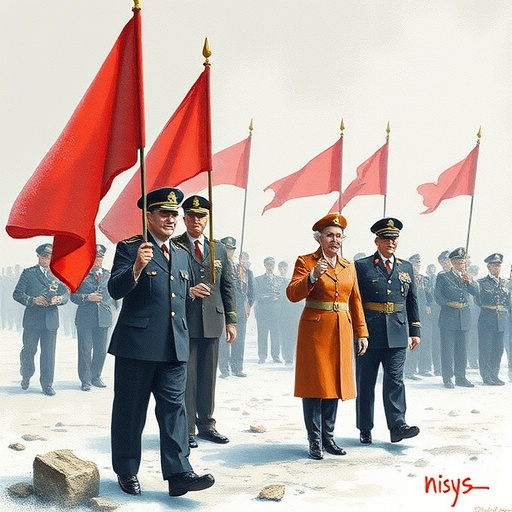
In recent times, observers and analysts alike have drawn unsettling parallels between the current international milieu and the geopolitical climate of the 1930s. Rising geopolitical tensions, escalating political polarization, intensified trade conflicts, and regional military clashes are phenomena evoking memories of a fraught past. This comparison raises a fundamental question: how do shifts in the global political and economic landscape redefine the internal dynamics of domestic politics? While existing scholarship on democratic backsliding has predominantly concentrated on the role of voters and political actors who seek to mobilize or manipulate electoral bases, the systematic study of how economic and political elites respond to these global shocks remains comparatively underexplored. Understanding the decision-making processes and incentives of these elites is crucial for comprehending how democracies may falter under external pressures.
Central to the discourse on international relations are economic sanctions and trade restrictions—tools frequently employed by states aiming to exert influence or pressure on adversarial regimes. However, the domestic repercussions of these instruments, particularly concerning shifts in political coalitions within affected nations, have not been fully elucidated. Economic sanctions are often presumed to weaken authoritarian regimes, yet their nuanced effects on the internal power structures and elite alignments merit deeper investigation. How do sanctions reshape the incentives for political elites, and how might these shifts alter the trajectory toward authoritarian governance?
Associate Professor Makoto Fukumoto of Waseda University embarked on an ambitious study to untangle these complex dynamics by examining Japan’s legislature during the critical years of 1936 to 1942. This era was marked by increasing military ascendancy in Japanese politics, dovetailing with severe international economic pressures, notably U.S. sanctions imposed between 1940 and 1941. By focusing on legislators tied to different industrial sectors, the study sought to illuminate how economic interests influenced elite behavior amidst mounting authoritarianism. This historical case study provides a controlled environment to observe the intersection of international economic coercion and domestic political realignment.
Fukumoto’s research meticulously analyzes parliamentary records alongside economic linkages, segmenting legislators by their associations with either export-oriented industries prone to sanction-induced damage or firms benefiting from increased military procurement. Statistical analyses reveal a striking divergence: lawmakers connected to export-dependent sectors vulnerable to sanctions exhibited increased support for military-backed authoritarian measures. In contrast, those whose constituencies profited from defense contracts displayed little inclination to acquiesce to authoritarian pressures, sometimes even asserting greater legislative independence. These findings confront the prevailing assumption that economic beneficiaries of war inherently champion authoritarian consolidation.
The study’s revelations challenge conventional narratives by demonstrating that economic vulnerability—rather than prosperity—is a potent motivator for elite alignment with authoritarian agendas. When elites perceive their economic survival as threatened by external sanctions or trade barriers, they may choose to endorse authoritarian policies as a means of securing protection and influence. This insight bears profound implications for our understanding of democratic erosion, suggesting that external economic shocks can catalyze internal political shifts that weaken democratic checks and balances from within.
These historical insights possess striking resonance in contemporary global affairs. They underscore the critical role that economic and political elites—comprising business magnates, legislators, and organizational powerbrokers—play in either defending or undermining democratic institutions. Whereas public discourse and scholarly attention frequently center voter behavior during democratic declines, Fukumoto’s work emphasizes that the internal choices of elites, armed with control over economic resources and legislative power, can decisively sway political trajectories toward or away from authoritarianism.
From a policy perspective, this research imparts cautionary lessons on the use of economic sanctions and trade restrictions as instruments of international diplomacy. While designed to coerce governments and influence state-level behavior, these measures may inadvertently destabilize politically moderate economic actors who advocate for cooperation and democratic principles. Instead, sanctions can empower hardline factions and authoritarian sympathizers by diminishing the bargaining power of economically connected elites resistant to undemocratic rule. Policymakers must therefore consider the domestic political landscapes of targeted nations and anticipate complex second-order effects when implementing economic pressure.
Moreover, the study provides valuable frameworks for interpreting elite behavior in authoritarian or hybrid political regimes. Political outcomes in these systems depend heavily on how elites navigate fluctuating power configurations and economic conditions. Fukumoto’s findings suggest that economic precarity among certain elite groups engenders accommodation to authoritarian initiatives rather than resistance. This dynamic offers a more nuanced lens for scholars and policymakers analyzing political developments in regimes where democratic institutions are fragile or compromised.
By examining a historical epoch marked by intense international tensions and economic upheaval, this research restrikes a chord with present-day dilemmas confronting democracies worldwide. It affirms that global economic and political shocks reverberate within domestic spheres, affecting not merely electoral politics but the very structure of political power and coalition formation. A comprehensive grasp of these processes is indispensable for safeguarding democratic governance amid turbulent times.
In sum, the research conducted by Associate Professor Makoto Fukumoto illuminates the delicate interplay between international economic shocks and domestic political realignments. Sanctions and trade restrictions, while pursued as tools to foster democratic accountability or punish aggression, possess the paradoxical potential to erode the very institutions they aim to protect by reshaping elite incentives. This research offers indispensable perspectives for scholars, policymakers, and the public striving to navigate the complexities of democracy in an increasingly interconnected and volatile world.
For those interested in exploring the comprehensive data, figures, and supplementary materials informing this study, a working paper version is accessible through Waseda University’s Institute of Political Economy Working Paper Series, complementing the finalized article published in the American Political Science Review.
Cite Scienmag News
Courtney Benton. (April 17, 2026). Analyzing the Influence of Sanctioned Elites on Shifts in Authoritarian Regimes. Scienmag. https://scienmag.com/analyzing-the-influence-of-sanctioned-elites-on-shifts-in-authoritarian-regimes/
Courtney Benton. "Analyzing the Influence of Sanctioned Elites on Shifts in Authoritarian Regimes." Scienmag, 17 April 2026, https://scienmag.com/analyzing-the-influence-of-sanctioned-elites-on-shifts-in-authoritarian-regimes/. Accessed 3 September 2026.
Courtney Benton. "Analyzing the Influence of Sanctioned Elites on Shifts in Authoritarian Regimes." Scienmag. April 17, 2026. https://scienmag.com/analyzing-the-influence-of-sanctioned-elites-on-shifts-in-authoritarian-regimes/


