


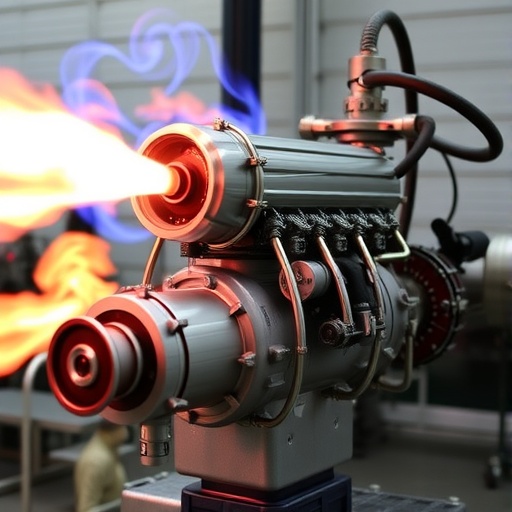
In the ever-evolving field of automotive engineering, hydrogen has emerged as a beacon of hope for sustainable transportation. As the world seeks alternatives to fossil fuels, the exploration of hydrogen as a viable fuel has gained momentum. A recent study conducted by Kinkhabwala, Krishna, Reppert, and their colleagues dives deep into the complexities of hydrogen as a fuel source in a unique context—specifically, examining backfire initiation and propagation in a single-cylinder hydrogen port-fuel-injection engine. This groundbreaking research combines experimental results with computational analysis, providing a multifaceted understanding of these critical phenomena.
The research begins by outlining the fundamental traits of hydrogen as a fuel. Hydrogen has the potential to reduce greenhouse gas emissions significantly. Its high energy content per unit mass and quick ignition characteristics make it an attractive alternative. However, these same properties also pose challenges to engine engineers, especially concerning stability and safety. In particular, the propensity for backfiring—an uncontrolled combustion event that can lead to performance issues and engine damage—serves as a focal point of this study, as researchers strive to unveil the underlying mechanisms.
Backfire, in this context, refers to a scenario where combustion occurs outside of the combustion chamber. This can be detrimental not only to the engine’s performance but can also pose safety risks. The researchers noted that when using hydrogen fuel, specific conditions could lead to an increased likelihood of backfire events, primarily due to its broad flammability range. Thus, understanding these conditions offers critical insights necessary for the development of future hydrogen-powered engines.
The study employs both experimental trials and computational simulations to analyze backfire events fundamentally. In the experimental phase, data was collected from a single-cylinder engine specifically designed for hydrogen port-fuel injection. The researchers meticulously documented various parameters, including temperature, pressure, and concentration ratios of hydrogen and air within the combustion chamber, to ascertain the exact conditions conducive to backfire initiation.
Computational modeling also played a crucial role in the study. Using cutting-edge technology, the researchers created simulations to predict the behavior of hydrogen combustion under diverse operational conditions. By integrating computational fluid dynamics (CFD) into their analysis, they aimed to simulate how backfire develops and propagates once it begins. This dual approach—experiment and simulation—allowed them to cross-verify their results and refine their understanding of the dynamics involved in backfire events.
The results of both the experimental and computational analyses yielded compelling insights. The researchers found that variables such as the fuel-air mixture ratio, cylinder pressure, and temperature were critical in determining the likelihood of backfire initiation. Their findings indicated that certain thresholds must be monitored to maintain optimal performance and prevent backfiring. This knowledge sets the stage for engineers to develop control strategies that can minimize the risk of such events in practical applications.
Furthermore, the study revealed that the configuration of the combustion chamber plays a pivotal role in backfire dynamics. Engine design traditionally influences combustion efficiency and emissions. However, for hydrogen engines, the unique properties of hydrogen demand a reevaluation of design principles to ensure safety and stability. As the researchers illustrated, adapting these designs could potentially mitigate backfire incidents, making hydrogen engines more viable for commercial use.
In a broader context, this research aligns with global trends towards decarbonizing transportation. As countries formulate stricter emissions regulations and aim to adhere to international climate agreements, developing reliable hydrogen-powered systems could significantly contribute to meeting these goals. The implications of this study stretch beyond mere academic interest, touching on real-world issues of energy transition and environmental sustainability.
The researchers also discuss the potential applications of their findings. Optimizations derived from their analysis could lead to the design of smarter, more efficient hydrogen engines—not only improving performance and longevity but also ensuring driver safety. As the engineering community continually seeks innovative solutions to meet the challenges posed by climate change, findings like these are crucial in paving the way for effective hydrogen technologies.
The study’s contributions extend into the realms of controlled combustion and emissions reduction. Understanding and predicting backfire is vital for engineers looking to harness hydrogen’s potential without compromising engine integrity or safety. By shedding light on the complex phenomena surrounding backfire initiation and propagation, the researchers are effectively positioning the automotive sector to embrace hydrogen technology more readily.
In conclusion, Kinkhabwala, Krishna, and Reppert’s research offers an essential perspective on hydrogen as an alternative fuel, illuminating challenges and solutions in controlling backfire in hydrogen engines. Their thorough investigation forms a cornerstone for further studies, which could eventually lead to the widespread adoption of hydrogen-powered vehicles, transitioning the automotive industry towards a more sustainable future. The need for clean, efficient energy sources has never been more pressing, and the insights provided by this study could very well shape the future landscape of automotive technology.
As automotive engineering advances towards a greener paradigm, continued collaboration between experimental research and computational modeling will be essential. This holistic approach fosters the development of innovative solutions while addressing the inherent risks associated with emerging fuel technologies. This research not only contributes to the academic body of knowledge but serves as a practical guide for engineers and manufacturers striving to overcome the hurdles presented by hydrogen fuel applications.
Cite Scienmag News
Denise Maddox. (January 25, 2026). Analyzing Backfire in Hydrogen-Powered Engines. Scienmag. https://scienmag.com/analyzing-backfire-in-hydrogen-powered-engines/
Denise Maddox. "Analyzing Backfire in Hydrogen-Powered Engines." Scienmag, 25 January 2026, https://scienmag.com/analyzing-backfire-in-hydrogen-powered-engines/. Accessed 6 September 2026.
Denise Maddox. "Analyzing Backfire in Hydrogen-Powered Engines." Scienmag. January 25, 2026. https://scienmag.com/analyzing-backfire-in-hydrogen-powered-engines/


