


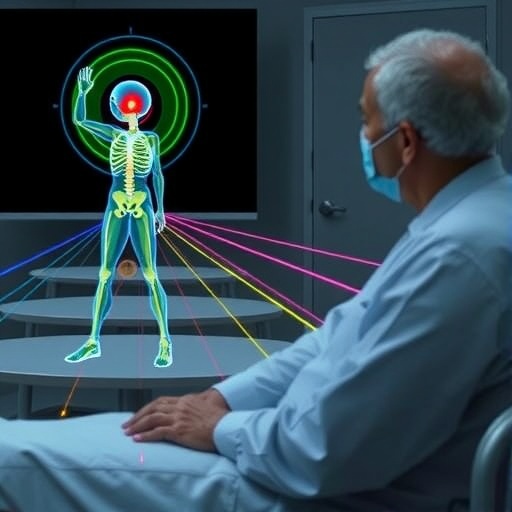
In a groundbreaking advancement poised to transform pediatric neurodevelopmental surveillance, researchers have unveiled an innovative, radar-based movement analysis system designed for outpatient settings. This pioneering technique offers a contactless, automated method to detect early motor irregularities in infants without any overt neurological symptoms. As neurodevelopmental disorders require early intervention for optimal outcomes, this tool promises a revolution in proactive pediatric care, emphasizing ease of use, repeatability, and non-invasiveness.
The impetus behind this study is the critical need for reliable, scalable screening modalities that can be repeatedly applied in outpatient environments without causing distress or requiring specialized operators. Traditional neurodevelopmental assessments often hinge on subjective observational scales or invasive, time-consuming procedures unsuitable for frequent monitoring. To address these limitations, the investigative team leveraged radar technology, which utilizes electromagnetic waves to capture movement data non-invasively and seamlessly.
Automated movement analysis through radar exploits the Doppler effect and wave reflections to quantify subtle motor activity signatures in real time. Unlike video-based methods, radar is impervious to low lighting, privacy concerns, and occlusions caused by clothing or blankets. These unique attributes render radar an ideal candidate for infant motor monitoring, enabling unobtrusive, repeatable evaluation even in busy outpatient clinics. The system continuously streams movement data, which proprietary algorithms then translate into a movement index, reflecting the infant’s motor function profile.
The technology’s validation involved a cohort of infants without overt neurological impairments, reinforcing its utility as a screening rather than a diagnostic tool. By establishing normative movement indices in this population, the research sets the groundwork for identifying deviations suggestive of neurodevelopmental risk. The automated radar system successfully captured frequency, amplitude, and pattern characteristics of spontaneous infant movements, parameters traditionally associated with the integrity of central motor pathways.
From a technical perspective, the radar device emits low-power microwave signals that scatter upon encountering the infant’s body. The returning signals bear frequency shifts proportional to movement velocities, which are recorded and processed using advanced signal processing techniques. Specifically, time-frequency analysis and machine learning algorithms distill these data into interpretable scores reflecting motor performance. This sophisticated interplay between hardware and software enables continuous, objective, and quantitative assessment without human bias.
Importantly, this contactless approach addresses common challenges with conventional methods such as the General Movement Assessment (GMA), which, while predictive, requires expert raters and video recordings under controlled conditions. Radar-based systems democratize screening by automating interpretation and reducing dependency on specialized personnel. Moreover, the method’s confinement to outpatient clinics enhances follow-up feasibility, allowing routine surveillance that can seamlessly integrate into standard pediatric visits.
Potential applications extend beyond initial screening; continuous movement monitoring may enable dynamic tracking of developmental trajectories, guiding clinical decision-making and early therapeutic interventions. In resource-limited settings where expert evaluators are scarce, radar-based tools can bridge gaps, providing objective data to primary care providers and facilitating referrals to specialists when warranted. This advancement thus holds substantial public health implications by augmenting early detection frameworks globally.
While promising, the research acknowledges limitations, notably the need for larger population studies to refine normative datasets and confirm predictive validity in infants with known neurodevelopmental disorders. Additionally, integration with electronic health records and user-friendly interfaces will be critical for widespread clinical adoption. Future work may incorporate multimodal sensors and explore wireless radar designs to enhance user experience.
The ethical dimension is addressed, emphasizing the non-invasive nature of radar waves, which employ safe, low-intensity emissions conforming to international safety standards. The contactless design alleviates infant discomfort and parent concerns associated with wearable devices or intrusive examinations, fostering greater compliance and acceptance among caregivers and healthcare providers.
This breakthrough aligns with broader trends harnessing artificial intelligence and sensor technologies to revolutionize clinical monitoring. By automating complex assessments, such systems reduce workload and augment precision medicine strategies. The convergence of radar engineering, computational algorithms, and pediatric neurology exemplifies interdisciplinary innovation targeting pressing clinical challenges.
In conclusion, the automated, contactless radar-derived movement index represents a paradigm shift in infant motor surveillance. Its ability to provide repeatable, objective, and non-intrusive screening offers a powerful tool for early identification of infants at risk for neurodevelopmental abnormalities. As the technology progresses towards commercialization and clinical integration, it stands to enhance early childhood healthcare, optimizing outcomes through proactive intervention.
This novel methodology also sparks excitement about future expansions into other neurological and developmental assessments across age groups. By continuously monitoring subtle motor function changes, clinicians may gain unprecedented insights into disease progression and treatment response. The fusion of next-generation radar sensing with data analytics signals a new era in neurodevelopmental diagnostics and monitoring.
The reported research underscores the vital importance of innovation in pediatric healthcare and sets a foundation for ongoing technological evolution. With continued validation and refinement, radar-based movement analysis could become a ubiquitous feature of well-baby visits worldwide, democratizing access to early neurodevelopmental risk detection and opening new avenues for personalized child health monitoring.
This advancement stands as a testament to the power of combining engineering ingenuity with clinical expertise to solve longstanding medical challenges. The introduction of automated radar-derived movement indices may ultimately shift paradigms, enabling far earlier recognition of motor difficulties and expediting access to interventions that improve lifelong trajectories for at-risk infants.
Cite Scienmag News
Harold Sullivan. (June 8, 2026). Radar-Based Contactless Movement Monitoring for Outpatients. Scienmag. https://scienmag.com/radar-based-contactless-movement-monitoring-for-outpatients/
Harold Sullivan. "Radar-Based Contactless Movement Monitoring for Outpatients." Scienmag, 8 June 2026, https://scienmag.com/radar-based-contactless-movement-monitoring-for-outpatients/. Accessed 4 September 2026.
Harold Sullivan. "Radar-Based Contactless Movement Monitoring for Outpatients." Scienmag. June 8, 2026. https://scienmag.com/radar-based-contactless-movement-monitoring-for-outpatients/


