


A call for collaboration to define the language in all AI related spaces, with a focus on ‘diverse intelligent systems’ that include AI (Artificial Intelligence), LLMs (Large Language Models) and biological intelligences is underway. The study was led by Cortical Labs – the biological computing startup that created ‘Dishbrain’ – and brought together scientists, ethicists and researchers from the United Kingdoms, Canada, USA, the EU, Australia and Singapore. Together they have proposed a pathway forward to unify the language in the rapidly growing and controversial area.

Credit: Cortical Labs
A call for collaboration to define the language in all AI related spaces, with a focus on ‘diverse intelligent systems’ that include AI (Artificial Intelligence), LLMs (Large Language Models) and biological intelligences is underway. The study was led by Cortical Labs – the biological computing startup that created ‘Dishbrain’ – and brought together scientists, ethicists and researchers from the United Kingdoms, Canada, USA, the EU, Australia and Singapore. Together they have proposed a pathway forward to unify the language in the rapidly growing and controversial area.
Whether progress is silicon-based such as the use of large language models, or through synthetic biology methods such as the development of organoids, a clear need for a community-based approach to seeking consensus on nomenclature is now vital.
Commenting on the collaboration, Brett Kagan, Chief Scientific Officer at Cortical Labs, said: “We’re extremely excited about collaborating with the industry on a study that is both timely and essential. Ultimately, the purpose of this collaboration is to create a critical field guide for researchers, across a broad range of fields, who are engaged in the development of diverse generally intelligent systems. In what is a rapidly evolving space, such a guide doesn’t yet exist.
Other scientists involved in the effort, such as Professor Ge Wang from RPI, USA share similar excitement: “Currently, multimodal multitask foundation models are under rapid development via digital communication but this approach is subject to major limitations. In this big picture, our proposed efforts will be instrumental.”
Toward a nomenclature consensus
Language used to describe specific phenomena for scientific and public discourse is complex and can be highly contentious for emerging science and technology. Rapidly growing fields aiming to create generally intelligent systems are controversial with disagreements, confusion, and ambiguity pervading discussions around the semantics used to describe this myriad of technologies.
Even 15 years ago, for example, at least 71 distinct definitions of “intelligence” had been identified. The diverse technologies and disciplines that contribute toward the shared goal of creating generally intelligent systems further amplify disparate definitions used for any given concept. Today it is increasingly impractical for researchers to explicitly re-define every term that could be considered ambiguous, imprecise, interchangeable or seldom formally defined in each paper.
A common language is needed to recognise, predict, manipulate, and build cognitive (or pseudo-cognitive) systems in unconventional embodiments that do not share straightforward aspects of structure or origin story with conventional natural species. Previous work proposing nomenclature guidelines are generally highly field specific and developed by selected experts, with little opportunity for broader community engagement.
It’s for this reason that researchers and scientists in related fields are being invited to collaborate, broadly agree upon, and adopt nomenclature for this field. The purpose of the work is to provide utility and nuance to the discussion and offer authors an option to use language explicitly, unambiguously, and consistently, insofar as rapidly emerging fields will allow, through the adoption of nomenclature adhering to a theory-agnostic standard.
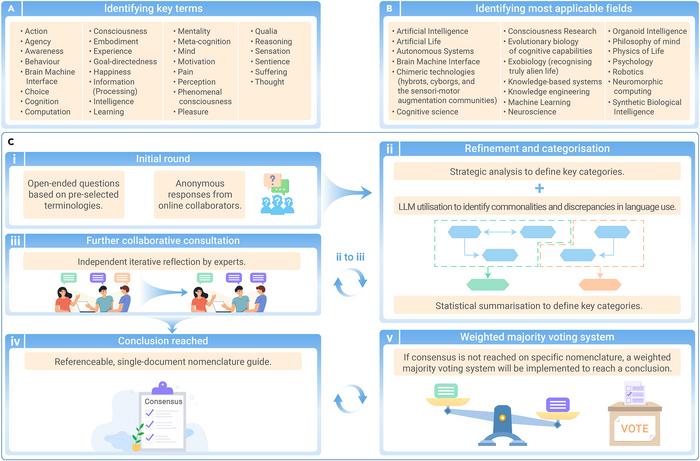
The collaboration will seek to define a non-exhaustive list of key terms (Figure 1A). The study to establish nomenclature consensus will be most applicable to a number of specific fields (Figure 1B) including, but not limited to, artificial intelligence, autonomous systems, consciousness research, machine learning, organoid intelligence and robotics. However, other fields beyond those listed may also derive value from the approach toward consensus.
The collaboration will be carried out using a mixed method approach with a modified Delphi method (Figure 1C). This approach entails an initial round with pre-selected open-ended questions (i), strategic refinement and categorisation (ii), and collaborative consultation (iii) in an iterative manner (ii and iii) until a suitable level of consensus is achieved (iv). If consensus is not reached on any specific terms, a weighted majority voting system will be implemented to reach a conclusion (v).
To participate, interested collaborators can register at:
Journal
The Innovation
Method of Research
Commentary/editorial
Subject of Research
People
Article Title
Toward a nomenclature consensus for diverse intelligent systems: Call for collaboration
Article Publication Date
17-Jun-2024
Cite Scienmag News
Drew Townsend. (July 30, 2024). An international effort to define intelligence, consciousness and more: efforts to create consensus definitions for diverse intelligent systems. Scienmag. https://scienmag.com/an-international-effort-to-define-intelligence-consciousness-and-more-efforts-to-create-consensus-definitions-for-diverse-intelligent-systems/
Drew Townsend. "An international effort to define intelligence, consciousness and more: efforts to create consensus definitions for diverse intelligent systems." Scienmag, 30 July 2024, https://scienmag.com/an-international-effort-to-define-intelligence-consciousness-and-more-efforts-to-create-consensus-definitions-for-diverse-intelligent-systems/. Accessed 3 September 2026.
Drew Townsend. "An international effort to define intelligence, consciousness and more: efforts to create consensus definitions for diverse intelligent systems." Scienmag. July 30, 2024. https://scienmag.com/an-international-effort-to-define-intelligence-consciousness-and-more-efforts-to-create-consensus-definitions-for-diverse-intelligent-systems/

