


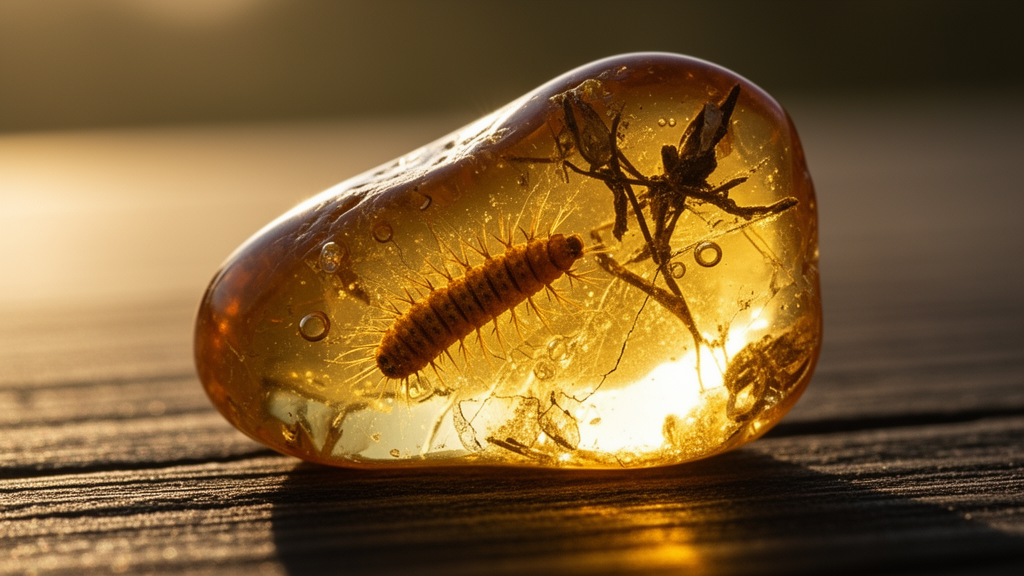
Three beetle larvae preserved in amber, two from roughly 100-million-year-old Cretaceous deposits in Myanmar and one from about 25-million-year-old Miocene amber in Mexico, are described in a new study as probable members of the beetle group Cucujiformia. Each of the tiny larvae carries prominent lateral processes fringed with specialised setae, a feature seen today in several unrelated cucujiform lineages such as handsome fungus beetles, pleasing fungus beetles, minute bark beetles and ladybird beetles. The fossils are reported in the journal Fossil Record, and their combination of characters does not match any single modern larva exactly, leaving their precise relationships an open question.
The specimens, catalogued as SNHMB.G 8195, SNHMB.G 8196 and PED 1955, are small. SNHMB.G 8195 measures about 1.86 millimetres in total body length, SNHMB.G 8196 about 2.47 millimetres and PED 1955 about 2.41 millimetres. All three have oval, dorso-ventrally flattened bodies that are parallel-sided in dorsal view, divided into an anterior head and a posterior trunk. The trunk is further differentiated into a three-segmented thorax with legs and a legless abdomen. In each specimen, the convex lateral edges of most thoracic and abdominal segments are drawn out into one lateral process per edge, and these processes bear distinctive hairs.
The documentation relied on high-resolution imaging. The fossil specimens were recorded on a Keyence VHX-6000 digital microscope against white and black backgrounds, using cross-polarised co-axial and low-angle ring light illumination, with images stitched into composites and processed with high dynamic range functions. For comparison, the researchers photographed three extant fungus-feeding larvae of the family Endomychidae, the handsome fungus beetles, held in the Coleoptera Collection of the Natural History Museum of Denmark in Copenhagen. These modern specimens, of Endomychus biguttatus, Endomychus coccineus and Eumorphus quadriguttatus, were shot with macro-photography equipment using cross-polarised twin flash and focus stacking.
Each fossil larva shows its own combination of details. SNHMB.G 8195, from the Mexican amber, has legs with five elements each, coxa, trochanter, femur, tibio-tarsus and claw, and its lateral processes carry tubercles with simple setae about 0.11 to 0.13 millimetres long. Its ninth abdominal tergite is fan-shaped without a medial indentation, a shape resembling that of modern larvae of Endomychus. SNHMB.G 8196, from Kachin amber, has elongated antennae with at least three elements and processes bearing fringed setae between 0.05 and 0.25 millimetres long; its ninth abdominal tergite appears almost bilobed, with a medially indented posterior rim reminiscent of modern larvae of Mycetina.
PED 1955, the second Kachin amber specimen, is the most slender of the three. Its ninth abdominal segment bears two cone-shaped posterior processes, possibly urogomphi, each about 0.09 millimetres long. Urogomphi are rare in extant larvae of Endomychidae, and the combination of a medially indented posterior rim with possible urogomphi appears unknown among living handsome fungus beetle larvae. The distal parts of these possible urogomphi instead resemble those of the larva of Omosita nearctica, a sap-feeding beetle of the family Nitidulidae. The dorsal surface of this fossil carries paired darker patches on all thoracic and the first eight abdominal tergites, within which small dark warts are discernible.
The identification as beetle larvae rests on a chain of morphological reasoning. The segmented body with a three-segmented, leg-bearing thorax and no wings, the absence of genitalia and compound eyes, and the lack of abdominal leg derivatives indicate immature stages of Holometabola, the insects with complete metamorphosis. A strongly sclerotised head capsule supports assignment to Coleoptera. Legs with five elements point to either Myxophaga or Polyphaga, but the absence of spiracle gills on the abdomen rules against Myxophaga. The flattened habitus with multiple trunk processes then resembles larvae of Cucujiformia, particularly within the supergroups Cucujoidea and Coccinelloidea, where such processes occur in Erotylidae, Cerylonidae, Coccinellidae and Endomychidae.
Because processes appear in several lineages of both Cucujoidea and Coccinelloidea, the authors consider it at least as likely that the different groups developed them independently through convergent evolution rather than inheriting them from a single common ancestor. Convergence is common among beetles, a group approaching 400,000 described species, in which rapid speciation has produced many lineages of similar overall morphology. When such species face similar selective pressures, similar traits can evolve repeatedly. The study therefore interprets the setiferous processes of the new fossils as features that arose in response to comparable ecological demands, rather than as evidence of a single origin.
The fossils also differ from modern Endomychidae in ways that complicate a firm family assignment. The fossil larvae are markedly smaller than extant larvae with comparable processes, and although the specimens may not all represent the same life stage, the size difference is obvious; the authors note that similar size differences over time have been described for larvae of other insect groups and for adults in Myanmar amber, so the fossils could be later-stage larvae of overall small-bodied animals. Each fossil has a differently shaped ninth abdominal tergite, and SNHMB.G 8196 resembles in some characters the ladybird beetle larva of Sticholotis ruficeps, though that modern species has a narrower, medially convex rather than indented tergite. The fossils may therefore belong to Endomychidae, to another process-bearing lineage, to one or more extinct lineages, or to early offshoots whose exact morphology no longer survives.
Ecologically, the picture is suggestive but not certain. Many extant cucujiform larvae with setiferous processes live in decaying wood infested with fungi, and some, including certain Endomychidae, are obligatory fungus-feeders specialising on single fungal species. The flattened body of such larvae lets them squeeze into small crevices, often directly under bark. The authors suggest the processes most likely served defence, such as camouflage, rather than hunting, since the larvae were probably not predatory; cloaking with fungal hyphae or spores is known from some modern Endomychidae, whose females even wrap hyphae around eggs for protection. On this basis, SNHMB.G 8195, which shares many characters with modern Endomychidae, can plausibly be presumed a fungus feeder, but for PED 1955 and SNHMB.G 8196 such a lifestyle cannot be firmly inferred, because some modern cucujiform larvae, notably ladybird beetles, can be mycophagous, plant-eating or predaceous.
The finds also fill gaps in the amber record. Kachin amber has already yielded a wide range of wood-associated ecological roles, from hard-wood and soft-wood borers to predators of wood-eating larvae and possible feeders on fungi-infested rotting wood, but the new larvae add a distinct appearance to the fungus-associated category. In Miocene amber, wood-associated larvae other than wood predators have so far rarely been reported, so recognising SNHMB.G 8195 as a possible wood-associated fungus feeder is an important amendment to that fauna. Adult Endomychidae are already known from Kachin amber, and while the evolutionary history of Coccinellidae has been traced back to the Cretaceous, no ladybird beetle fossil of that age is known, the oldest being an adult from Eocene French Oise amber, so any relationship of the new fossils to ladybird beetles must be interpreted carefully. The study concludes that the three larvae are an important addition to the Cretaceous and Miocene amber faunas, likely cucujiform larvae whose setiferous processes evolved convergently and probably aided defence, camouflage and, at least in some of them, feeding on fungi.
Subject of Research: Fossil beetle larvae with setiferous lateral processes from Cretaceous and Miocene ambers and their relationship to cucujiformian beetles
Article Title: Possible fungus-eating cucujiformian beetle larvae with setiferous processes from Cretaceous and Miocene ambers
Article References: Zippel, A., Haug, C., Elverdi, Z., Müller, P., & Haug, J. T. (2023). Possible fungus-eating cucujiformian beetle larvae with setiferous processes from Cretaceous and Miocene ambers. Fossil Record, 26(2), 191-207. https://doi.org/10.3897/fr.26.104553
Image Credits: AI Generated
DOI: 10.3897/fr.26.104553
Keywords: beetle larvae, Cucujiformia, Endomychidae, Kachin amber, Mexican amber, Cretaceous, Miocene, convergent evolution, fossil record, fungus feeding, setiferous processes, paleontology
Cite Scienmag News
Gavin Prescott. (October 27, 2026). Amber fossils reveal beetle larvae with bristly processes from Cretaceous and Miocene forests. Scienmag. https://scienmag.com/amber-fossils-reveal-beetle-larvae-with-bristly-processes-from-cretaceous-and-miocene-forests/
Gavin Prescott. "Amber fossils reveal beetle larvae with bristly processes from Cretaceous and Miocene forests." Scienmag, 27 October 2026, https://scienmag.com/amber-fossils-reveal-beetle-larvae-with-bristly-processes-from-cretaceous-and-miocene-forests/. Accessed 27 October 2026.
Gavin Prescott. "Amber fossils reveal beetle larvae with bristly processes from Cretaceous and Miocene forests." Scienmag. October 27, 2026. https://scienmag.com/amber-fossils-reveal-beetle-larvae-with-bristly-processes-from-cretaceous-and-miocene-forests/


