



view more
Credit: Tales Alves-Júnior et al., 2026.
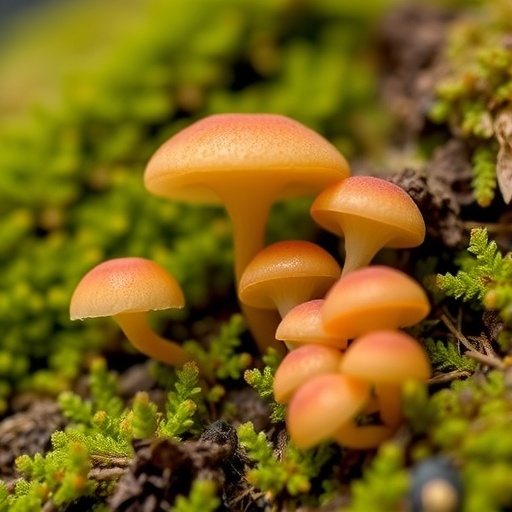
MANAUS, Brazil — A team led by researchers at the National Institute for Amazonian Research (INPA), in Manaus, has found evidence that the “zombie-ant” fungus (genus Ophiocordyceps), globally known for controlling ant behavior and forcing infected ants to bite onto plants before dying, also lives hidden inside mosses in the Amazon rainforest.
By analysing the DNA of mosses collected at the Ducke Reserve in Manaus, the scientists detected the same parasitic fungus present not only in infected and manipulated insects, but also in the mosses where the infected insect is manipulated to bite. This indicates that the fungus has one life stage as an insect parasite and another, endophytic (living inside the plant) stage that had gone unnoticed until now.
The genus Ophiocordyceps comprises more than 350 species of fungi known for infecting a wide range of insects. Some of these species are famous for a behaviour that sounds like science fiction: after infecting an ant, the fungus alters its behaviour and forces it to leave the colony, climb the vegetation, and clamp its mandibles onto a specific spot, the so-called “death grip,” shortly before dying and releasing its spores.
In 2020, studies in China had already shown that a species from the same genus, known as “Himalayan gold” (O. sinensis), lived endophytically in plants in alpine regions. The major breakthrough of this new INPA study is demonstrating this same dual lifestyle in fungi that manipulate the insect to specifically and consistently bite plants that harbor the endophytic stage of the “zombie fungus.” This suggests that the behavioral manipulation goes beyond the fungus-ant association, and that the plant harbouring the fungus’ endophytic phase may also possibly influence the manipulation itself.
The research was carried out at the Adolpho Ducke Forest Reserve, north of Manaus, and relied on metabarcoding, a technique that allows researchers to read the DNA of all fungi present in an environmental sample at once. The results revealed that the fungus was present not only in infected ants but also consistently in the surrounding mosses, including in plants located more than 10 metres away from any ant infected by the parasite.
In the Amazon, researchers had already noticed that some manipulated ant species predominantly seek out mosses to bite for the “death grip,” but little was known about a possible prior colonisation of the moss by the same insect-parasitising fungus. DNA analyses showed that even highly host-specialised fungal lineages, such as O. camponoti-nidulantis (infecting Camponotus nidulans) and O. kniphofioides (infecting Cephalotes atratus), were sheltered within bryophytes in the surrounding vegetation.
The discovery reshapes our understanding of the life cycle of these fungi and how these organisms evolve and survive. The ability to associate with plants may help the fungus persist through periods when insect hosts are scarce, and could also help explain the intriguing fidelity of certain fungal lineages to specific moss types.
“We have always thought of this fungus (Ophiocordyceps) as a parasite exclusive to insects, especially the ones it manipulates. What our data suggest is that the story is much larger: the same fungus appears to be ubiquitous in the surrounding moss communities. Our results illustrate a far closer link between the lifecycles of the plants and fungi involved in the behavioral manipulation of Amazonian ants.”
— Tales Alves Jr., biologist, Master’s in Botany from INPA and lead author of the study.
“The well-known behavioral manipulation caused by Ophiocordyceps may not result solely from the interaction between fungus and ant, but from a complex relationship among the fungus, its host, and the plant where the same fungus lives silently as an endophyte.”
— João Paulo Machado de Araújo, co-author and researcher at the Natural History Museum of Denmark (University of Copenhagen).
Journal
IMA Fungus
Article Title
Metabarcoding reveals a hidden endophytic stage of the ‘zombie-ant’ fungus in Amazonian mosses
Article Publication Date
14-Jul-2026
Katrin Jivkova
Pensoft Publishers
dissemination@pensoft.net
Office: 359-287-04281
Journal
IMA Fungus
Article Title
Metabarcoding reveals a hidden endophytic stage of the ‘zombie-ant’ fungus in Amazonian mosses
Article Publication Date
14-Jul-2026
Cite Scienmag News
Roger Howard. (July 30, 2026). Amazonian ‘zombie’ fungus harbors a hidden stage inside forest mosses, new study reveals. Scienmag. https://scienmag.com/amazonian-zombie-fungus-harbors-a-hidden-stage-inside-forest-mosses-new-study-reveals/
Roger Howard. "Amazonian ‘zombie’ fungus harbors a hidden stage inside forest mosses, new study reveals." Scienmag, 30 July 2026, https://scienmag.com/amazonian-zombie-fungus-harbors-a-hidden-stage-inside-forest-mosses-new-study-reveals/. Accessed 4 September 2026.
Roger Howard. "Amazonian ‘zombie’ fungus harbors a hidden stage inside forest mosses, new study reveals." Scienmag. July 30, 2026. https://scienmag.com/amazonian-zombie-fungus-harbors-a-hidden-stage-inside-forest-mosses-new-study-reveals/

