


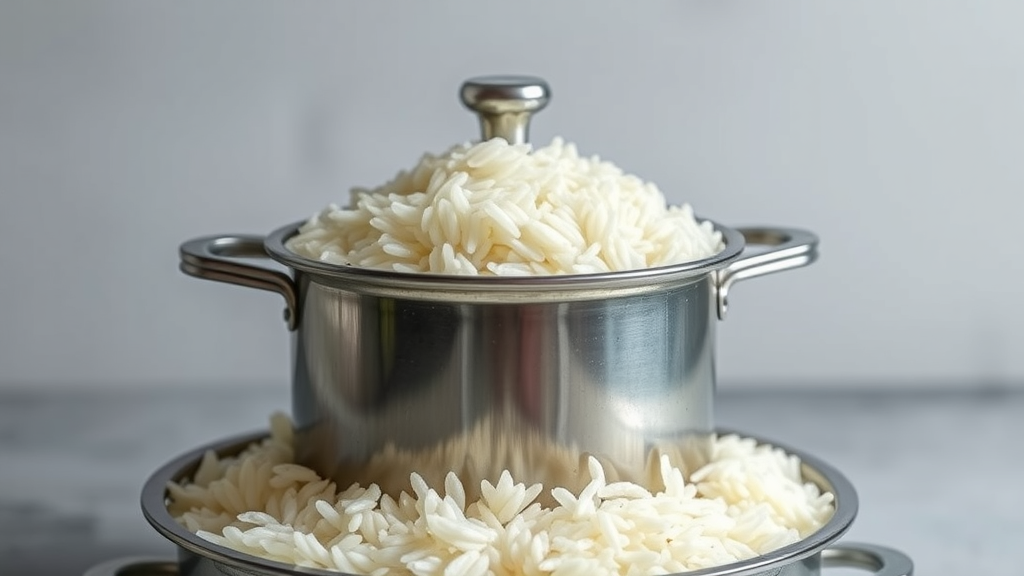
A humble pot of rice has delivered one of the most striking warnings yet about the cookware sitting in millions of kitchens. In a new pilot study conducted in Hyderabad, India, researchers found that plain white rice cooked in an uncoated aluminum vessel contained 19.83 milligrams of aluminum per 100 grams—roughly forty times more than identical rice prepared in stainless steel, copper, or earthenware pots, all of which came in below one milligram per 100 grams. The findings, published in the journal Discover Toxicology, quantify in sobering detail how a material prized for being lightweight, cheap, and conductive can quietly transform an everyday staple into a significant source of dietary metal exposure. For the food vendors, street cooks, and small restaurant workers who participated in the study, aluminum is not an occasional convenience but the default tool of their trade, used daily by more than four in five respondents.
The research team, led by Jerripothu Prema Kejiya, Koniki Lakshmi Jahnavi, and colleagues at institutions including Hindu College in Guntur and Manna Biotech Private Limited in Hyderabad, designed the investigation to bridge a persistent gap between laboratory measurements and real-world cooking behavior. Rather than relying solely on tightly controlled conditions, the researchers simulated ordinary household and commercial cooking: 100-gram portions of a single batch of long-grain white rice were boiled in 150 milliliters of tap water in four different pot materials until the water was absorbed, without standardizing heating time or temperature. No salt, spices, or other ingredients were added, precisely because these could confound the aluminum signal. The deliberately unpolished approach was intended to capture the variability of actual kitchens, where pots are worn, flames fluctuate, and nobody measures the pH of their dinner.
The analytical backbone of the study was inductively coupled plasma mass spectrometry, or ICP-MS, a technique capable of detecting trace metals at extraordinary sensitivity. Food samples were oven-dried at 100 degrees Celsius and then ashed in a muffle furnace at 550 degrees Celsius to destroy organic matter, leaving behind mineral residue that was dissolved in trace-metal-grade nitric acid. Calibration curves built from certified aluminum standards achieved linearity exceeding an R-squared of 0.999, while procedural blanks, spike-recovery experiments yielding recoveries between 90 and 110 percent, and detection limits in the low hundredths of a milligram per kilogram confirmed the reliability of the measurements. Every sample was analyzed in triplicate. When the numbers came back, the contrast between cookware types was so extreme that a one-way analysis of variance produced an F-statistic of 542.7 with a p-value below 0.0001 and an effect size, eta squared, of 0.99—meaning virtually all of the variance in aluminum content was explained by which pot the rice had been cooked in.
Health-risk contextualization makes those figures more alarming than they might first appear. The European Food Safety Authority has set a tolerable weekly intake of one milligram of aluminum per kilogram of body weight, equivalent to roughly 0.14 milligrams per kilogram per day. The authors note that under high-consumption scenarios, aluminum-cooked rice alone could approach or exceed those recommended limits. Not all of that aluminum reaches the bloodstream—gastrointestinal absorption of aluminum is typically low, around 0.1 to 0.3 percent—but chronic exposure even at sub-acute doses has been linked in the scientific literature to oxidative stress, interference with iron metabolism, neurotoxicity, bone disorders, and anemia. Aluminum has also been controversially implicated in neurodegenerative disease, with elevated levels reported in the brains of Alzheimer’s patients, although a causal relationship remains unproven. What is certain is that aluminum serves no beneficial function in the human body, making every avoidable source of exposure a reasonable target for reduction.
The study did not stop at laboratory rice. The researchers also collected four popular street foods from local vendors to gauge real-world contamination: stir-fried noodles and Manchurian dumplings packed hot into aluminum foil containers, a chocolate bar in its original foil wrapper, and chicken biryani cooked in large aluminum handi pots using the traditional dum steam method before being wrapped in foil for customers. Biryani showed the highest aluminum concentration at roughly five to six milligrams per 100 grams, followed by noodles and Manchurian at approximately two to three milligrams, while chocolate registered below one milligram. These single-sample measurements cannot statistically separate the contribution of cookware from aluminum naturally present in ingredients, a limitation the authors acknowledge candidly. But combined with the controlled rice experiment, they paint a coherent picture: both cooking vessels and food-contact packaging measurably enrich the food supply with aluminum, extending exposure beyond domestic kitchens into the commercial street-food economy that feeds millions of urban Indians daily.
Perhaps the most revealing dimension of the study, however, was behavioral. Alongside the chemical analysis, the team administered a structured questionnaire to 35 food vendors, street cooks, and small restaurant workers near their research institute. The demographic profile reflected the informal food economy: 54.3 percent male, mostly aged 18 to 60, with 45.7 percent holding secondary-school certificates and 31.4 percent undergraduate degrees, while 11.4 percent had no formal schooling at all. The vast majority, 85.7 percent, were self-employed food vendors. What emerged was a portrait of near-universal aluminum reliance paired with striking ignorance of its consequences. Fully 82.9 percent of respondents used aluminum cookware daily, yet only 48.6 percent were aware that aluminum could pose any health risk—and of those who were, a mere 5.7 percent could name a specific condition, loosely citing brain problems or Alzheimer’s disease. Sixty percent had never even considered switching to alternative materials.
The statistical analysis revealed a crucial psychological distinction that could reshape how public health campaigns are designed. Education level was significantly associated with awareness of aluminum risks, confirmed by a chi-square test (chi-squared = 10.91, p = 0.028) and a moderate positive Spearman correlation (r = 0.344, p = 0.045). But awareness alone showed only a weak, statistically insignificant relationship with actual cookware use (r = -0.26, p = 0.124)—knowing about a hazard, it turns out, does not by itself change behavior. The decisive variable was emotional: concern about aluminum toxicity exhibited a strong inverse correlation with frequency of aluminum use (r = -0.599, p < 0.001). In other words, perceived risk, not abstract knowledge, drives protective action. Participants who had switched away from aluminum typically did so after a trigger event—encountering new information through social networks or television—a finding consistent with behavior-change theory and a hopeful signal that well-aimed risk communication can measurably alter kitchen practices.
The physical evidence of degradation collected by the researchers lent visceral support to the analytical data. Nearly half of respondents, 45.7 percent, had noticed blackening, whitening, or surface pitting on their aluminum pots, and about 11.4 percent had actually weighed their utensils over time, documenting cumulative mass losses of 10 to 50 grams. That missing metal did not vanish into thin air; laboratory corrosion studies show that repeated boiling, salinity, and acidic foods accelerate the dissolution of the protective aluminum oxide layer, releasing ionic aluminum directly into food. The discoloration that vendors dismiss as normal wear-and-tear is, chemically speaking, the visible signature of the same leaching process quantified by ICP-MS. The authors suggest these observable cues could serve as powerful educational tools, connecting daily experience to an otherwise invisible chemical risk—if a pot is pitting and blackening, aluminum is ending up in the meal.
Why does aluminum remain so dominant despite these risks? The survey answers are soberingly practical: durability (31.4 percent), market availability (28.6 percent), and family habit (20 percent) were the leading reasons cited, followed by lack of awareness of alternatives (11.4 percent) and affordability (8.6 percent). Comparable economic drivers have been documented from Bangladesh to Egypt, and researchers have previously described aluminum cookware in developing countries as an unrecognized public health threat. The study’s policy prescriptions therefore extend well beyond education. The authors call for translated, relatable risk messaging—framing a single bowl of aluminum-pot rice as a substantial fraction of one’s weekly safe limit—alongside mandatory labeling of cookware alloy composition, migration standards modeled on European Commission Regulation No 1935/2004 for food-contact materials, and the incorporation of metal-exposure topics into food-handler training and municipal licensing. Structural interventions, including subsidized trade-in programs for stainless steel and support for traditional cast iron or earthenware, could address the economic logic that currently locks vendors into aluminum. The researchers also recommend simple protective habits: avoid cooking acidic or salty foods in aluminum, never store leftovers in aluminum pots, and discard old, pitted vessels. Future work should expand sample sizes, include baseline measurements of raw ingredients to enable precise source attribution, assess bioavailability rather than total content, and integrate biomonitoring of urinary or hair aluminum to confirm internal exposure. As a pilot study, its numbers are indicative rather than definitive—but the convergence of analytical, observational, and behavioral evidence makes a compelling case that one of the world’s most common cooking materials deserves far more regulatory and public attention than it currently receives.
Subject of Research: Aluminum migration from cookware into food and the behavioral determinants of cookware use among urban food vendors
Article Title: Dietary aluminum exposure from cookware uses and its association with behavioral determinants in an urban pilot study
Article References: Kejiya, J. P., Jahnavi, K. L., sai, G. K., Vadlamudi, S., Gudapati, S. L., Boddupalli, P., S, J. G., S, R. P., Munikumar, M., & B, C. K. (2026). Dietary aluminum exposure from cookware uses and its association with behavioral determinants in an urban pilot study. Discover Toxicology, 3(1), Article 11. https://doi.org/10.1007/s44339-026-00057-x
Image Credits: AI Generated
DOI: 10.1007/s44339-026-00057-x
Keywords: aluminum, cookware, food contamination, dietary exposure, heavy metals, ICP-MS, street food, risk perception, public health, food safety, pilot study, neurotoxicity
Cite Scienmag News
Alan Morgan. (September 12, 2026). Aluminum Pots Pump Dangerous Levels of Metal Into Everyday Rice, Study Warns. Scienmag. https://scienmag.com/aluminum-pots-pump-dangerous-levels-of-metal-into-everyday-rice-study-warns/
Alan Morgan. "Aluminum Pots Pump Dangerous Levels of Metal Into Everyday Rice, Study Warns." Scienmag, 12 September 2026, https://scienmag.com/aluminum-pots-pump-dangerous-levels-of-metal-into-everyday-rice-study-warns/. Accessed 5 October 2026.
Alan Morgan. "Aluminum Pots Pump Dangerous Levels of Metal Into Everyday Rice, Study Warns." Scienmag. September 12, 2026. https://scienmag.com/aluminum-pots-pump-dangerous-levels-of-metal-into-everyday-rice-study-warns/


