


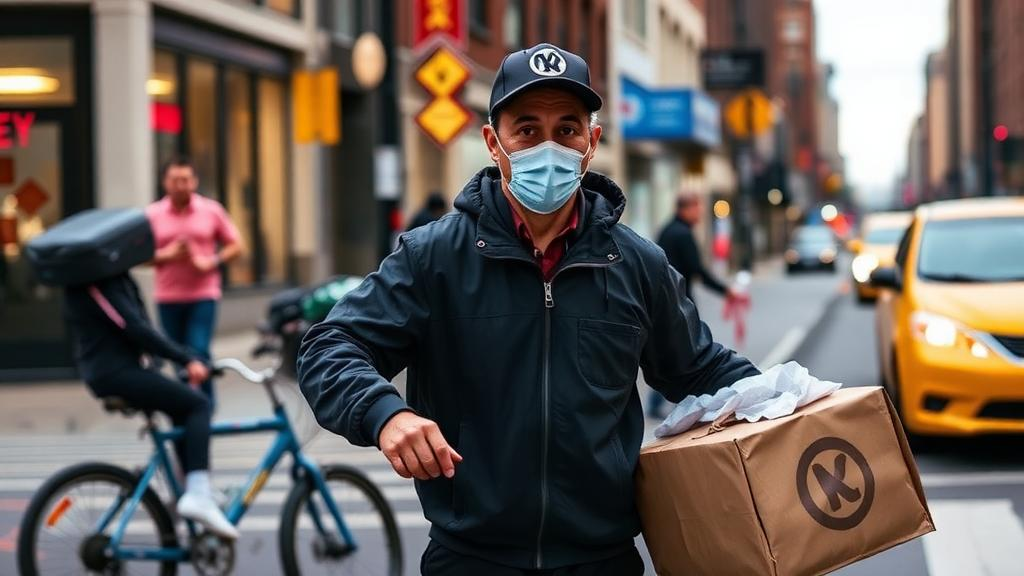
New York City’s app-based food delivery workers are sustaining injuries at a rate more than five times higher than the national average for delivery messengers, and four in ten meet the criteria for severe psychological distress, according to a new data brief from the CUNY Graduate School of Public Health and Health Policy (CUNY SPH), produced in partnership with the Worker’s Justice Project (WJP). The brief, titled Driven by Algorithms: Unsafe Work in NYC Food Delivery, draws on a 2026 survey of 561 delivery workers recruited across all five boroughs between March and May of that year. Its central finding is stark: more than half of the workers surveyed reported being injured on the job, and the researchers link that toll not simply to the hazards of riding through traffic, but to the way the delivery platforms themselves organize, monitor, and discipline the labor force.
The survey, conducted in French, Bangla, Spanish, and English, reached workers through recruitment led by WJP staff. Of 805 workers approached, 618 responded and 561 eligible workers consented and completed the questionnaire. The researchers are careful to note that the findings describe the workers surveyed and should not be interpreted as statistically representative of the entire citywide workforce. Even so, they point out that several results align with the most recent data and anecdotal evidence on the composition and experience of New York’s delivery workforce, a labor pool dominated by immigrants who depend almost entirely on platform income to support their families.
The numbers on algorithmic control are striking. More than 80 percent of respondents said the food delivery apps mostly or entirely determine how quickly orders must be completed, which routes workers take, and how many hours they work. That level of control, the authors argue, translates directly into risky behavior on the street. Two-thirds of workers said they rush to deliver on time in order to maintain high ratings, 56 percent said they work in bad weather, and 30 percent said they work even when they feel very sick. Each of these behaviors, from speeding between restaurants and apartments to riding through storms while ill, represents a pathway by which platform-managed incentives become physical harm.
The injury statistics quantify the consequences. Fifty-three percent of respondents reported a work-related injury, a figure the researchers convert to 48 injuries per 100 full-time equivalent workers, more than five times the national rate for delivery messengers. Forty-six percent of all respondents reported an injury serious enough to require medical care or to cause them to miss work. Compounding the danger, 30 percent of the workers surveyed said they lack health insurance, meaning that a single serious crash or assault can translate into unpayable medical debt on top of lost wages. For a workforce that keeps the city fed through all weather and all hours, the occupational safety net is thin to nonexistent.
Mental health outcomes were equally severe. Forty percent of surveyed workers met the criteria for severe psychological distress, a state of overwhelming mental burnout that requires urgent mental healthcare. That rate is five times the rate among adult New Yorkers overall and ten times the rate among working-age adults nationally. The authors emphasize that this distress is not an incidental byproduct of hard work but is shaped by the structural conditions of platform labor: intense work demands, little control over how the job is organized, and constant uncertainty about whether access to work will continue from one day to the next.
Violence and theft add further layers of risk. Thirty-six percent of surveyed workers reported having been physically assaulted while working, and 86 percent reported theft of equipment or belongings, with losses averaging about 2,100 dollars. For workers earning their living primarily through app-based delivery, the loss of an e-bike or a phone is not merely an inconvenience; it can mean the temporary loss of the ability to work at all, deepening the financial precarity that the survey documents throughout.
Perhaps the most consequential mechanism the study identifies is the threat of deactivation, the practice by which platforms cut off a worker’s access to the app and therefore to income. Fifty-two percent of workers said they worried about being deactivated if they did not deliver fast enough. Seventy percent had contacted an app about a deactivation issue in the previous month, but only 37 percent of those workers said the issue was resolved satisfactorily. When asked what they most wanted to change about their jobs, 56 percent chose protection from deactivation, more than any other option. Workers were especially supportive of two specific reforms: resolution of deactivation cases within 24 hours and 14 days’ advance notice before deactivation takes effect.
The dependence on platform income explains why deactivation looms so large. Ninety-six percent of surveyed workers said app delivery was their only job in the previous month, 98 percent earned at least half of their income from delivery, and 53 percent said delivery was their family’s only source of income. In practical terms, a deactivation notice is not a disciplinary footnote; it is the sudden removal of a household’s livelihood, often with little explanation and no timely avenue for appeal. The researchers argue that this precarity should be understood as an occupational exposure in its own right, one with measurable consequences for mental and physical health.
The study’s authors frame the findings in explicitly occupational health terms. “The toll we documented shows up both in injuries and in mental health,” said Mustafa Hussein, assistant professor at CUNY SPH and lead author on the brief. “More than half the workers we surveyed had been hurt on the job, and 40 percent have severe psychological distress. Understanding what drives those outcomes, including how the apps organize and monitor work, is essential to protecting the people who keep this city fed.” Senior author Nevin Cohen, professor at CUNY SPH and director of the CUNY Urban Food Policy Institute, added that when an app can cut off a worker’s income with little explanation and no timely way to resolve it, that constitutes a health issue as well as a labor issue, and that workers told the team clearly what they need first: deactivation cases resolved within 24 hours and advance notice before they lose access to their jobs.
Senior author Sherry Baron, professor at the Barry Commoner Center for Health and the Environment at CUNY Queens College and an occupational health physician and researcher, noted that from an occupational health perspective the risks these workers face are not limited to what happens on the street, and that intense work demands, little control over how the job is organized, and constant uncertainty about keeping access to work all shape workers’ health and deserve the same attention as more visible workplace hazards. Ligia Guallpa, executive director of the Worker’s Justice Project and a co-author, said delivery workers have long described how much is at stake when an app can limit or end their access to work, and that the findings show how widespread those concerns are and why workers want a clear, timely process when deactivation occurs. The brief was prepared by a team including Francesca Michielli, Mustafa Hussein, Sherry Baron, Nevin Cohen, Maria Figueroa, Ligia Guallpa, Emilia Vignola, Dana Calacci, Rositsa Ilieva, Yadira Sanchez, Zoey Laskaris, and Jacquelyn Sullivan, and represents a collaboration among CUNY SPH, the CUNY Urban Food Policy Institute, the Barry Commoner Center at Queens College, York College, the Worker’s Algorithm Observatory, the Worker’s Justice Project, and the Rockefeller Institute of Government, with support from the Robert Wood Johnson Foundation. As cities and states continue to debate minimum pay standards and due-process protections for gig workers, the study offers a detailed evidence base connecting algorithmic management to concrete health outcomes, and it gives worker advocates a specific, testable set of demands: fast resolution of deactivation cases and advance notice before access to work is terminated.
Subject of Research: Occupational health and algorithmic management of app-based food delivery workers in New York City
Article Title: NYC delivery workers injured at more than five times the national rate under intense labor control by the apps, survey finds
Article References: NYC delivery workers injured at more than five times the national rate under intense labor control by the apps, survey finds. (n.d.). Original publication
Image Credits: AI Generated
DOI: Not provided
Keywords: gig economy, delivery workers, occupational health, algorithmic management, deactivation, psychological distress, workplace injury, New York City, platform labor, CUNY SPH, Worker's Justice Project, labor rights
Cite Scienmag News
Blake Davidson. (October 2, 2026). Algorithmic Control Drives Injury and Distress Among NYC App Delivery Workers, Survey Finds. Scienmag. https://scienmag.com/algorithmic-control-drives-injury-and-distress-among-nyc-app-delivery-workers-survey-finds/
Blake Davidson. "Algorithmic Control Drives Injury and Distress Among NYC App Delivery Workers, Survey Finds." Scienmag, 2 October 2026, https://scienmag.com/algorithmic-control-drives-injury-and-distress-among-nyc-app-delivery-workers-survey-finds/. Accessed 4 October 2026.
Blake Davidson. "Algorithmic Control Drives Injury and Distress Among NYC App Delivery Workers, Survey Finds." Scienmag. October 2, 2026. https://scienmag.com/algorithmic-control-drives-injury-and-distress-among-nyc-app-delivery-workers-survey-finds/


