


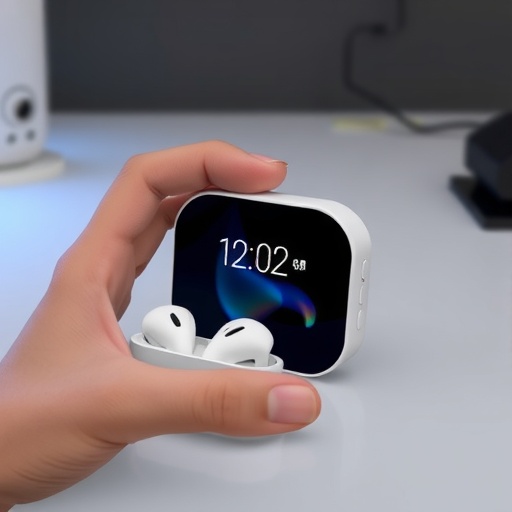
Researchers at the University of Illinois have developed a pocket-sized fluorescence reader that could bring laboratory-grade molecular testing closer to homes, clinics, and other settings far from centralized laboratories. Called VPodDuo, the wireless device is designed to analyze two samples at the same time: a patient sample and a control. Its compact housing is similar in size to an AirPods case, but inside it contains the optical and electronic components required to quantify fluorescent signals produced by sensitive diagnostic assays.
The device was developed by a team led by Han Keun Lee in the laboratory of electrical and computer engineering professor Brian Cunningham, in collaboration with bioengineering professor Xing Wang. Their findings, published in the IEEE Sensors Journal, describe the design and validation of a dual-port, smartphone-linked fluorimeter for rapid molecular diagnostic assays at the point of care. The research was supported by the National Institutes of Health and the U.S. Department of Veterans Affairs.
Many familiar home tests rely on labeled molecules that produce a visible line when they encounter a target substance. Pregnancy tests and some rapid infectious-disease tests use this approach because it is inexpensive, portable, and easy to interpret. However, line-based assays can have limited sensitivity and generally provide only qualitative or semi-quantitative information. Each new pathogen or biomarker may also require a separately designed test strip. Fluorescence-based testing offers a more flexible alternative because the intensity of emitted light can be measured quantitatively and, in some assays, amplified through highly specific molecular reactions.
Conventional fluorescence readers, however, are often poorly suited to use outside laboratories. They may be bulky, expensive, and dependent on trained operators. Some systems use cameras to image an entire reaction area, allowing the instrument to determine where a fluorescent signal appears and how strong it is. While powerful, camera-based systems require sophisticated optics, image processing, and alignment. The Illinois team instead built its reader around photodetectors, components that measure light intensity directly without capturing a spatial image. This design reduces the size and complexity of the instrument, although it also creates a challenge: a single detector cannot easily distinguish a patient result from a separate negative control.
The earlier VPod system addressed portability but could measure only one sample at a time. VPodDuo expands the concept with two optical ports, enabling simultaneous measurement of a test sample and a control sample. The paired configuration provides a reference against which the patient sample can be evaluated, helping compensate for variation in reagents, environmental conditions, and the performance of individual tests. By recording both signals under comparable conditions, the system can improve confidence in whether a measured fluorescence change reflects the biological target rather than an artifact of the testing process.
The instrument is compatible with molecular assays that generate green-emitting fluorescence. In these assays, fluorescent dyes or labeled probes respond to the presence or quantity of a specific genetic sequence or biomarker. The photodetectors convert the emitted light into electrical signals, which can then be analyzed by the device’s electronics. Because the optical reader is not limited to a single biological target, the same hardware may be used with different assay chemistries, provided they produce fluorescence within the system’s detection range.
In validation experiments, the researchers demonstrated that VPodDuo could detect and quantify genetic material associated with several medically important targets. These included Zika virus, HIV, and methicillin-susceptible Staphylococcus aureus, a bacterial species that can cause serious infections. The team also tested human genetic markers associated with the possible presence of cancer cells. The results indicate that the reader can support assays aimed at both infectious diseases and cancer-related biomarkers, although each application would still require its own validated molecular test and appropriate clinical studies before use in patient care.
The device was designed as part of a larger point-of-care system rather than as an isolated piece of laboratory equipment. VPodDuo connects wirelessly to a mobile device, where a software application guides the user through operation and assists with interpreting results. The system also includes safeguards intended to reduce accidental misuse, an important consideration when testing is performed by people without laboratory training. These features are intended to standardize the workflow, from inserting the assay and collecting the optical measurement to displaying the result.
The researchers emphasize that point-of-care testing is not necessarily meant to replace definitive diagnosis in a hospital or clinical laboratory. Its value may instead lie in making testing more frequent and accessible, allowing infections or disease-associated signals to be identified sooner and enabling patients to seek appropriate care without first overcoming the logistical barriers of a laboratory visit. Lee said the broader goal is to make advanced fluorescent molecular technologies practical beyond centralized facilities, potentially supporting earlier intervention for infectious diseases and improving access to emerging approaches for cancer detection. Further development and clinical validation will be needed to determine how VPodDuo performs across real-world samples, users, and testing environments.
News Publication Date: 21-May-2026
Web References: https://ieeexplore.ieee.org/document/11533642
References: IEEE Sensors Journal; DOI: 10.1109/JSEN.2026.3693175
Cite Scienmag News
Ophelia Keating. (August 7, 2026). AirPods-Sized Fluorescence Device Could Enable Timely At-Home Molecular Testing. Scienmag. https://scienmag.com/airpods-sized-fluorescence-device-could-enable-timely-at-home-molecular-testing/
Ophelia Keating. "AirPods-Sized Fluorescence Device Could Enable Timely At-Home Molecular Testing." Scienmag, 7 August 2026, https://scienmag.com/airpods-sized-fluorescence-device-could-enable-timely-at-home-molecular-testing/. Accessed 3 September 2026.
Ophelia Keating. "AirPods-Sized Fluorescence Device Could Enable Timely At-Home Molecular Testing." Scienmag. August 7, 2026. https://scienmag.com/airpods-sized-fluorescence-device-could-enable-timely-at-home-molecular-testing/


