


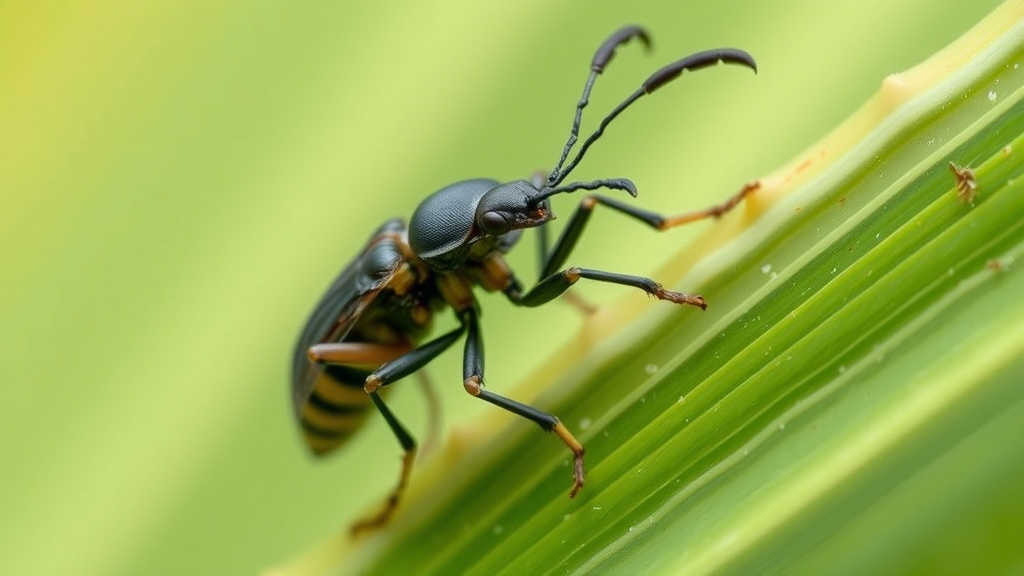
The red palm weevil is a silent assassin of palm trees. Its larvae tunnel deep inside the trunk, devouring the tissue that keeps the tree alive, and by the time visible symptoms appear on the outside, the damage is usually irreversible. Across tropical and subtropical regions, this single beetle species causes enormous economic losses in commercial palm plantations, and the main line of defense—pheromone traps baited with aggregation pheromones and food attractants—still depends on people opening traps and counting insects by hand. A new study published in Smart Agricultural Technology proposes a way to take humans out of that loop, using an attention-enhanced deep learning model that can spot the weevil reliably even inside cluttered, poorly lit trap images.
The research team, led by T. Vaikunta Pai with colleagues including G. Ramesh and Pareekshith G. Bhat, built their system around the YOLO family of object detectors, which have become the workhorses of real-time computer vision. Unlike older two-stage detectors such as Faster R-CNN, YOLO models localize and classify objects in a single forward pass through the network, making them fast enough for embedded monitoring hardware. The team started with YOLOv8, a recent version that introduced anchor-free prediction and decoupled detection heads—separate network branches for classification and bounding-box regression—which simplify training and improve feature learning.
But the researchers quickly ran into a problem familiar to anyone who has deployed object detection in the field: the baseline models that performed well on validation data stumbled on unseen images. Red palm weevils in trap photographs appear as small objects in cluttered scenes, often overlapping with other insects, debris, and reflections under shifting lighting. Many non-target insects, particularly certain flies and beetle species, look strikingly similar in size and shape. Models trained on limited, homogeneous datasets also generalize poorly, producing false detections and unstable performance when confronted with images they had never seen.
The team’s first response was to fix the data rather than the model. They assembled 531 original images from field observations and public sources, including 90 images of non-target insects deliberately included as contextual negative samples. Through systematic augmentation—brightness and contrast adjustments, horizontal and vertical flips, blurring, and lighting variations—they expanded the dataset 9.4-fold to 5,017 images containing 66,724 annotated weevil instances. All images were manually annotated on the Roboflow platform as a single-class detection task, with non-target insects left unlabeled so the model would learn to treat them as background. The data was split 80:10:10 into training, validation, and test sets.
With the refined dataset in hand, the researchers compared two lightweight YOLOv8 variants under identical conditions. The larger YOLOv8s achieved the higher precision, 98.14 percent, and the best mean average precision at an overlap threshold of 0.5, at 99.04 percent. But its recall of 93.91 percent meant it missed more weevils—a serious flaw in pest monitoring, where a single overlooked insect can signal the start of an infestation. The smaller YOLOv8n detected 97.77 percent of weevils while remaining light enough for real-time, resource-constrained deployment, making it the better-balanced foundation for further work.
The key innovation came next: the team integrated a Convolution Block Attention Module, or CBAM, into the YOLOv8n backbone. CBAM applies two attention mechanisms in sequence. The channel attention module pools feature maps with both global average and global max pooling, passes the results through a shared two-layer multilayer perceptron with a reduction ratio of 16, and uses a sigmoid function to produce weights that amplify informative feature channels while suppressing irrelevant ones. The spatial attention module then applies a 7-by-7 convolution to pooled spatial descriptors, generating a map that highlights the regions of the image most likely to contain the target. Four CBAM modules were inserted into the backbone, one immediately after each C2f bottleneck block, refining features before they reach the multi-scale fusion neck that combines P3, P4, and P5 resolution levels.
Training was carried out on Google Colab Pro+ with an NVIDIA Tesla A100 GPU, using stochastic gradient descent with an initial learning rate of 0.01, cosine decay scheduling, momentum of 0.937, and a batch size of 16 over 300 epochs, with early stopping after 50 epochs without improvement. The loss function combined three components: a Complete Intersection over Union loss for bounding-box regression that penalizes poor overlap, center distance, and aspect-ratio mismatch; binary cross-entropy losses for classification and objectness, which together push the model to assign high confidence only to genuine weevils and suppress false alarms in background regions.
The results showed exactly what the attention mechanism was designed to deliver. Precision jumped from 92.08 percent in the baseline YOLOv8n to 96.45 percent, a substantial reduction in false positives, while recall remained high at 96.80 percent. The stricter mAP@0.5:0.95 metric, which averages performance across increasingly demanding overlap thresholds, improved from 73.59 to 75.35 percent, indicating better localization accuracy. In qualitative tests on unseen trap images, the model localized weevils across different container types, lighting conditions, and insect densities, producing cleanly separated bounding boxes in moderate scenes and remaining mostly accurate even in densely clustered images where severe occlusion caused occasional confidence fluctuations.
The study is candid about its limits. Under extreme lighting, motion blur, partial occlusion, and the presence of lookalike insects, the model sometimes missed detections or produced slightly imprecise boxes, and the authors note that lightweight detectors still struggle in genuinely hostile visual conditions. They also acknowledge that no dedicated ablation study isolated the individual contributions of augmentation versus negative samples, and that alternative CBAM placements, module counts, and kernel sizes were not compared. Future work will address both gaps.
Even so, the achievement is significant for precision agriculture. Compared with representative attention-enhanced and pest-detection models in the literature, the proposed YOLOv8n-CBAM achieved a competitive 98.83 percent mAP@0.5 while keeping the computational footprint small enough for practical trap-based monitoring. By automating the counting of weevils in pheromone traps, the system could enable continuous population tracking and early-warning alerts across plantations, guiding timely decisions about trap optimization, sanitation, biological control, and pesticide use. For an industry battling a pest that kills from the inside out, giving the machines an attentive eye may be the earliest warning palm growers can get.
Subject of Research: Attention-enhanced deep learning detection of red palm weevils in pheromone trap images
Article Title: Attention-enhanced YOLOv8n-CBAM for robust RPW detection in trap-based environments
Article References: Pai, T. V., Ramesh, G., Bhat, P. G., Hegde, V., Sathwik, S., & Kumar, S. (2026). Attention-enhanced YOLOv8n-CBAM for robust RPW detection in trap-based environments. Smart Agricultural Technology, 15, Article 102573. https://doi.org/10.1016/j.atech.2026.102573
Image Credits: AI Generated
DOI: 10.1016/j.atech.2026.102573
Keywords: red palm weevil, YOLOv8, CBAM, attention mechanism, object detection, deep learning, pheromone traps, pest monitoring, precision agriculture, computer vision, Smart Agricultural Technology, palm plantations
Cite Scienmag News
Alan Morgan. (September 25, 2026). AI With an Eye for Detail Catches the Palm-Killing Weevils That Humans Miss. Scienmag. https://scienmag.com/ai-with-an-eye-for-detail-catches-the-palm-killing-weevils-that-humans-miss/
Alan Morgan. "AI With an Eye for Detail Catches the Palm-Killing Weevils That Humans Miss." Scienmag, 25 September 2026, https://scienmag.com/ai-with-an-eye-for-detail-catches-the-palm-killing-weevils-that-humans-miss/. Accessed 4 October 2026.
Alan Morgan. "AI With an Eye for Detail Catches the Palm-Killing Weevils That Humans Miss." Scienmag. September 25, 2026. https://scienmag.com/ai-with-an-eye-for-detail-catches-the-palm-killing-weevils-that-humans-miss/


