


A randomized controlled trial conducted in the hills of Lebanon’s Chouf region has found that three months of Transcendental Meditation practice significantly improved psychological well-being among rural women living under sustained social, economic and environmental pressure. The study, published in the peer-reviewed journal Women’s Health, reported that women who learned the technique showed greater gains in happiness, resilience and self-efficacy, along with larger reductions in perceived stress, than women assigned to an active control condition. The differences between the two groups were statistically significant at p ≤ .001 on every measure the researchers assessed, a level of consistency across outcomes that the investigators describe as unusually encouraging for a behavioral intervention of this kind.
The trial enrolled 114 women drawn from approximately 20 villages across the Chouf region, an area whose residents have contended with continuing economic instability, political unrest and environmental challenges in recent years. Researchers from Maharishi International University in Fairfield, Iowa, randomly assigned participants either to learn the Transcendental Meditation technique or to an active control group that received weekly videos on self-development and well-being. The use of an active control condition matters methodologically: rather than comparing meditators against people receiving nothing, the design allowed the team to compare the effects of learning the meditation technique against participation in another structured activity explicitly aimed at self-improvement, strengthening the case that the observed changes were attributable to the practice itself rather than to attention, expectation or the passage of time.
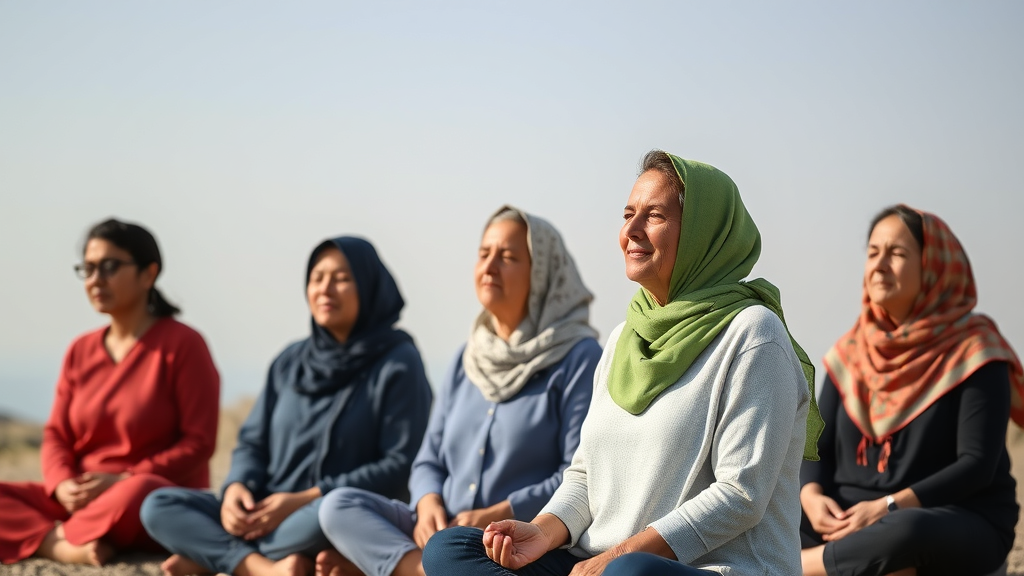
Participants in the meditation group were instructed to practice for 20 minutes twice a day, sitting comfortably with their eyes closed. Adherence proved remarkably high for a community-based trial. Sixty percent of the women reported practicing twice daily every day or most days, 18 percent practiced once a day, and 20 percent practiced irregularly. No harmful events related to participation were reported during the study period. The researchers say this combination of high adherence and an absence of adverse events is notable, particularly given that the participants were navigating daily lives shaped by chronic stressors rather than volunteering from a leisure-rich, low-stress population.
After three months, the meditation group outperformed the control group on all four outcome measures. Happiness showed the largest change of the four. Women practicing the technique reported increases in happiness at both the one-month and three-month assessments. The control group followed a different trajectory: a small improvement at one month, followed by a marked decrease at three months. The researchers suggest this divergence is meaningful because it indicates that the benefits of the meditation practice did not merely fade or plateau but appeared to consolidate over the study period, while the initial boost seen in the control condition reversed by the end of follow-up.
The statistical analysis also probed which factors were most closely tied to happiness. The team found that self-efficacy and perceived stress were both significantly related to happiness levels, and in their model self-efficacy emerged as the strongest predictor, followed by perceived stress. Together, the two variables accounted for 42 percent of the variance in happiness, a substantial share for psychological research of this kind. Self-efficacy, defined as a person’s perception of their ability to achieve desired results through their own actions, increased over the three months in the meditation group while decreasing in the control group. The researchers argue that this pairing of rising self-efficacy and falling perceived stress is particularly important because both variables were independently linked to happiness in their analysis, pointing to a plausible mechanism through which the practice may exert its effects.
Marie Loiselle, PhD, principal investigator and a researcher in the Department of Maharishi Vedic Science at Maharishi International University, emphasized the strength of the trial’s methods and the breadth of its results. She described the study as significant given its randomized controlled design and the statistically significant changes observed on every measure, noting that it is very encouraging because the women improved across several dimensions of psychological well-being at the same time. In her view, the results suggest that Transcendental Meditation may offer these women an additional way to cope with the significant pressures they face in daily life. Frederick Travis, PhD, who served as statistician and senior advisor on the study, highlighted the same two variables from a different angle. He said the improvements in self-efficacy and the reductions in perceived stress are particularly important because both were related to happiness in the analysis, adding that the findings provide a basis for further research into approaches that may help people cope with persistent environmental stress.
The choice of population was deliberate. The researchers note that women in Lebanon can face multiple, overlapping sources of stress, including economic instability, political unrest, environmental problems and gender inequality. Previous research has also identified cultural and social barriers that may discourage some people from seeking professional help for stress and related psychological difficulties, meaning that low-barrier, self-administered practices could fill a gap where conventional mental health services are difficult to access or socially stigmatized. The trial itself grew out of a community program: the researchers worked in collaboration with the Ladies Foundation for Pure Knowledge, which was nearing the end of a project to teach Transcendental Meditation to approximately 1,000 women in the Chouf region. The foundation approached the research team to investigate whether the practice was producing measurable benefits among the women learning it, turning an ongoing outreach effort into an opportunity for rigorous evaluation.
Susan Hamza, the foundation’s director, reflected on the scale of the response among participants in the broader teaching project. She said that so many of the participants told her their life had been transformed in many ways that words could not even begin to describe, and that those involved in realizing the project have her deep gratitude. Such testimonies are, by themselves, anecdotal, but the trial’s quantitative results give that community enthusiasm an empirical footing: the measured changes in happiness, resilience, self-efficacy and perceived stress among the 114 trial participants aligned with the direction of the reports coming out of the larger teaching program.
The study was approved by the Maharishi International University Research Institute Review Board and registered with the U.S. Clinical Trials Registry under identifier NCT05836129. Funding was provided by the Ladies Foundation of Pure Knowledge in Lebanon and by individual donors, and the authors reported no potential conflicts of interest. The research method was classified as a randomized controlled trial, and the subject population consisted of people rather than clinical samples recruited through hospitals, which the authors present as a strength when studying well-being in community settings.
The investigators are careful to frame the findings as a beginning rather than a conclusion. Of the 114 women who enrolled, 83 completed both posttests, and participants were followed for only three months, leaving open questions about durability and about whether the effects would hold in larger and more diverse samples. The team recommends future studies with six- or 12-month follow-up periods and larger populations in Lebanon and potentially elsewhere in the Middle East, where chronic, population-level stressors are common and scalable, low-cost interventions for psychological resilience are in short supply. If the results are confirmed, the researchers suggest, a technique that requires no equipment, no clinical setting and only 40 minutes a day could become a practical complement to existing efforts to support mental well-being in communities under sustained pressure. Transcendental Meditation itself is described by its practitioners as a simple, natural technique that does not involve concentration, control of the mind, contemplation or monitoring of thoughts or breathing, and that allows the active thinking mind to settle into a state of inner calm, characteristics that may help explain both the high adherence observed in the trial and the feasibility of extending the approach to other stressed populations.
Subject of Research: Effects of Transcendental Meditation on psychological well-being in rural Lebanese women
Article Title: Randomized trial finds Transcendental Meditation improves happiness, resilience and self-efficacy in rural Lebanese women
Article References: Randomized trial finds Transcendental Meditation improves happiness, resilience and self-efficacy in rural Lebanese women. (n.d.). Original publication
Image Credits: AI Generated
DOI: Not provided
Keywords: Transcendental Meditation, randomized controlled trial, Lebanon, rural women, happiness, resilience, self-efficacy, perceived stress, mental health, Women's Health journal, Maharishi International University, psychological well-being
Cite Scienmag News
Courtney Benton. (September 25, 2026). Three Months of Meditation Lifts Happiness and Resilience in Rural Lebanese Women, Trial Finds. Scienmag. https://scienmag.com/three-months-of-meditation-lifts-happiness-and-resilience-in-rural-lebanese-women-trial-finds/
Courtney Benton. "Three Months of Meditation Lifts Happiness and Resilience in Rural Lebanese Women, Trial Finds." Scienmag, 25 September 2026, https://scienmag.com/three-months-of-meditation-lifts-happiness-and-resilience-in-rural-lebanese-women-trial-finds/. Accessed 4 October 2026.
Courtney Benton. "Three Months of Meditation Lifts Happiness and Resilience in Rural Lebanese Women, Trial Finds." Scienmag. September 25, 2026. https://scienmag.com/three-months-of-meditation-lifts-happiness-and-resilience-in-rural-lebanese-women-trial-finds/


