


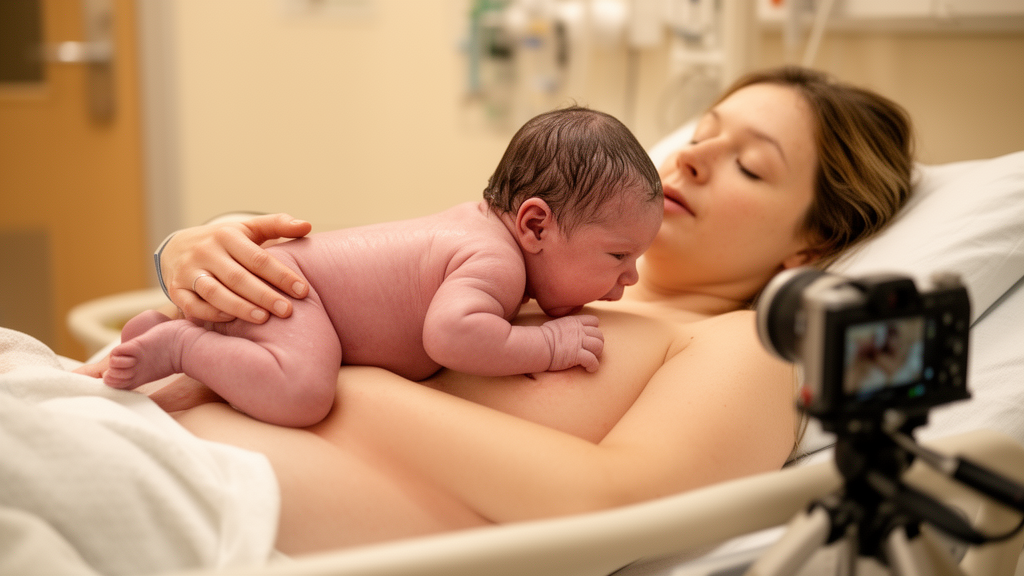
A deep learning model that watches a newborn’s first journey to the breast may offer an objective way to identify infants whose instinctive breast crawl is impaired, according to a proof-of-concept study conducted at a single tertiary hospital. The breast crawl is an instinctive sequence of behaviors that allows a newborn, when placed skin-to-skin on its mother’s abdomen, to move toward and attach to the nipple. Timely initiation of breastfeeding depends on this process, yet current assessment relies on subjective endpoint observation, which cannot provide an early, objective measure of crawl competency or support timely intervention for at-risk mother-infant dyads.
In the prospective observational study, researchers recruited 114 full-term mother-newborn dyads and video recorded their breast crawl sessions. Thirty neonatal behaviors were annotated using an extended Widström framework, a structured scheme for describing the stages of newborn behavior during the crawl. Because the model operates on the complete recorded episode, up to the first suckling, it performs retrospective characterization of crawl competency rather than prospective prediction. The team built a two-stage framework. First, a three-dimensional convolutional neural network, or 3D-CNN, recognized the 30 neonatal behaviors from multichannel video combining RGB, pose, edge, and depth information, producing an action timeline for each session. Second, 75 behavioral descriptors derived from that timeline were combined with 65 perinatal clinical variables in a fully connected network to predict a five-level competency grade. Shapley Additive Explanations, or SHAP, was then used to rank feature contributions.
Among the 114 newborns, who had a mean birth weight of 3,185 grams, the model showed moderate overall discriminative ability. It identified high-risk infants with F1-scores of 0.82 for Grade 3, meaning crawling without reaching the nipple, and 0.67 for Grade 4, meaning no crawling at all. Performance for the rare Grade 2, reaching the nipple without attempting to suckle, was inconclusive because only three newborns fell into that category. On a held-out test set of 20 newborns, the model achieved a macro-average area under the curve of 0.77 and a micro-average AUC of 0.81. In a post-hoc binary analysis aligned with the intended clinical use, comparing Grades 3 and 4 against Grades 0 to 2, sensitivity was 1.00, with a 95 percent confidence interval of 0.69 to 1.00, specificity was 0.70, with a confidence interval of 0.35 to 0.93, and accuracy was 0.85, with a confidence interval of 0.62 to 0.97. The confidence intervals were wide throughout, reflecting the small test set.
The SHAP analysis offered a behavioral window into what the model found informative. An earlier onset of hand-to-perioral activity was among the most salient features associated with better crawl competency, while a shorter interval between maternal pethidine administration and delivery ranked among the most salient features associated with poorer competency. These findings suggest that the timing of specific newborn movements, and certain perinatal drug exposures, carry measurable signals about how competently an infant completes the crawl, though the associations are exploratory.
The authors are careful to frame the work as preliminary and hypothesis-generating. The estimates derive from a single center, the test set was small, and the feature selection procedure was not nested, meaning it was not fully embedded within the validation scheme in a way that would guard against optimistic performance estimates. Grade 2 could not be evaluated at all because of its rarity in the sample. Before any clinical application, the team states that external validation with a prespecified nested analysis plan is required.
Even with those caveats, the study points toward a concrete technical path for making breast crawl assessment less subjective. Rather than relying on an observer’s judgment of whether a crawl reached its endpoint, the pipeline converts a recorded session into a timeline of recognized behaviors, distills that timeline into quantitative descriptors, and merges them with clinical variables to produce a graded competency estimate. If validated externally, such a system could serve as an objective adjunct for identifying neonates at risk of impaired breast crawl, giving clinicians an early, reproducible measure to complement observation of mother-infant dyads during the critical first hours of breastfeeding.
Subject of Research: A deep learning video analysis model for automated, graded assessment of neonatal breast crawl competency and identification of at-risk newborns.
Article Title: A deep learning model for automated assessment of neonates at risk of impaired breast crawl: a proof-of-concept video-based study
Article References: Xiang, Z., Tong, Y., Chen, Y., Xiong, A., Shi, X., & Luo, B. (2026). A deep learning model for automated assessment of neonates at risk of impaired breast crawl: a proof-of-concept video-based study. Frontiers in Public Health, 14, Article 1908206. https://doi.org/10.3389/fpubh.2026.1908206
Image Credits: AI Generated
DOI: 10.3389/fpubh.2026.1908206
Keywords: deep learning, breast crawl, neonates, breastfeeding, video analysis, 3D-CNN, Widström framework, SHAP, newborn behavior, proof-of-concept, observational study, perinatal variables
Cite Scienmag News
Harold Sullivan. (October 26, 2026). AI Video Analysis Flags Newborns at Risk of Impaired Breast Crawl. Scienmag. https://scienmag.com/ai-video-analysis-flags-newborns-at-risk-of-impaired-breast-crawl/
Harold Sullivan. "AI Video Analysis Flags Newborns at Risk of Impaired Breast Crawl." Scienmag, 26 October 2026, https://scienmag.com/ai-video-analysis-flags-newborns-at-risk-of-impaired-breast-crawl/. Accessed 26 October 2026.
Harold Sullivan. "AI Video Analysis Flags Newborns at Risk of Impaired Breast Crawl." Scienmag. October 26, 2026. https://scienmag.com/ai-video-analysis-flags-newborns-at-risk-of-impaired-breast-crawl/


