


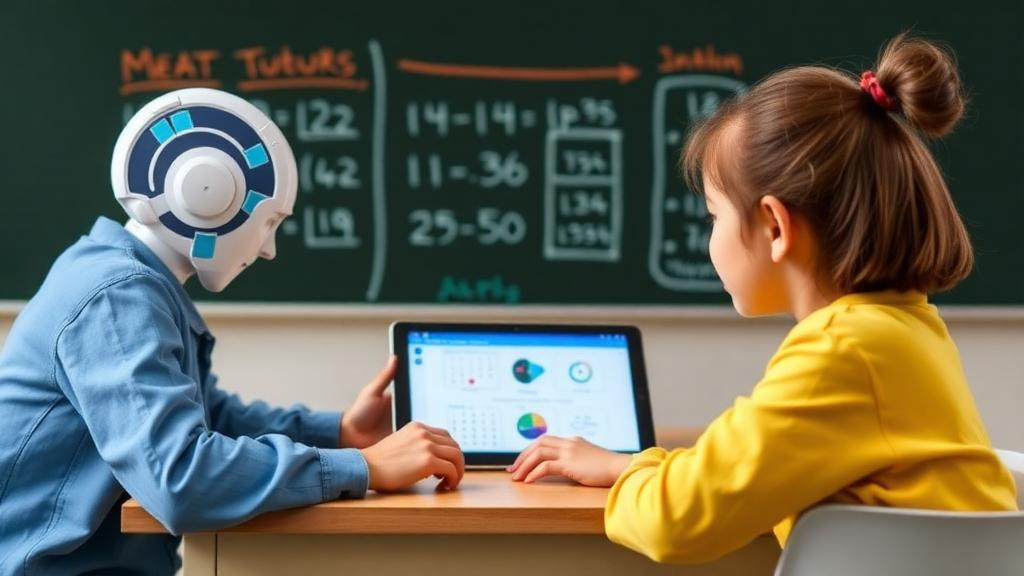
Artificial intelligence has been promised as a classroom revolution for more than a decade, yet rigorous evidence about what actually happens when young children learn mathematics with these systems has remained surprisingly thin. A new multi-year study from Radboud University in the Netherlands now offers one of the most detailed long-term pictures to date, and its conclusion is both encouraging and sobering. Primary school pupils who worked with an AI-supported adaptive learning tool learned arithmetic more quickly than children who did not, but the effects were modest, and the researchers are emphatic that no algorithm can replace the person standing at the front of the room. The study, published in the journal Learning and Instruction, tracked nearly eight thousand Dutch children over three years, making it one of the first investigations to capture the long-term cognitive consequences of adaptive learning technology at this scale.
The research team, led by education researcher Susanne de Mooij, examined the development of numeracy skills among 7,885 primary school pupils during the period between 2014 and 2017, when adaptive learning systems were first being introduced in Dutch classrooms. The design was observational and comparative: classes that used an adaptive learning system for their mathematics instruction were matched against classes that taught numeracy through conventional means, without such software. The researchers then followed the mathematical growth of both groups across multiple school years, asking a deceptively simple question. Do children who practice arithmetic with software that continuously adjusts to their ability level actually progress faster than children who do not?
The technology at the heart of the study is conceptually elegant. An adaptive learning system automatically calibrates the difficulty of each exercise to the individual pupil working through it. When a child answers correctly and consistently, the system serves up more challenging problems, pushing the child forward along their own learning curve. When a child begins to struggle, the software responds by offering simpler tasks, allowing the pupil to consolidate foundational skills before moving on. In theory, this creates a continuously optimized learning trajectory for every child in a class, something that a single teacher managing thirty pupils simultaneously can only approximate with the greatest effort.
The results showed that, on average, pupils who used the adaptive system displayed more positive growth in their mathematics performance over the years of the study compared with pupils who learned without it. In cognitive terms, the feared scenario simply did not materialize. This matters because a persistent worry has shadowed digital learning tools since their arrival: that screen-based practice is somehow less effective than working with paper and pencil, and that children exposed to it learn less deeply. De Mooij and her colleagues found no support for that fear in the domain of arithmetic. If anything, the digital environment produced a small but consistent advantage in how quickly children’s numeracy skills developed.
It is precisely the longitudinal character of the study that gives this finding its weight. According to De Mooij, most previous research into adaptive learning systems has either measured only short-term effects or been conducted on much smaller samples, leaving educators and policymakers to make decisions about expensive technology on the basis of limited evidence. Adaptive learning platforms have now been in use for almost fifteen years, and today they operate in more than half of all Dutch primary schools. That widespread adoption, she notes, has run well ahead of the scientific evaluation of the tools, a situation this study begins to correct by tracking skill development over years rather than weeks.
The researchers are careful, however, to resist any temptation toward triumphalism. The effects they measured are small, and De Mooij stresses that the tool should be understood as producing a generally positive trend rather than a dramatic transformation. There is no miracle cure here, no software that will suddenly close achievement gaps on its own. What the data do reveal is a pattern of modest, reliable benefit, the kind of incremental improvement that, multiplied across thousands of classrooms and hundreds of hours of practice, can meaningfully shape how a generation of children acquires foundational mathematical skills.
Perhaps the most socially significant finding concerns where those benefits concentrate. The positive effect of the adaptive technology was particularly evident in large schools and in vulnerable schools serving many pupils from less advantaged socio-economic backgrounds. De Mooij offers a plausible mechanism: in such settings, there is often greater variation between pupils in their starting levels and learning paces. A conventional whole-class lesson must aim somewhere near the middle of that distribution, leaving the weakest and strongest learners underserved. Adaptive technology, by contrast, can tailor instruction to each individual child’s needs, and the wider the spread of abilities in a classroom, the more valuable that tailoring becomes. In this sense, the technology appears to function as an equity instrument, delivering its largest gains precisely where educational disadvantage is most concentrated.
This framing leads directly to the study’s central message about the role of the teacher. The researchers describe the adaptive learning tool as something that supports teachers rather than replacing them, and they are explicit about why. A single teacher cannot adapt lesson content to thirty pupils at the same time, but with a tool of this kind, pupils’ mathematics skills can be improved while the teacher’s workload is simultaneously reduced. The software absorbs the mechanical burden of individualizing practice, freeing the professional to do the things that only a professional can do. In classrooms under pressure, that dual benefit, better outcomes and less administrative strain, may prove to be the technology’s most persuasive selling point.
Crucially, the researchers insist that the teacher always remains in control of the learning process. It is the teacher who draws up the lesson plan, who decides what pupils learn, and who oversees everything that happens in the classroom. The adaptive system, for all its algorithmic sophistication, is fed solely by the data stored within it, whereas a teacher has access to vastly richer information: a child’s mood on a difficult morning, the social dynamics of the room, the moment when a frustrated pupil needs encouragement rather than another exercise. The algorithm sees answers; the teacher sees the child. That asymmetry, the researchers suggest, is not a temporary limitation of current technology but a structural feature of what teaching actually is.
The study arrives at a moment when schools around the world are being urged, sometimes aggressively, to adopt AI-driven educational products, often on the strength of marketing claims rather than longitudinal evidence. Against that backdrop, the Dutch findings offer a template for how the technology should be evaluated: over years, at scale, with comparison groups, and with honest acknowledgment that the measured effects are small. The picture that emerges is neither utopian nor dismissive. Adaptive learning tools, deployed under the guidance of skilled teachers, can help children learn arithmetic a little faster, and they can help most in the schools that need help the most. That is a genuinely useful result, and it comes with a built-in safeguard: the evidence itself reminds us that the decisive variable in the classroom is still the human being who plans the lessons, reads the room, and decides, every day, what learning should look like.
Subject of Research: Long-term effects of AI-supported adaptive learning systems on arithmetic skills in primary school pupils
Article Title: Learning maths goes (slightly) better with AI, but teacher plays a key role
Article References: Learning maths goes (slightly) better with AI, but teacher plays a key role. (n.d.). Original publication
Image Credits: AI Generated
DOI: Not provided
Keywords: adaptive learning, artificial intelligence, primary education, mathematics, arithmetic, numeracy, educational technology, Radboud University, longitudinal study, teachers, Learning and Instruction, Netherlands
Cite Scienmag News
Courtney Benton. (October 2, 2026). AI Tutoring Tools Boost Primary School Maths Skills, But Teachers Stay Essential. Scienmag. https://scienmag.com/ai-tutoring-tools-boost-primary-school-maths-skills-but-teachers-stay-essential/
Courtney Benton. "AI Tutoring Tools Boost Primary School Maths Skills, But Teachers Stay Essential." Scienmag, 2 October 2026, https://scienmag.com/ai-tutoring-tools-boost-primary-school-maths-skills-but-teachers-stay-essential/. Accessed 4 October 2026.
Courtney Benton. "AI Tutoring Tools Boost Primary School Maths Skills, But Teachers Stay Essential." Scienmag. October 2, 2026. https://scienmag.com/ai-tutoring-tools-boost-primary-school-maths-skills-but-teachers-stay-essential/


