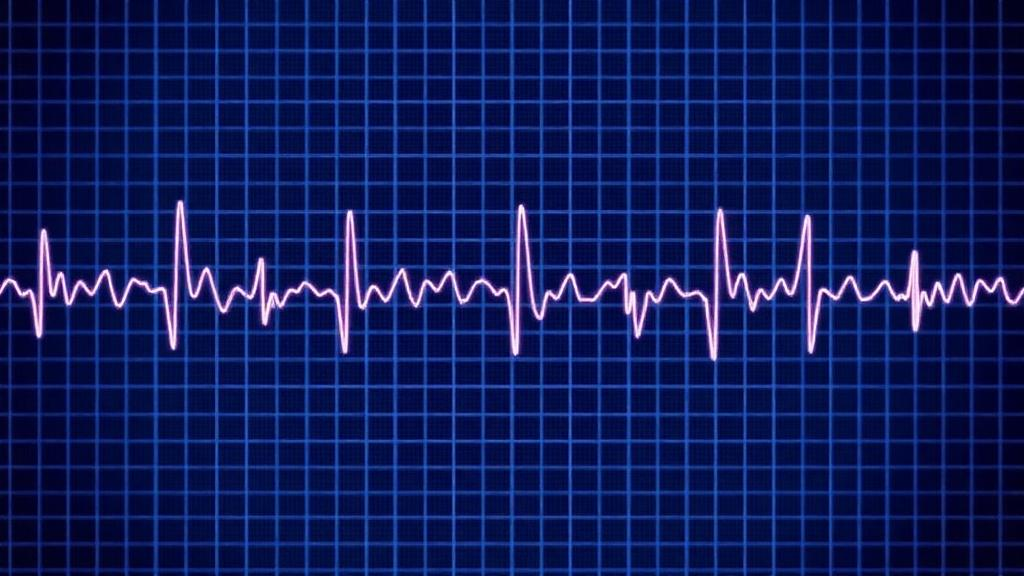
A routine electrocardiogram, the century-old test that records the heart’s electrical activity through twelve electrodes on the chest, has long been a blunt instrument for detecting blocked coronary arteries. Now, a prospective study published in PLOS Digital Health suggests that artificial intelligence can extract far more diagnostic signal from that same tracing than cardiologists traditionally could, potentially reshaping how patients are evaluated before invasive heart catheterization.
Researchers led by Salah Al-Zaiti and colleagues tested an AI-enhanced ECG model, known as the ECG-SMART AI score, in symptomatic outpatients scheduled for elective coronary angiography at a tertiary medical center. The question was deceptively simple: could a model originally trained to spot acute coronary occlusion, the complete blockage of a heart artery during a heart attack, also identify patients with angiographically significant coronary artery disease before they ever reached the catheterization laboratory?
The stakes are considerable. Each year, large numbers of patients with chest pain or other cardiac symptoms undergo elective coronary angiography, an invasive procedure in which a catheter is threaded to the heart and contrast dye reveals the anatomy of the coronary arteries. Yet a substantial fraction of these procedures finds no artery narrow enough to warrant intervention, exposing patients to radiation, contrast dye, catheter-related risks, and cost without therapeutic benefit. A noninvasive tool that could refine the pretest probability of significant disease would allow clinicians to select candidates for angiography more judiciously.
The study enrolled 363 patients, with an average age of about 59 years and a slight male majority. Before their procedures, each patient received a standard 12-lead ECG, which was then analyzed offline by the previously validated AI model. The researchers classified patients into two risk categories using predefined thresholds: low risk or intermediate-to-high risk. The benchmark for success was strict and clinically meaningful: angiographically significant coronary artery disease, defined as at least 70 percent narrowing in a major epicardial vessel or at least 50 percent narrowing of the left main coronary artery, the vessel that supplies most of the heart’s blood.
The results were striking. Overall, 36.1 percent of the patients had angiographically significant disease. The AI score flagged 44 percent of the cohort as intermediate-to-high risk and 56 percent as low risk. Crucially, after statistical adjustment for conventional clinical characteristics such as standard risk factors and symptoms, the intermediate-to-high risk classification remained independently associated with significant coronary disease, carrying an odds ratio of 3.12. In plain terms, patients the AI flagged as higher risk were roughly three times more likely to have a critically narrowed artery than comparable patients the model deemed low risk.
Discrimination, the statistical measure of how well a test separates the diseased from the healthy, was good: the model achieved an area under the receiver operating characteristic curve of 0.79, with a 95 percent confidence interval of 0.74 to 0.84. An AUROC of 0.5 would indicate performance no better than a coin flip, while 1.0 represents perfect classification. At a clinically useful operating point, the model delivered 60 percent precision at 80 percent recall, meaning that when it identified patients as high risk, a majority indeed had significant disease, and it captured most of the patients who truly did.
What makes this finding scientifically notable is the concept of generalizability. The model was not built for this task. It was developed to detect acute coronary occlusion, a different and more dramatic physiological state in which the ECG often shows dramatic changes such as ST-segment elevation. Coronary artery disease in stable, symptomatic outpatients is subtler: a 70 percent stenosis may produce only faint perturbations in the electrical signal, perturbations that human readers and conventional criteria routinely miss. That a model trained on one condition can transfer to another suggests the deep learning system has learned features of the ECG that reflect underlying coronary physiology rather than the surface signatures of a single disease state.
The technical implications extend beyond cardiology. Modern AI-ECG systems typically use convolutional or transformer-based neural networks that consume the raw voltage waveforms of all twelve leads simultaneously, detecting spatial and temporal patterns invisible to the naked eye. These networks can pick up on subtle changes in QRS morphology, T-wave vector, and beat-to-beat variability that encode information about myocardial ischemia, scar, and electrical remodeling. The ECG-SMART study adds to a growing body of evidence that such models can infer structural and hemodynamic information, from reduced ejection fraction to atrial fibrillation risk, from signals once thought to carry only rhythm and conduction data.
Cautious interpretation remains essential. The study was conducted at a single tertiary center in a population already selected for elective angiography, so the prevalence of significant disease, 36 percent, is far higher than in the general population of symptomatic outpatients. Precision and recall will shift when the same model is applied to lower-prevalence settings, and prospective validation in independent, more diverse cohorts is the necessary next step. The authors also emphasize that the AI score is not a replacement for clinical judgment or for stress testing, computed tomography angiography, or other established modalities, but rather a complement that adds noninvasive information to refine pretest probability.
Even with those caveats, the practical appeal is hard to overstate. The 12-lead ECG is cheap, fast, painless, and universally available, from rural clinics to emergency departments worldwide. If an AI layer can convert this ubiquitous tracing into a reliable estimate of the likelihood of obstructive coronary disease, clinicians could spare low-risk patients an unnecessary invasive procedure while accelerating high-risk patients toward definitive care. The ECG-SMART AI score, validated here in an elective angiography population, offers a compelling glimpse of that future, one in which a century-old diagnostic tool, augmented by machine learning, becomes a far sharper instrument for seeing inside the heart’s arteries without ever breaking the skin.
Subject of Research: AI-enhanced electrocardiography for detecting obstructive coronary artery disease before elective angiography
Article Title: Diagnostic performance of the ECG-SMART AI score for detecting angiographically significant coronary artery disease in patients undergoing elective coronary angiography
Article References: Bani Hani, D. A., Alshraideh, J. A., Alduraidi, H., Saleh, A., Riek, N. T., Daoud, K., Ji, R. Q., Saba, S., Callaway, C. W., & Al-Zaiti, S. (2026). Diagnostic performance of the ECG-SMART AI score for detecting angiographically significant coronary artery disease in patients undergoing elective coronary angiography. PLOS Digital Health, 5(10), e0001701. https://doi.org/10.1371/journal.pdig.0001701
Image Credits: AI Generated
DOI: 10.1371/journal.pdig.0001701
Keywords: AI-ECG, coronary artery disease, electrocardiogram, coronary angiography, deep learning, diagnostic accuracy, PLOS Digital Health, acute coronary occlusion, machine learning, cardiology, pretest probability, prospective cohort study
Cite Scienmag News
Blake Davidson. (October 10, 2026). AI Turns a Routine ECG Into a Powerful Predictor of Hidden Heart Artery Disease. Scienmag. https://scienmag.com/ai-turns-a-routine-ecg-into-a-powerful-predictor-of-hidden-heart-artery-disease/
Blake Davidson. "AI Turns a Routine ECG Into a Powerful Predictor of Hidden Heart Artery Disease." Scienmag, 10 October 2026, https://scienmag.com/ai-turns-a-routine-ecg-into-a-powerful-predictor-of-hidden-heart-artery-disease/. Accessed 10 October 2026.
Blake Davidson. "AI Turns a Routine ECG Into a Powerful Predictor of Hidden Heart Artery Disease." Scienmag. October 10, 2026. https://scienmag.com/ai-turns-a-routine-ecg-into-a-powerful-predictor-of-hidden-heart-artery-disease/