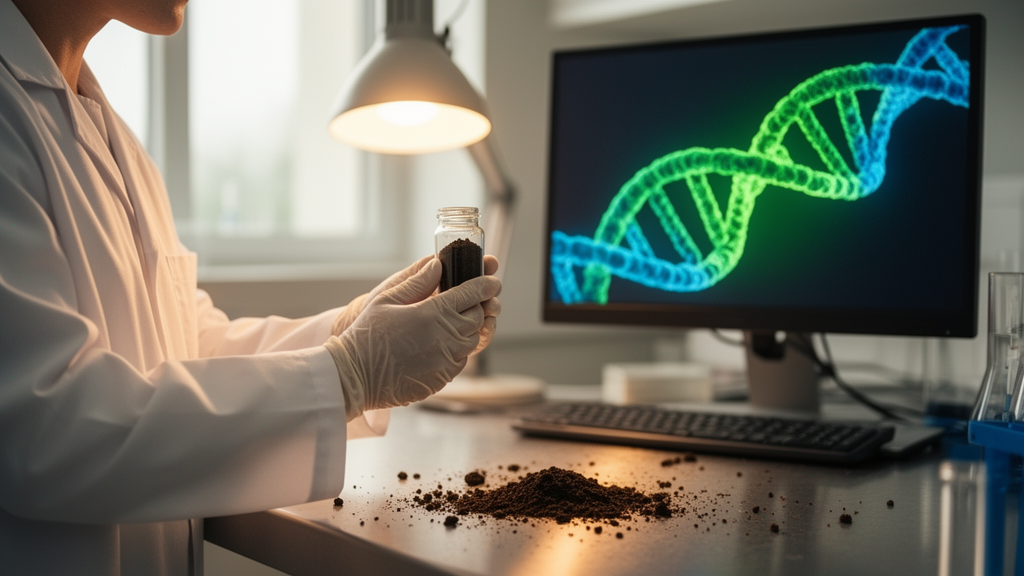
A handful of soil contains a crowded world of bacteria, fungi and other organisms. Scientists can extract and sequence the DNA of that entire community at once, but the result is millions of short genetic fragments from many different species, and much of it has remained impossible to identify. Researchers at the Hebrew University of Jerusalem and partner institutions have now developed an artificial intelligence tool, called BBERT, that recognizes bacterial DNA in fragments as short as 100 DNA letters, making it faster and easier to study the complex communities living in soil.
The study, published in Nucleic Acids Research, was led by Dr. Amir Erez of the Hebrew University’s Racah Institute of Physics and Dr. Omri M. Finkel of its Department of Plant and Environmental Sciences. Dmitry Alekhin, Dr. Moshe Alon and Dr. Tomer Sidi contributed equally to the work, alongside colleagues from the University of Haifa and the Agricultural Research Organization’s Volcani Institute.
The challenge the tool addresses is familiar to anyone who works with environmental DNA. When scientists sequence DNA from a whole soil sample, they receive a jumble of short pieces from many organisms, often without knowing what the finished genomes should look like. It is like sorting a huge pile of puzzle pieces from many different puzzles. Existing tools usually identify fragments by comparing them with sequences stored in reference databases, but many soil organisms are missing from those databases. Without a suitable match, their DNA can remain unidentified or be labeled incorrectly. Researchers often call this unexplained genetic material microbial “dark matter.”
BBERT approaches the problem differently. It uses a type of AI also employed in language technology, but instead of learning patterns in sentences, it learns patterns in bacterial DNA. Once trained, it can assess an unfamiliar fragment without needing to find a matching sequence in a reference database. The tool asks three questions: Does this DNA look bacterial? Does it contain instructions for making part of a protein? And, if so, where should the cell’s reading machinery start grouping the DNA letters to interpret those instructions correctly?
In benchmark tests, BBERT distinguished bacterial from non-bacterial DNA with approximately 90% accuracy, outperforming the other deep-learning tools evaluated. It identified fragments containing protein-making instructions with approximately 88% accuracy and assigned their correct reading frame with approximately 96% accuracy. The researchers then applied BBERT to 1,969 publicly available soil DNA datasets, where it identified a substantial share of fragments that a widely used comparison tool had left unclassified.
The results also added a clue to the mystery of microbial dark matter. Fragments that could not be linked to known functions were more likely to contain non-bacterial DNA than fragments that could be interpreted. This suggests that the mystery involves genetic material from several sources, alongside unfamiliar bacteria.
BBERT also helped with another demanding task: joining short DNA fragments into longer stretches to reconstruct bacterial genomes. In tests using simulated mixtures of organisms, filtering the DNA with BBERT before reconstruction reduced average processing time from about 66 hours to 25 hours per dataset. The reconstructed sequences contained fewer mismatches and gaps, while retaining approximately 96% of the average bacterial-genome coverage achieved without filtering.
The team also tested the approach on DNA collected from wild legume root nodules, structures where plants house bacteria and where samples contain a mixture of plant and microbial DNA. BBERT filtering halved reconstruction time and cut peak computer memory use from 188 to 82 gigabytes. It also reduced contamination in several reconstructed bacterial genomes, although some bacterial information was lost in the process.
The tool is not a perfect sorter. It can miss some bacterial fragments and mistake other DNA for bacterial DNA. For example, it can confuse DNA from chloroplasts, the structures plants use for photosynthesis, with bacterial sequences, reflecting their ancient bacterial origins. It can also struggle to distinguish bacteria from archaea, another major group of microorganisms. The researchers note that these limits help scientists decide when and how to use the tool.
BBERT can run on a personal computer with a suitable graphics card, and the researchers also demonstrated it on a laptop, which could make it easier for laboratories without large computing facilities to analyze environmental DNA. By making tiny DNA fragments easier to interpret, the tool gives scientists a practical way to explore the hidden life in soil, and it could also help them return to existing collections of environmental DNA and uncover information that earlier analyses could not resolve.
Subject of Research: A deep-learning tool for identifying bacterial DNA in short soil metagenomic fragments.
Article Title: New AI tool helps scientists identify bacteria hidden in soil
Article References: New AI tool helps scientists identify bacteria hidden in soil. Original publication (Bibliographic details unavailable.)
Image Credits: AI Generated
DOI: Not provided
Keywords: BBERT, soil microbiome, metagenomics, artificial intelligence, bacterial DNA, microbial dark matter, genome reconstruction, Nucleic Acids Research, Hebrew University of Jerusalem, environmental DNA, computational biology, tool
Cite Scienmag News
Morgan Morrow. (October 29, 2026). AI tool decodes bacterial DNA hidden in soil samples. Scienmag. https://scienmag.com/ai-tool-decodes-bacterial-dna-hidden-in-soil-samples/
Morgan Morrow. "AI tool decodes bacterial DNA hidden in soil samples." Scienmag, 29 October 2026, https://scienmag.com/ai-tool-decodes-bacterial-dna-hidden-in-soil-samples/. Accessed 1 November 2026.
Morgan Morrow. "AI tool decodes bacterial DNA hidden in soil samples." Scienmag. October 29, 2026. https://scienmag.com/ai-tool-decodes-bacterial-dna-hidden-in-soil-samples/