


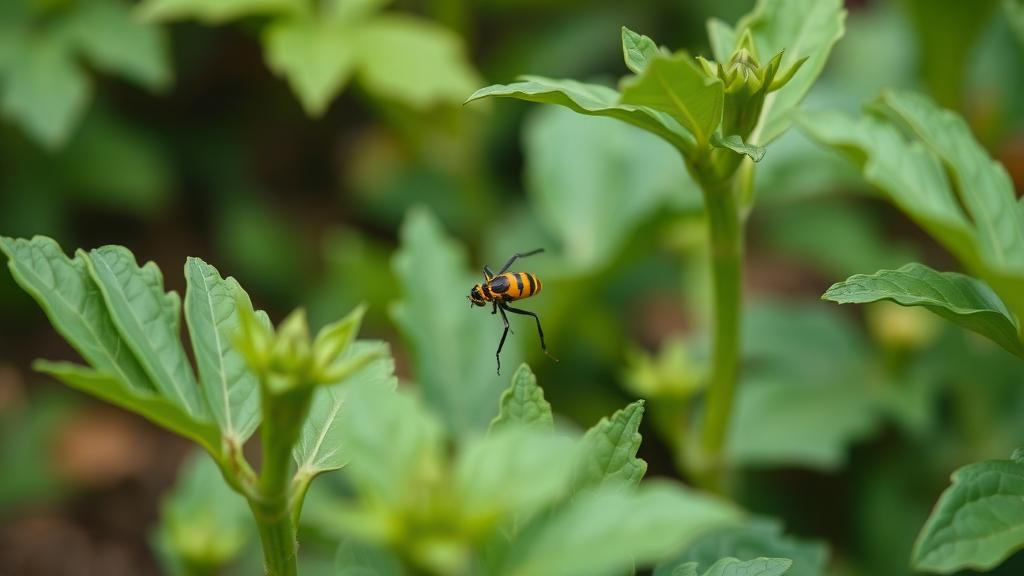
Insect pests quietly destroy an estimated 20 to 40 percent of global crop production every year, a toll that ripples through farmer incomes, national economies and the food supply that billions of people depend on. Traditional defenses against this damage have barely changed in decades: human scouts walking fields, eyeballing leaves, and making subjective calls about what they see. A new study published in Discover Artificial Intelligence proposes a way to replace that labor-intensive guesswork with an automated system that not only identifies pests with high accuracy but also explains, visually, why it made each call.
The framework, developed by J. Briskilal, M. K. Vidhyalakshmi, Aswathy K. Cherian and colleagues at institutions including SRM Institute of Science and Technology and Manipal University Jaipur, is called CPSA-RIPD-CSTGCN, short for Crop Protection in Smart Agriculture — Real-time Insect Pest Detection using Continual Spatio-Temporal Graph Convolutional Network. Its central architectural idea is to treat a crop field not as a collection of independent photographs but as a graph, in which individual plants or leaves are vertices connected by spatial relationships, while a temporal dimension tracks how pest activity evolves across successive observations. This dual spatio-temporal modeling is what the researchers say allows the system to catch subtle, early-stage infestations that conventional image classifiers miss.
At the heart of the network lies a continual convolution mechanism. Standard temporal convolutions must store the previous K-1 data slices in memory before computing an output, which inflates memory use and slows processing as video streams in continuously from field cameras. The continual approach instead processes each incoming slice immediately, aggregating weighted contributions across time lags into a compact running representation. The output at each time step is computed as a bias term plus the sum of these temporally delayed contributions, with batch normalization stabilizing training and a delayed residual connection preserving weight compatibility with standard architectures. The result, according to the authors, is real-time, memory-efficient detection suited to streaming agricultural data.
Before any image reaches the network, it passes through a preprocessing stage built on the Ensemble Transform Schmidt–Kalman Filter, or ETSKF, a technique borrowed from atmospheric data assimilation. The filter performs resizing and normalization to standardize inputs, suppresses noise, and applies a transformation matrix derived from an orthogonal basis of healthy and pest-affected crop imagery. This projection emphasizes the directions in feature space that separate damaged tissue from healthy tissue while a small identity regularizer damps overly variable components. The goal is robustness against the messy realities of field imaging: shifting illumination, occlusion, and inconsistent image quality that routinely degrade automated detection systems.
Once preprocessed, images are augmented through rotation, flipping, scaling, shearing and contrast adjustment, expanding the effective training set and reducing overfitting. The augmented data then feeds into the CSTGCN, which was trained on ten economically important pest classes drawn from the IP102 benchmark dataset: Rice Leaf Roller, Rice Water Weevil, Corn Borer, Wheat Blossom Midge, Beet Army Worm, Alfalfa Weevil, Viteus vitifoliae, Toxoptera citricidus, Mango Flat Beak Leafhopper and Red Spider. To squeeze the most from the architecture, the team employed a metaheuristic called the Revolution Optimization Algorithm, which maintains a population of candidate hyperparameter solutions and alternates between a broad exploration phase, which pulls candidates toward a reference leader to survey diverse infestation patterns, and a focused exploitation phase that makes fine adjustments to promising configurations.
The reported results are striking. Using a 60-40 training-testing split and five-fold cross-validation, the framework achieved 97 percent accuracy, 98 percent precision, 98 percent recall and a 98 percent F1 score, with a mean cross-validation accuracy of 97.0 plus or minus 0.32 percent. That consistency matters: the standard deviation across folds was the lowest of any model tested, while general-purpose architectures such as VGG16 and InceptionV3 showed variance figures of 0.88 to 0.92 percent, reflecting their sensitivity to how training data is partitioned. The authors attribute this stability to the ROA-based optimization, which adaptively retunes network weights for different training partitions.
The comparison against established baselines was lopsided. VGG16 managed only 82 percent accuracy, InceptionV3 85 percent, MobileNetV2 87 percent, DenseNet121 88 percent and EfficientNetB0 89 percent. Task-specific pest detection systems fared better but still trailed: EDCP-DIA-RNN reached 94 percent, EPCY-TPA-ANN 91 percent and ICPM-ESA-CNN 90 percent. The gap, the researchers argue, stems from a structural difference. Standard convolutional networks are spatial classifiers for static frames; they do not model temporal dynamics or inter-region relationships within crop fields. The CSTGCN explicitly encodes both, letting it recognize the faint signatures of early infestation that frame-level classifiers cannot see. Ablation studies reinforced this point: removing the ETSKF preprocessing dropped accuracy to 92 percent, removing ROA dropped it to 93 percent, and only the full combination reached the headline 97 percent figure.
What may prove most consequential, however, is the framework’s insistence on showing its work. After classification, Gradient-weighted Class Activation Mapping, or Grad-CAM, backpropagates class gradients through the final convolutional layer to produce heat maps highlighting the image regions that drove each prediction. Domain experts validated that these saliency maps correspond to biologically meaningful features: rolled leaf margins for the Rice Leaf Roller, frass deposits and stem entry points for the Corn Borer, webbing and stippling on leaf undersides for the Red Spider, gall formations for Viteus vitifoliae, and aphid clusters along leaf veins for Toxoptera citricidus. When the same visualization was applied to baseline models, VGG16 frequently lit up background vegetation and soil instead of the pest, while InceptionV3 and MobileNetV2 faltered on low-contrast classes. Even the framework’s roughly 3 percent of misclassified samples yielded insight, with Grad-CAM revealing that errors clustered on visually ambiguous early-stage damage, such as Corn Borer injury overlapping with Beet Army Worm feeding patterns — a finding that directly informs future data collection priorities.
The authors are candid about the limits of the work. Evaluation relied on the IP102 benchmark rather than large-scale field data collected under varied weather, illumination and occlusion conditions; only ten of the dataset’s 102 pest classes were tested; and the combined computational weight of the CSTGCN and ROA could hinder deployment on resource-constrained edge devices. Grad-CAM, moreover, is a post-hoc interpretability tool that illuminates but does not fully explain the network’s internal reasoning. Future work outlined by the team includes lightweight model compression, benchmarking on embedded accelerators such as NVIDIA Jetson platforms, multimodal sensing that fuses RGB imagery with multispectral, thermal and environmental sensor data, and few-shot learning to extend coverage to unseen pest species without full retraining. For now, the study offers a template for what agricultural AI may need to become: not just accurate, but transparent enough for a farmer to trust what the machine claims to see in the field.
Subject of Research: Explainable deep learning for real-time insect pest detection in smart agriculture
Article Title: Explainable deep learning framework for real-time insect pest detection in smart agriculture
Article References: Briskilal, J., Vidhyalakshmi, M. K., Cherian, A. K., Neduncheliyan, S., Kumar, A., & Kumar, R. (2026). Explainable deep learning framework for real-time insect pest detection in smart agriculture. Discover Artificial Intelligence, 6(1), Article 1435. https://doi.org/10.1007/s44163-026-02109-y
Image Credits: AI Generated
DOI: 10.1007/s44163-026-02109-y
Keywords: deep learning, insect pest detection, smart agriculture, graph convolutional network, Grad-CAM, explainable AI, crop protection, IP102 dataset, computer vision, precision agriculture, hyperparameter optimization, Kalman filter
Cite Scienmag News
Alan Morgan. (October 12, 2026). AI That Shows Its Work: Explainable Deep Learning Spots Crop Pests in Real Time. Scienmag. https://scienmag.com/ai-that-shows-its-work-explainable-deep-learning-spots-crop-pests-in-real-time/
Alan Morgan. "AI That Shows Its Work: Explainable Deep Learning Spots Crop Pests in Real Time." Scienmag, 12 October 2026, https://scienmag.com/ai-that-shows-its-work-explainable-deep-learning-spots-crop-pests-in-real-time/. Accessed 12 October 2026.
Alan Morgan. "AI That Shows Its Work: Explainable Deep Learning Spots Crop Pests in Real Time." Scienmag. October 12, 2026. https://scienmag.com/ai-that-shows-its-work-explainable-deep-learning-spots-crop-pests-in-real-time/


