


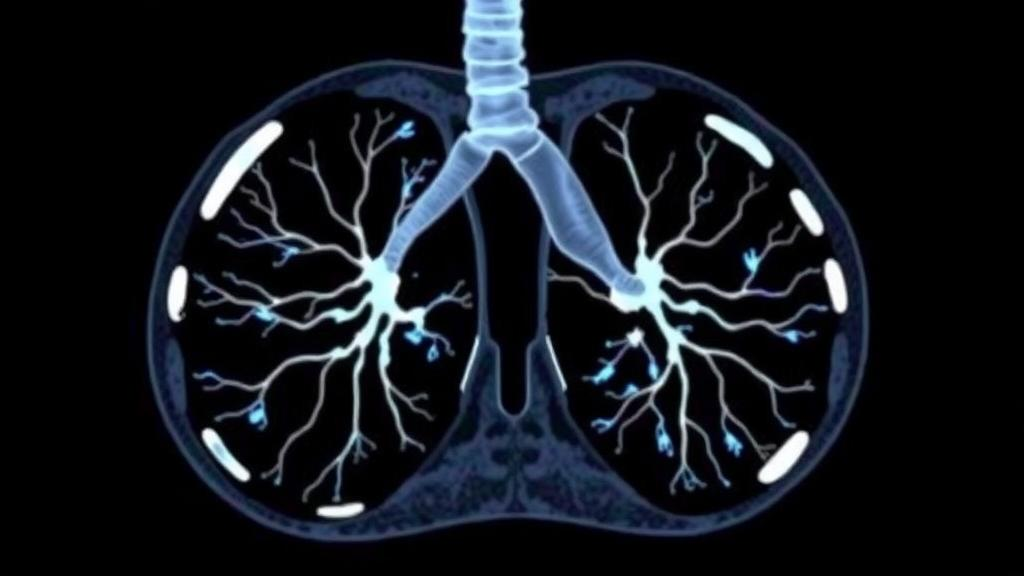
One of the most dangerous tricks that early-stage lung cancer can play on surgeons is invisible on the operating table. Tumor cells can drift into the air-filled passageways surrounding a tumor, a pattern pathologists call spread through air spaces, or STAS. These floating tumor clusters are invisible to the naked eye during surgery, yet they are strongly linked to recurrence and poorer survival. The problem is that STAS can only be confirmed after surgery, when a pathologist slices into the removed tumor, which means the surgeon has already committed to an operation before knowing whether a more aggressive approach was warranted. A new study published in BMC Medical Imaging suggests that artificial intelligence, applied to ordinary computed tomography scans, may be able to flag this hidden invasion pattern before a single incision is made.
The research team, led by investigators at the First Affiliated Hospital of Nanchang University in China, developed a prediction model that fuses two complementary ways of reading a CT image. The first approach, known as habitat radiomics, treats a tumor not as a uniform lump but as a patchwork of biologically distinct subregions. The second approach uses three-dimensional deep learning, allowing a neural network to learn its own features directly from volumetric image data. When the two were combined, the resulting model achieved an area under the receiver operating characteristic curve, or AUC, of 0.824 in an independent testing cohort, significantly outperforming a conventional whole-tumor radiomics model. An AUC of 0.824 indicates good discriminative ability, meaning the model could separate STAS-positive from STAS-negative tumors considerably better than chance.
The study enrolled 248 patients with stage I lung adenocarcinoma, the most common form of lung cancer and one that is increasingly caught at an early stage thanks to widespread low-dose CT screening. Of these patients, 120 were confirmed to have STAS on postoperative pathology, while 128 did not. The cohort was divided into a training set of 173 cases used to build the models and a testing set of 75 cases reserved for evaluating how well the models generalized to unseen data. This retrospective design, approved by the hospital’s ethics committee with informed consent waived, allowed the researchers to compare five distinct modeling strategies head to head.
The habitat radiomics approach is the conceptual heart of the study. Rather than extracting a single set of texture and shape features from the entire tumor, the researchers applied K-means clustering to voxel-level feature vectors pooled from all tumors in the study. In practical terms, every tiny three-dimensional pixel of every tumor was described by a vector of quantitative image characteristics, such as intensity and texture measures, and these vectors were grouped into four clusters. Each cluster represents a habitat, a subregion of the tumor that shares a consistent imaging signature and, by extension, may reflect a distinct underlying biology such as solid proliferation, lepidic growth, necrosis, or stromal invasion. Tumors are heterogeneous organs in miniature, and averaging across them can wash out exactly the signals that matter most.
Among the four habitats, one designated Habitat H4 proved to be the single most informative region. A radiomics model built on Habitat H4 alone achieved a testing-cohort AUC of 0.802, with a 95 percent confidence interval of 0.700 to 0.904, clearly outperforming the conventional whole-tumor radiomics model, which managed an AUC of only 0.739. This result carries an important message: where you look inside a tumor can matter as much as how you measure it. The peripheral or specific subregions captured by H4 apparently harbor imaging features that correlate with the biological propensity of tumor cells to invade air spaces, features that get diluted when the whole tumor is analyzed as a single unit.
On the deep learning side, the researchers compared a multichannel two-dimensional approach with a fully three-dimensional one. The 3D deep learning model, which processes the tumor as a complete volumetric object rather than a stack of independent slices, reached a testing-cohort AUC of 0.815, ahead of the 2D model’s 0.747. This advantage makes intuitive sense. STAS is fundamentally a spatial phenomenon, involving tumor cells detached from the main mass and dispersed through three-dimensional airway structures, so a model that can reason about volume, shape, and spatial context should have an edge over one that sees only flat cross-sections.
The real payoff came from fusion. When the researchers combined the Habitat H4 radiomic features with the features learned by the 3D deep learning network, the resulting hybrid model achieved an AUC of 0.913 in the training cohort and 0.824 in the testing cohort, the highest numerical performance of any model tested. A DeLong statistical test confirmed that the fusion model significantly outperformed the conventional radiomics model. The two feature families appear to be complementary rather than redundant: handcrafted habitat features encode interpretable regional texture patterns, while deep features capture subtle, high-dimensional spatial relationships that no human-designed descriptor would think to measure. Calibration curves showed favorable agreement between predicted probabilities and actual outcomes, and decision curve analysis demonstrated greater clinical net benefit, meaning that acting on the model’s predictions would, across a range of decision thresholds, help more patients than it would harm.
Why does preoperative STAS prediction matter so much clinically? Surgical strategy for early-stage lung adenocarcinoma is a genuine fork in the road. For small, seemingly indolent nodules, surgeons may offer sublobar resection, such as a wedge or segmentectomy, which preserves lung function but may be insufficient if the tumor is shedding cells into air spaces. For tumors with aggressive features, lobectomy with systematic lymph node sampling remains the standard. If a CT-based model could reliably indicate a high probability of STAS before surgery, it could tip the balance toward the more definitive operation, potentially reducing the risk of leaving behind microscopic disease. Conversely, a confidently negative prediction could support a more conservative approach in suitable patients, sparing healthy lung tissue. The model could also inform discussions about the adequacy of surgical margins and the intensity of postoperative surveillance.
The study has limitations that the authors themselves acknowledge, and these deserve emphasis. The data came from a single institution and were retrospective, meaning the model has not yet been tested on prospectively collected patients at other centers. The testing cohort of 75 cases is modest, and the confidence intervals around the AUC estimates are correspondingly wide. Deep learning models also carry a risk of learning artifacts, such as scanner-specific signatures, rather than true tumor biology, and external validation on multi-institution data would be needed to rule this out. The authors explicitly state that the model’s role in surgical decision-making requires further validation in external and prospective studies before it should influence clinical practice. The work was supported by the National Natural Science Foundation of China and several Jiangxi provincial research programs, reflecting a broader push in China to build clinically deployable imaging AI.
Even with those caveats, the study offers a compelling glimpse of where precision oncology is heading. The idea of habitat analysis, borrowed conceptually from ecology, where researchers map how species occupy distinct niches within an ecosystem, is increasingly being applied to tumors, and this study shows it can be combined productively with deep learning rather than competing with it. For patients with early-stage lung cancer, the stakes are concrete: a noninvasive reading of a routine CT scan that warns the surgical team about an invisible pattern of spread could change the extent of an operation and, potentially, the odds of recurrence. As larger, multi-center validation studies arrive, the fusion of habitat radiomics and 3D deep learning may move from an encouraging research result to a practical tool sitting beside the radiologist’s workstation, quietly reshaping how lung cancer surgery is planned.
Subject of Research: Preoperative prediction of spread through air spaces in early-stage lung adenocarcinoma using CT-based habitat radiomics and deep learning
Article Title: CT-based habitat radiomics and deep learning for preoperative prediction of spread through air spaces in early-stage lung adenocarcinoma
Article References: CT-based habitat radiomics and deep learning for preoperative prediction of spread through air spaces in early-stage lung adenocarcinoma. (n.d.). https://doi.org/10.1186/s12880-026-02892-1
Image Credits: AI Generated
DOI: 10.1186/s12880-026-02892-1
Keywords: lung adenocarcinoma, spread through air spaces, STAS, CT imaging, habitat radiomics, deep learning, machine learning, radiomics, preoperative prediction, tumor heterogeneity, surgical decision-making, BMC Medical Imaging
Cite Scienmag News
Nathaniel Bowman. (October 12, 2026). AI Reads CT Scans to Predict Hidden Lung Cancer Spread Before Surgery. Scienmag. https://scienmag.com/ai-reads-ct-scans-to-predict-hidden-lung-cancer-spread-before-surgery/
Nathaniel Bowman. "AI Reads CT Scans to Predict Hidden Lung Cancer Spread Before Surgery." Scienmag, 12 October 2026, https://scienmag.com/ai-reads-ct-scans-to-predict-hidden-lung-cancer-spread-before-surgery/. Accessed 12 October 2026.
Nathaniel Bowman. "AI Reads CT Scans to Predict Hidden Lung Cancer Spread Before Surgery." Scienmag. October 12, 2026. https://scienmag.com/ai-reads-ct-scans-to-predict-hidden-lung-cancer-spread-before-surgery/


