


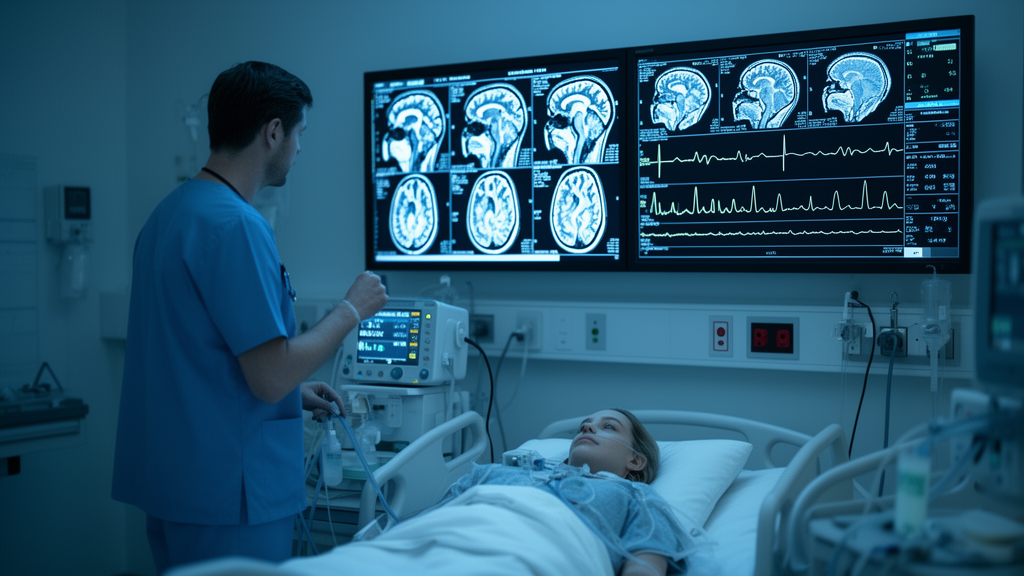
Sepsis is one of medicine’s most feared adversaries, a runaway immune response to infection that can shut down organs one by one. Yet even when patients survive the initial storm, a quieter threat often lingers: sepsis-associated encephalopathy, or SAE, a diffuse brain dysfunction that can leave survivors confused, comatose, or permanently neurologically impaired. Diagnosing SAE has long been a frustrating exercise in guesswork, because no single blood test, imaging finding, or bedside score can reliably separate patients whose brains are suffering from those whose minds remain intact. Now, a team of researchers in Wuhan, China, has combined automated brain MRI analysis with machine learning to build a diagnostic model that may bring much-needed clarity to this clinical blind spot.
The study, published in BMC Medical Imaging by Shasha Shao, Yanyan Liu, Jun Feng, and colleagues at Tongji Hospital of Tongji Medical College, Huazhong University of Science and Technology, took a retrospective case-control approach. The researchers enrolled 35 healthy controls and 72 patients with sepsis, of whom 34 had sepsis-associated encephalopathy and 38 did not. Every participant underwent three-dimensional T1-weighted magnetic resonance imaging, the workhorse sequence for visualizing brain anatomy in high resolution. Rather than relying on radiologists’ subjective impressions, the team used FreeSurfer, a widely respected software pipeline, to automatically segment the whole brain into its constituent structures and extract precise volumetric measurements.
The technical ambition of the project is considerable. Automated whole-brain segmentation generated an enormous feature space: after rigorous quality control, the researchers analyzed 540 distinct features spanning the three groups. These included the volumes of cortical and subcortical structures, ventricular spaces, and other neuroanatomical compartments that might subtly change when the brain is injured by systemic inflammation. To prevent the model from drowning in noise or memorizing spurious correlations, the team applied least absolute shrinkage and selection operator regression, known as LASSO, with 10-fold cross-validation performed exclusively on the training data. This step whittled the feature set down to 27 reliable indicators associated with SAE.
Those 27 indicators tell a biologically coherent story. Alongside the clinical severity scores APACHE II, the Acute Physiology and Chronic Health Evaluation II score, and SOFA, the Sequential Organ Failure Assessment score, the model highlighted structural changes in the hippocampus, thalamus, amygdala, lateral ventricle, and globus pallidus. These are not random regions. The hippocampus is central to memory and is exquisitely vulnerable to metabolic and inflammatory insult; the thalamus acts as the brain’s relay station for consciousness and arousal; the amygdala governs emotional processing; and the basal ganglia structures, including the globus pallidus, are known targets of toxic and metabolic injury. Ventricular enlargement, meanwhile, is a classic indirect marker of tissue loss, as cerebrospinal fluid-filled spaces expand to fill the void left by atrophying brain matter.
With features in hand, the researchers trained eight different machine learning models, combining clinical scores with neuroimaging measurements in a multimodal framework. Hyperparameter tuning was carried out using GridSearchCV with 3-fold stratified cross-validation, a standard technique that systematically searches combinations of model settings while keeping class proportions balanced across validation splits. Performance was assessed on a stratified hold-out validation set, providing an estimate of how the models might behave on unseen patients. The clear winner was XGBoost, an eXtreme Gradient Boosting algorithm that builds an ensemble of decision trees, each new tree correcting the errors of its predecessors. XGBoost achieved an area under the receiver operating characteristic curve, or AUC, of 0.92, indicating excellent discrimination between patients with SAE, septic patients without encephalopathy, and healthy controls, along with superior calibration, meaning its predicted probabilities tracked actual outcomes well.
Crucially, the team did not treat the model as an inscrutable black box. They deployed SHAP analysis, SHapley Additive exPlanations, a technique borrowed from cooperative game theory that assigns each feature a contribution value for every individual prediction. The SHAP findings revealed nonlinear relationships: rising APACHE II and SOFA scores and progressive neuroanatomical atrophy jointly pushed predictions toward SAE, but not in a simple straight-line fashion. Among the most influential predictors were the two clinical scores together with volumetric changes in the cerebellar cortex, hippocampus, and amygdala. The involvement of the cerebellar cortex is particularly intriguing, as this region, long associated primarily with motor coordination, is increasingly recognized as a participant in cognition and is vulnerable in systemic inflammatory states.
The clinical implications are potentially significant. In intensive care units, septic patients are often too sedated, too ill, or too unstable for elaborate neuropsychological testing, and conventional imaging frequently appears deceptively normal in SAE. Electroencephalography can show diffuse slowing, but it is nonspecific. A quantitative pipeline that pairs routinely collected severity scores with automated MRI volumetry could, in principle, give clinicians an objective, reproducible signal of brain involvement, helping them stratify risk, intensify monitoring, and counsel families about prognosis. Because the model distinguishes not only SAE patients from healthy controls but also from septic patients without encephalopathy, it addresses the diagnostically hardest comparison, the one that actually matters at the bedside.
The study also contributes to the scientific understanding of what sepsis does to the brain. The convergence of imaging evidence on limbic and deep gray matter structures fits with pathological and animal studies suggesting that SAE involves blood-brain barrier disruption, microglial activation, neuronal apoptosis, and impaired cerebral perfusion. By pinpointing which anatomical measurements carry the most diagnostic weight, the work offers candidate structural correlates of the syndrome, potentially guiding future studies of biomarkers and neuroprotective interventions. The use of explainable AI methods like SHAP also reflects a broader movement in medical machine learning toward transparency, allowing clinicians to see not just what a model predicts but why.
Nevertheless, the authors and outside observers alike should temper enthusiasm with caution. This was a retrospective, single-center study with a modest sample size of 107 participants, and the results are explicitly preliminary. Retrospective designs are vulnerable to selection bias, and models trained on data from one hospital may not generalize to populations with different demographics, imaging protocols, or sepsis etiologies. The researchers themselves emphasize that prospective validation in larger, multi-center cohorts is required before any clinical translation. Overfitting, even with careful cross-validation and LASSO selection, remains an ever-present risk when hundreds of features meet dozens of patients, and the 0.92 AUC will likely settle at a lower value in truly independent data.
Even with those caveats, the study represents a meaningful step toward a long-sought goal: turning the fuzzy, subjective diagnosis of sepsis-associated encephalopathy into a quantitative, data-driven assessment. If future multicenter trials confirm these findings, an ICU patient’s brain MRI could one day be fed through an automated segmentation pipeline within hours, merged with APACHE II and SOFA scores, and returned as a calibrated risk estimate for encephalopathy, enabling earlier interventions when the brain is still salvageable. For a complication associated with high mortality and devastating long-term neurological outcomes among sepsis survivors, that combination of artificial intelligence, neuroimaging, and clinical acumen could not arrive soon enough.
Subject of Research: Machine learning diagnosis of sepsis-associated encephalopathy using automated whole-brain MRI segmentation and clinical severity scores
Article Title: Automated whole-brain MRI segmentation combined with clinical scores for the diagnosis of sepsis-associated encephalopathy: a case-control study
Article References: Shao, S., Liu, Y., Yang, J., Zhou, D., Peng, C., Liu, D., Wang, J., & Feng, J. (2026). Automated whole-brain MRI segmentation combined with clinical scores for the diagnosis of sepsis-associated encephalopathy: a case-control study. BMC Medical Imaging. https://doi.org/10.1186/s12880-026-02734-0
Image Credits: AI Generated
DOI: 10.1186/s12880-026-02734-0
Keywords: sepsis-associated encephalopathy, machine learning, XGBoost, MRI, FreeSurfer, APACHE II, SOFA, SHAP, LASSO regression, critical care, neuroimaging, BMC Medical Imaging
Cite Scienmag News
Ophelia Keating. (October 16, 2026). AI Reads Brain Scans and ICU Scores to Spot a Deadly Sepsis Complication. Scienmag. https://scienmag.com/ai-reads-brain-scans-and-icu-scores-to-spot-a-deadly-sepsis-complication/
Ophelia Keating. "AI Reads Brain Scans and ICU Scores to Spot a Deadly Sepsis Complication." Scienmag, 16 October 2026, https://scienmag.com/ai-reads-brain-scans-and-icu-scores-to-spot-a-deadly-sepsis-complication/. Accessed 16 October 2026.
Ophelia Keating. "AI Reads Brain Scans and ICU Scores to Spot a Deadly Sepsis Complication." Scienmag. October 16, 2026. https://scienmag.com/ai-reads-brain-scans-and-icu-scores-to-spot-a-deadly-sepsis-complication/


