


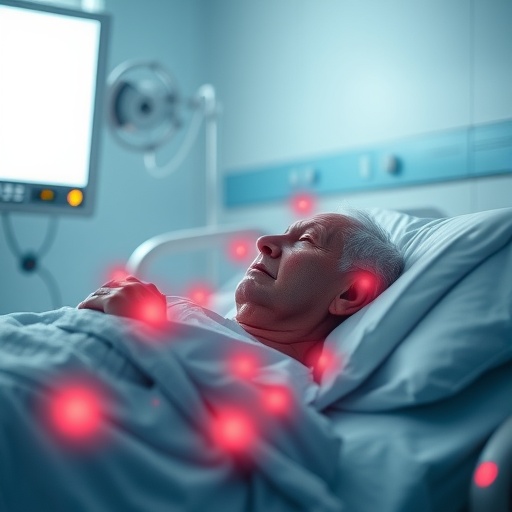
In a groundbreaking advancement at the intersection of endocrinology, critical care medicine, and artificial intelligence, a recent study has unveiled a novel machine learning-based model designed specifically to predict delirium linked to hypothyroidism in elderly patients admitted to intensive care units (ICUs). This pioneering work addresses a crucial clinical challenge: delirium, a common yet often underrecognized neuropsychiatric syndrome in elderly hypothyroid patients, significantly complicates recovery and worsens prognosis. By harnessing sophisticated data analytics and predictive algorithms, researchers have opened new vistas for early identification and management that could dramatically improve outcomes.
Delirium, characterized by acute cognitive disturbances including confusion, disorientation, and fluctuating consciousness, is notoriously prevalent among elderly ICU patients. When compounded by hypothyroidism—a condition marked by insufficient thyroid hormone production—delirium becomes even more complex and resistant to conventional interventions. The thyroid gland plays an indispensable role in regulating metabolism, neural function, and homeostasis, and its impairment in elderly patients can magnify these metabolites’ vulnerabilities and neurological susceptibilities. Yet, until now, no predictive tool has effectively integrated clinical, biochemical, and demographic data to forecast the onset of hypothyroidism-associated delirium in this high-risk group.
The research team, led by Guan B., Lin L., Chen Z., and collaborators, embarked on an extensive data-driven inquiry to solve this pressing problem. They collected and analyzed a large dataset from elderly hypothyroid patients admitted to multiple ICUs, encompassing variables such as thyroid hormone levels, inflammatory markers, vital signs, comorbidities, medication profiles, and neurological assessment scores. What distinguishes their approach is the application of advanced machine learning methodologies, including gradient boosting machines and neural networks, capable of discerning subtle, nonlinear patterns invisible to traditional statistical models.
One of the study’s critical innovations lies in feature engineering—the process of selecting and transforming raw clinical data into meaningful input for the algorithms. The researchers meticulously identified biomarkers and clinical parameters most strongly correlated with delirium onset, such as variations in thyroid-stimulating hormone (TSH), free thyroxine (FT4), and biomarkers indicative of systemic inflammation like C-reactive protein (CRP). These features were integrated alongside demographic factors such as age, sex, and preexisting neurological conditions, fostering a holistic predictive framework that surpasses prior models in sensitivity and specificity.
In practical terms, the machine learning model demonstrated remarkable accuracy in anticipating which elderly hypothyroid patients were at highest risk for developing delirium during their ICU stay. The model’s predictive prowess, validated through rigorous cross-validation techniques and external cohort testing, offers clinicians a potential decision support tool to stratify patients early and tailor preventive interventions more precisely. This could include adjustments in thyroid hormone replacement therapy, optimized sedation management, and proactive neurocognitive monitoring, collectively mitigating delirium’s incidence and severity.
The implications of this technological breakthrough extend beyond immediate clinical utility. Delirium in the ICU is associated with prolonged hospitalization, increased healthcare costs, and long-term cognitive decline or mortality. Early prediction through machine learning facilitates resource allocation, better communication among multidisciplinary teams, and personalized patient care plans. Furthermore, the study’s methodological framework sets a precedent for integrating endocrinological and neurological data streams within AI platforms, potentially applicable to a spectrum of disorders intersecting metabolism and brain health.
Importantly, the research underscores the growing role of artificial intelligence in precision medicine. By leveraging computational power to analyze vast, complex datasets, AI can elucidate relationships that were previously inaccessible to human cognition. This paradigm shift challenges conventional diagnostic algorithms, promoting real-time, data-informed clinical decisions that could revolutionize care standards in critical settings—especially for vulnerable populations such as the elderly with multisystem comorbidities.
The research team also addressed potential challenges associated with implementing machine learning tools in ICU practice. They discussed strategies to ensure interpretability and transparency of the model’s predictions, a vital factor for clinician acceptance and ethical use. They employed techniques such as SHAP (SHapley Additive exPlanations) values to illustrate how individual variables influenced model output, bridging the gap between black-box algorithms and the clinical reasoning process.
Moreover, the study acknowledges the importance of continuous learning and model adaptation. ICU environments and patient populations are dynamic, and predictive models must evolve accordingly. Future directions include integrating longitudinal patient data, exploring multimodal inputs like neuroimaging and EEG signals, and conducting prospective clinical trials to validate utility and impact on patient outcomes further.
The study also highlights the multifactorial etiology of delirium, emphasizing that hypothyroidism constitutes one among many interacting risk factors. The machine learning model accounts for this complexity by incorporating comprehensive datasets that reflect the critical illness milieu, including organ dysfunction scores, medication effects (e.g., sedatives and anticholinergics), and electrolyte imbalances. Such comprehensive modeling enhances the precision of risk stratification, facilitating targeted care pathways.
In addition to its clinical promise, the research addresses broader healthcare challenges posed by an aging global population. With elderly ICU admissions rising, the burden of delirium and hypothyroidism is expected to increase concomitantly. Predictive analytics offer scalable, cost-effective solutions to optimize patient outcomes and reduce systemic healthcare pressures. These advances embody the fusion of technology and medicine necessary to meet the complex demands of future critical care.
The publication of this study in BMC Geriatrics marks a significant milestone in geriatrics and critical care literature, providing a valuable resource for clinicians, researchers, and policymakers. It paves the way for multidisciplinary collaborations to refine AI-driven tools and integrate them responsibly into clinical workflows. The research team’s transparent sharing of methodology and open access dissemination further accelerates innovation and adoption.
As with all pioneering technologies, careful evaluation of ethical considerations such as data privacy, algorithmic bias, and equitable access is essential. The researchers stressed adherence to rigorous data governance frameworks and inclusive datasets to minimize disparities and ensure benefits are widely distributed across diverse patient populations.
Ultimately, this machine learning-based prediction model exemplifies how artificial intelligence can augment human oversight to unravel complex neuroendocrine interactions, anticipate complications, and enhance personalized care at the bedside. It signals a new era in managing elderly hypothyroid patients within ICUs—a population historically challenging to treat effectively amidst multifaceted vulnerabilities.
The synergy between clinical expertise, robust data, and cutting-edge AI techniques embodied in this study offers a blueprint for future endeavors addressing other multifaceted syndromes where timely prediction can transform outcomes. As technology continues to evolve, such integrative approaches will become cornerstones of next-generation healthcare, improving quality of life, reducing morbidity, and unlocking new knowledge frontiers in medicine.
Cite Scienmag News
Blake Davidson. (June 9, 2026). AI Predicts Delirium in Elderly ICU Hypothyroid Patients. Scienmag. https://scienmag.com/ai-predicts-delirium-in-elderly-icu-hypothyroid-patients/
Blake Davidson. "AI Predicts Delirium in Elderly ICU Hypothyroid Patients." Scienmag, 9 June 2026, https://scienmag.com/ai-predicts-delirium-in-elderly-icu-hypothyroid-patients/. Accessed 5 September 2026.
Blake Davidson. "AI Predicts Delirium in Elderly ICU Hypothyroid Patients." Scienmag. June 9, 2026. https://scienmag.com/ai-predicts-delirium-in-elderly-icu-hypothyroid-patients/


