


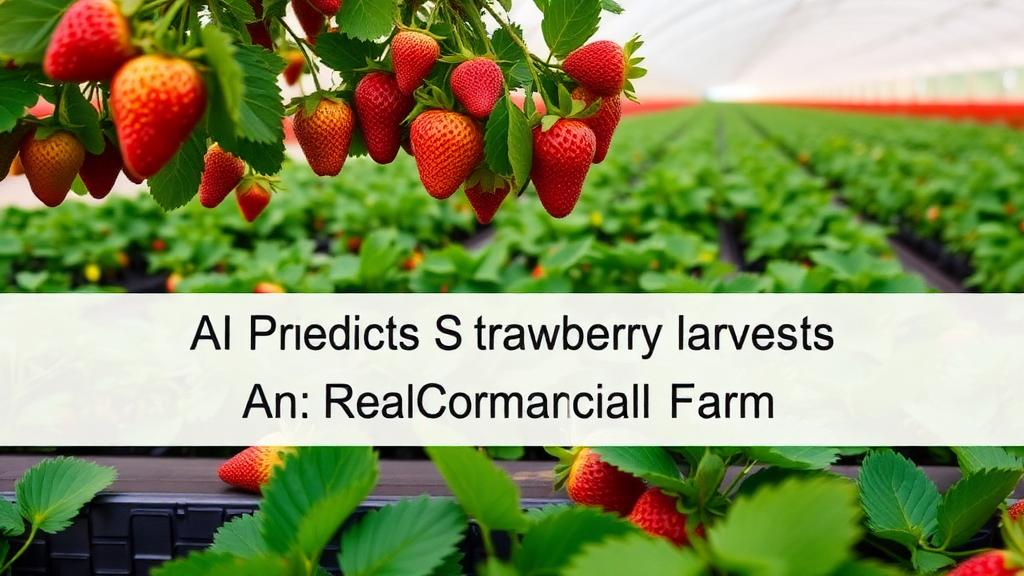
Few crops punish forecasting errors quite like strawberries. The fruit is delicate, the season is short, and every punnet that ripens without a picker or a cold-chain slot waiting for it is money left rotting in the field. A new study published in Smart Agricultural Technology shows that daily strawberry yields on a working commercial farm can be predicted with useful accuracy using artificial intelligence, but only when the models are built and tested with unusual care. The research, led by Salman Ahmed and Nicholas Caldwell of the University of Suffolk, draws on six consecutive production years of real operational data from a British soft-fruit farm, and its central message is as much about how models are evaluated as it is about how they are built.
The commercial stakes are considerable. The global fresh strawberry market has been estimated at roughly 20.7 billion US dollars in 2024, with projections exceeding 30 billion dollars by the mid-2030s as year-round demand grows. In the United Kingdom alone, official statistics value the strawberry crop at 389 million pounds for 2024. At daily resolution, even modest forecasting errors ripple through the entire operation: harvest crews are scheduled against predicted volumes, packing lines and storage capacity are booked in advance, and supermarkets hold contracts that assume reliable supply. A model that misses a peak picking day by a wide margin creates labour inefficiencies on one hand and post-harvest waste on the other.
What makes strawberries so hard to forecast is that daily yield is not a string of independent numbers but a biologically structured time series. Production follows a recognisable lifecycle: output starts at zero before harvest begins, climbs as plants enter peak fruiting, and falls back to zero as the season ends. That rise-peak-decline shape is governed by cultivar, planting density, accumulated temperature and humidity, and the decisions of farm managers. The researchers argue that a realistic forecasting framework must satisfy three conditions at once. It must preserve the natural lifecycle, including genuine zero-yield periods at season boundaries. It must enforce strict temporal alignment so that only information available before harvest can be used as a predictor. And it must test models on unseen future seasons rather than interpolating within the data it has already seen.
That last condition turns out to be the study’s sharpest methodological point. In agricultural machine learning, it is dangerously easy to inflate performance through information leakage, for example by letting weather recorded after a harvest event act as a predictor, or by using random train-test splits on strongly seasonal data. The team deliberately excluded aggregate productivity indicators such as yield per hectare and percentage picked from the feature set, because those variables indirectly encode the answer. Environmental sensor readings from the farm’s SoilMoistureSense platform, covering temperature and relative humidity, were aggregated strictly within calendar-day boundaries and merged by date so that no future information could slip into the pipeline.
The dataset itself is a portrait of messy commercial reality rather than a tidy laboratory experiment. It was assembled from three sources: annual weekly planning spreadsheets, 189 individual daily forecast files recording both the farm’s own operational predictions and actual harvested weights, and sub-daily environmental sensor exports. After cleaning and harmonisation across years, the modelling dataset contained 2,280 daily observations, which rose to 3,540 after the researchers appended seven zero-yield days at the start and end of each harvest cycle. That padding step, an ablation analysis showed, mattered a great deal: removing it degraded the best model’s mean absolute error from about 340 kilograms to nearly 611 kilograms, while extending padding to 14 days lowered absolute error further but reduced explained variance. The seven-day configuration offered the best balance.
Feature engineering was deliberately biological. Rolling averages of prior yield over 1, 3, 7, 14 and 21 days captured what the authors call production memory, the tendency of strawberry harvests to persist across neighbouring days as overlapping cohorts of fruit mature and ripen. Rolling seven-day temperature averages and 14-day humidity averages represented accumulated environmental exposure, reflecting how heat and moisture stress modulate fruit development. Plant counts from the planning spreadsheets served as a static capacity indicator for each field. Together these features let the models learn whether production is rising, plateauing or declining, without ever violating temporal causality.
The model comparison spanned thirteen approaches, from simple ridge regression through gradient boosting frameworks such as XGBoost, LightGBM and CatBoost, to compact neural networks including a multilayer perceptron, a small LSTM and a temporal convolutional network, and finally TabPFN, a pretrained tabular foundation model. The results were striking. Under a conventional random 80/20 split, TabPFN achieved the lowest error with a mean absolute error of 340.18 kilograms and an R-squared of 0.733, while the neural sequence models performed worse than a constant mean predictor, producing negative R-squared values. Leave-one-out cross-validation told the same story, with TabPFN again leading at a mean absolute error of 338.09 kilograms. The authors note that with only six seasons of data, the strong inductive biases of tree ensembles and pretrained tabular models matter far more than architectural depth, which is precisely why the from-scratch deep learning baselines struggled.
The most deployment-relevant test, however, was forward-year validation: train on 2020 through 2024, then predict the entirely unseen 2025 season. Under this protocol TabPFN remained the strongest performer with a mean absolute error of 438.53 kilograms and an R-squared of 0.696, followed by Random Forest, Histogram Gradient Boosting and Extra Trees. The rise in error relative to the random split is not a failure, the researchers argue, but an honest measure of genuine interannual variation in weather, phenology and management. Permutation importance analysis on the 2025 test season confirmed that the models rely on biologically sensible variables: recent yield lags dominate the ranking, and interaction features combining recent production with temperature and humidity contribute measurably, suggesting that weather modulates an established production trajectory rather than acting as an independent driver.
The study is candid about its limits. All data come from a single farm, so the work demonstrates temporal generalisation to an unseen season within one commercial setting, not transfer across farms or regions. The available sensors captured only temperature and humidity, and the authors identify the absence of solar radiation, day length, irrigation records and growing degree days as a likely explanation for a recurring error mode: the systematic underestimation of peak harvest days, when similar recent conditions can conceal very different yield potential. Adding phenology-aware signals such as flower or truss counts, whether recorded manually or by computer vision, is flagged as a plausible route to better peak capture.
Even so, the implications are significant for an industry built on thin margins and perishable goods. The findings suggest that daily yield forecasting can be integrated into commercial decision-support systems using the data farms already collect, without exotic sensors or vast historical archives. In small, discontinuous seasonal datasets, the study concludes, strong inductive bias and regularisation beat model complexity, and rigorous forward-year evaluation is the only honest yardstick of what a forecasting system will actually deliver when the next season begins. For growers weighing the promise of agricultural AI, that combination of realism and rigour may be the most valuable harvest of all.
Subject of Research: Daily strawberry yield forecasting with artificial intelligence in commercial horticulture
Article Title: Daily strawberry yield forecasting using artificial intelligence in commercial horticulture
Article References: Ahmed, S., & Caldwell, N. H. (2026). Daily strawberry yield forecasting using artificial intelligence in commercial horticulture. Smart Agricultural Technology, 15, Article 102583. https://doi.org/10.1016/j.atech.2026.102583
Image Credits: AI Generated
DOI: 10.1016/j.atech.2026.102583
Keywords: strawberry, yield forecasting, machine learning, TabPFN, deep learning, precision agriculture, time series, commercial horticulture, feature engineering, forward-year validation, IoT sensors, UK farming
Cite Scienmag News
Alan Morgan. (October 1, 2026). AI Predicts Daily Strawberry Harvests on a Real Commercial Farm. Scienmag. https://scienmag.com/ai-predicts-daily-strawberry-harvests-on-a-real-commercial-farm/
Alan Morgan. "AI Predicts Daily Strawberry Harvests on a Real Commercial Farm." Scienmag, 1 October 2026, https://scienmag.com/ai-predicts-daily-strawberry-harvests-on-a-real-commercial-farm/. Accessed 4 October 2026.
Alan Morgan. "AI Predicts Daily Strawberry Harvests on a Real Commercial Farm." Scienmag. October 1, 2026. https://scienmag.com/ai-predicts-daily-strawberry-harvests-on-a-real-commercial-farm/


