


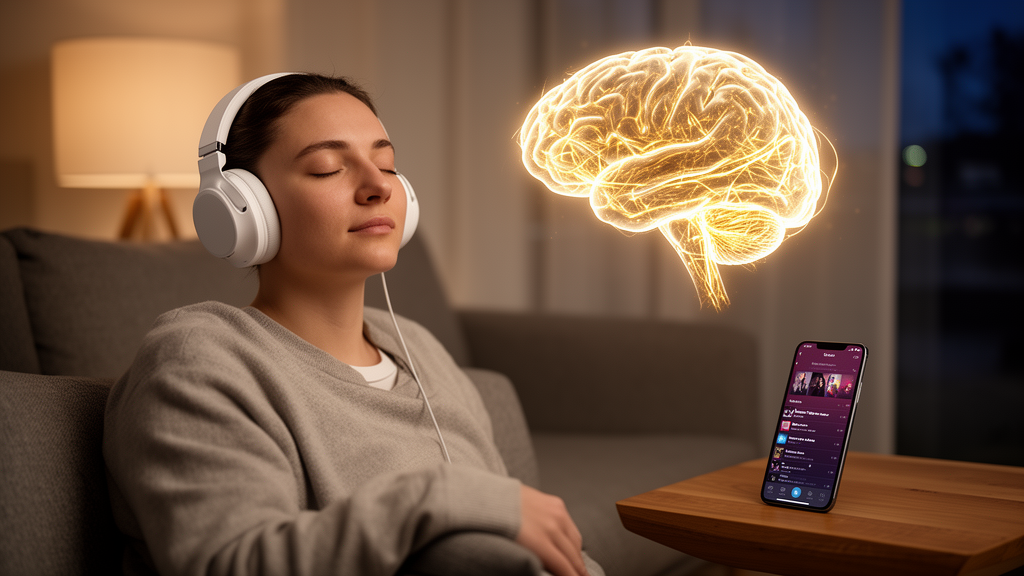
Music that adapts to your brain in real time sounds like science fiction, but a new critical review has taken the closest look yet at whether it actually works. The review, published in Frontiers in Human Neuroscience, synthesized 21 empirical studies of algorithmically personalized and artificial-intelligence-generated music interventions, covering at least 1,005 participants and reporting neurophysiological, neuroimaging, or objective behavioral outcomes. Its verdict is deliberately two-sided: the interventions consistently produce measurable changes in brain activity, and every study with a proper control favored the algorithmic condition, yet the evidence is too small, too unreplicated, and too methodologically immature to support any clinical use.
The central problem the review tackles is one most music-therapy trials never question: the assumption that the music itself is fixed. In nearly all conventional trials, participants receive either a researcher-selected program or their own preferred playlist, chosen in advance and deaf to what the listener’s brain is doing. Reviews of music therapy for dementia, cognitive decline, and sleep disturbance repeatedly flag unexplained heterogeneity, with the degree of individual tailoring nominated as the most plausible unmodeled factor. Algorithmic personalization promises to relax that assumption, and the technology to do so has matured rapidly in the engineering literature, largely out of sight of clinical neuroscience.
The review’s author, Jingting Jin of Jilin International Studies University, builds a taxonomy to cut through the field’s inconsistent terminology. The term “artificial intelligence” covers five distinct things in this literature: algorithmic selection from a corpus of existing recordings, rule-based sonification that maps physiological signals onto musical parameters, parametric modulation of pre-existing pieces, machine-learning generative composition, and closed-loop delivery in which the acoustic output at each moment depends on the listener’s own neural, autonomic, or movement signal. Only closed-loop contingency introduces a mechanism with no counterpart in fixed music, because the recursive coupling between brain state and sound is what neurofeedback theories of learning rest on.
Strikingly, only three of the 21 studies used a machine-learning generative model, despite the prominence of generative AI in popular accounts of the field. Most of the evidence concerns algorithmic personalization of existing material. Thirteen studies used neural sensing, predominantly EEG, and ten operated in real time, updating the sound continuously from the incoming signal. The theoretically most promising architecture, generative content under real-time neural sensing, is occupied by a single small emotion-induction experiment in 20 healthy participants, never tested against any clinical outcome.
The neurophysiological findings converge on frontal and prefrontal oscillatory effects, though they diverge by frequency band depending on each intervention’s target. One study reported that music generated from participants’ own resting-state EEG attenuated experimentally induced anxiety where self-selected preferred music and silence did not, with enhanced prefrontal theta oscillations as the correlate. A Japanese crossover trial found significantly higher normalized alpha power when white noise superimposed on classical music was genuinely contingent on neural activity, compared with yoked random feedback in the same participants. Other studies reported increased theta and alpha power during orthodontic pain, reduced beta connectivity alongside fatigue reduction, and EEG normalization under contingent oscillator feedback.
The most clinically striking result comes from a pre-post study in 19 children with epilepsy, in which all-night playlists selected to match audified healthy-hemisphere EEG reduced epileptiform spikes by a mean of 28.42%, with improvements in REM sleep and quality of life. Because overnight video-EEG spike counting cannot plausibly be influenced by participant expectations, this is among the more expectancy-resistant endpoints in the corpus. But the design lacked randomization, leaving regression to the mean unexcluded, and the review is explicit that a single nonrandomized trial in nineteen children establishes feasibility and a plausible signal, not efficacy.
Eight of the 21 studies carried a comparator capable of isolating the algorithmic component from music exposure itself, and all eight favored the algorithmic condition. Three of them isolated real-time contingency specifically by yoking the feedback or running the same generator unconditioned, finding advantages for genuinely adaptive delivery. One found that EEG-derived brain-wave music outperformed self-selected preferred music against induced anxiety, a contrast difficult to explain by stimulus-state matching alone, since preferred music is by construction well matched to the individual. Yet the review cautions that these eight studies address three different causal questions, use different architectures and outcomes, and that no specific finding has been independently replicated by a group other than the one that produced it.
The methodological weaknesses are severe. The median reported sample size was just 22, no study blinded participants, only one used single-blind conditions, no study reported blinded analysts, and none measured participant expectancy despite an intervention whose technological framing gives participants obvious grounds to expect benefit. Roughly two-thirds of the studies compared against silence, white noise, or nothing, meaning their effects speak to the value of music, not of personalization. Reporting of the personalization algorithms was often insufficient for replication, with sonification mappings described only at the level of a power-law principle. One prominent sleep finding, a decrease in delta power during slow-wave sleep, has been formally contested in a published commentary arguing it more plausibly indicates impairment than benefit. GRADE certainty was rated very low for every outcome domain, from EEG oscillatory power to sleep architecture, autonomic regulation, epileptiform activity, and cognitive and affective outcomes.
The review also stresses a distinction the field tends to blur: neurophysiological change, behavioral change, and clinical benefit are separate claims with separate evidential requirements. This corpus reports the first most often, the second less often, and the third least often, and a change in EEG oscillatory power does not by itself mean a person is better. Listener characteristics compound the problem. No included study measured musical sophistication with a validated instrument, none analyzed outcomes by sex or musical background, and fifteen of the twenty-one studies were conducted in East Asian populations, leaving generalization untested, even though a system claiming to tailor music to the individual is making a claim about individual differences.
What the evidence does support is continued, better-designed investigation. The review proposes eight requirements for future trials, including active comparators matched for musical exposure and novelty, yoked-feedback controls that hold the generative process constant while removing only the contingency, full reproducible reporting of the personalization algorithm, measured expectancy with verbatim recording of how the intervention was framed, and independent replication on a common set of endpoints. For now, the review concludes, the peer-reviewed evidence does not support clinical deployment, and claims of clinical readiness in commercial descriptions of adaptive music platforms substantially outrun what the published studies can actually show.
Subject of Research: Effects of AI-generated and algorithmically personalized music interventions on brain function, behavior, and health
Article Title: Artificial intelligence-generated and algorithmically personalized music interventions and their effects on brain function, behavior, and health: a critical review
Article References: Jin, J. (2026). Artificial intelligence-generated and algorithmically personalized music interventions and their effects on brain function, behavior, and health: a critical review. Frontiers in Human Neuroscience, 20, Article 1967909. https://doi.org/10.3389/fnhum.2026.1967909
Image Credits: AI Generated
DOI: 10.3389/fnhum.2026.1967909
Keywords: artificial intelligence, generative music, algorithmic personalization, EEG, neurofeedback, closed-loop systems, music therapy, brain function, anxiety, epilepsy, clinical evidence, GRADE certainty
Cite Scienmag News
Cassandra Pierce. (October 26, 2026). AI-Personalized Music Shows Neural Effects, But Evidence Remains Weak, Review Finds. Scienmag. https://scienmag.com/ai-personalized-music-shows-neural-effects-but-evidence-remains-weak-review-finds/
Cassandra Pierce. "AI-Personalized Music Shows Neural Effects, But Evidence Remains Weak, Review Finds." Scienmag, 26 October 2026, https://scienmag.com/ai-personalized-music-shows-neural-effects-but-evidence-remains-weak-review-finds/. Accessed 26 October 2026.
Cassandra Pierce. "AI-Personalized Music Shows Neural Effects, But Evidence Remains Weak, Review Finds." Scienmag. October 26, 2026. https://scienmag.com/ai-personalized-music-shows-neural-effects-but-evidence-remains-weak-review-finds/


