


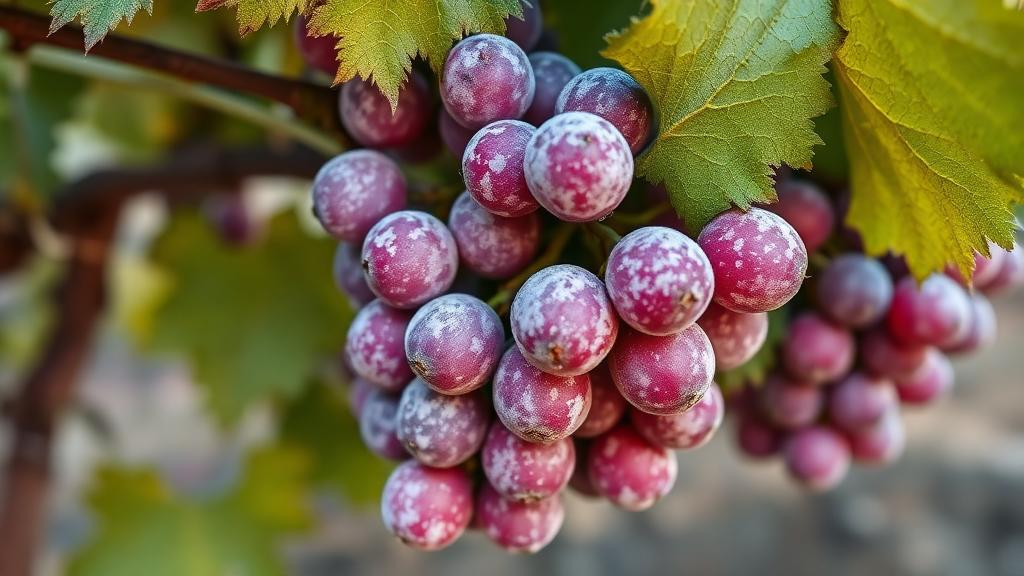
Powdery mildew is one of the most relentless enemies of grape growers worldwide. The fungal disease, caused by Erysiphe necator, does not merely trim yields; it degrades fruit quality, undermines marketability, and threatens the long-term sustainability of the grape and wine industries. Yet for all its economic weight, measuring how badly a vine is infected has remained stubbornly old-fashioned: human scouts walking vineyard rows, eyeballing leaves, and assigning coarse scores on four- or five-point scales. A new study published in Artificial Intelligence in Agriculture suggests that era may be ending. Researchers have built a family of large multi-modal AI models that can segment powdery mildew lesions pixel by pixel, quantify infection severity for every vine in a breeding vineyard, and even recover known resistance genes from the resulting data.
The problem the team set out to solve is deceptively simple to state and notoriously hard to execute. Accurate, objective, and scalable disease assessment underpins everything from fungicide timing to breeding decisions, but manual scouting cannot deliver it. Human evaluators differ from one another and from themselves over time; rater fatigue and variable lighting degrade consistency further; and coarse ordinal scales lack the resolution to capture subtle treatment effects. These inconsistencies ripple directly into genetics, where phenotype-to-genotype analyses depend on reliable measurements. Even when quantitative trait loci exist, noisy phenotypes can obscure them, reducing reproducibility across breeding programs. In regions like California, scouts must also peer into shaded inner canopy tissues where symptoms hide or pathogen viability is suppressed by ultraviolet light and heat.
Automated imaging systems have long promised a way out, capturing high-throughput visual data across entire vineyard blocks. But a bottleneck has persisted on the annotation side. Powdery mildew lesions are irregular, diffuse, and visually variable, making pixel-level labeling labor-intensive and dependent on scarce expert knowledge. Building large, high-quality, domain-specific datasets is prohibitively expensive, and conventional deep learning models trained from scratch on limited labeled data tend to falter in messy outdoor environments. The challenge, as the researchers frame it, is not acquiring imagery but teaching models to learn from scarce and noisy labels.
Their answer draws on the current paradigm shift in artificial intelligence from task-specific networks to generalist foundation models. The team fused two of the most influential vision foundation models: the Segment Anything Model, or SAM, trained on more than a billion masks and capable of promptable segmentation of arbitrary objects, and CLIP, a model trained on 400 million image-text pairs that aligns visual and linguistic representations in a shared embedding space. SAM contributes high-resolution spatial precision, preserving object boundaries and fine structure, while CLIP contributes semantic reasoning grounded in natural language. In the integrated architecture, each image is processed in parallel by both encoders. A learnable multilayer perceptron projects SAM’s embedding into CLIP’s latent space, the two representations are fused by element-wise addition, and the result is conditioned on text embeddings for prompts such as “Powdery mildew” or “Canopy.” A dot-product interaction between the fused visual representation and the text embedding produces a multi-modal representation that a second MLP transforms back into the spatial layout SAM’s mask decoder needs. The output is segmentation guided jointly by pixel-level detail and language-based disease concepts.
Because labeled agricultural data is scarce, the researchers systematically compared parameter-efficient fine-tuning strategies: full fine-tuning, adapter modules inserted into key layers, and low-rank adaptation, or LoRA, which updates attention and feedforward layers through small low-rank matrices. Each strategy was tested with two SAM backbones, ViT-B and ViT-H, and with either the encoder alone or both encoder and decoder trainable. The verdict was clear: adapter-based tuning with both modules trainable performed best, and the fine-tuning strategy mattered more than raw model size. LoRA’s tiny updates proved insufficient to transfer CLIP’s rich semantic knowledge into the agricultural domain, a finding that underscores how much representational capacity is needed to absorb new visual vocabulary.
The resulting models, PM-SAM-CLIP for lesion segmentation and Canopy-SAM-CLIP for canopy extraction, were trained on modest datasets collected in New York with custom imaging rigs using active strobe illumination to maximize contrast and consistency. PM-SAM-CLIP, built on the ViT-H backbone, was fine-tuned on just 175 manually annotated images; Canopy-SAM-CLIP used 415. Despite the small training sets, the models decisively outperformed baselines including PM-SAM, DeepLab v3+, and SegFormer. On the powdery mildew test set, PM-SAM-CLIP achieved 59.63 percent image-level mean intersection over union and 64.12 percent dataset-level, beating the strongest baseline by roughly 13 to 14 percentage points and weaker baselines by more than 30. Crucially, on the worst-performing subsets of images, where competing models nearly collapsed to zero, the multi-modal model maintained scores between 21.51 and 30.25 percent, demonstrating that semantic context stabilizes performance on the hardest cases, such as sparse lesions and cluttered canopies. Canopy segmentation reached 95.59 percent image-level accuracy with strong worst-case robustness.
The real test came in California, at a USDA vineyard in Parlier planted with a genetically diverse mapping population spanning multiple Vitis species and managed under a different trellis system than the New York training data. Deployed zero-shot, without any additional fine-tuning, PM-SAM-CLIP segmented infections across two growing seasons and more than 30,000 images, contending with confounders like dust and sunburn that visually mimic mildew. A post-processing step intersecting predicted infection masks with canopy masks suppressed false positives outside biologically relevant tissue. At the vine level, severity was computed as the maximum normalized overlap between infection and canopy masks across all images of each vine, mirroring how expert scouts assess the worst infection instance. The agreement with human experts was striking: 79 percent of vines in 2023 and 81 percent in 2024 received identical scores, and more than 98 percent fell within one score level of the human rating. The pipeline even captured subtleties humans cannot, such as the difference between 75 and 76 percent infected area.
The most consequential validation came from genetics. The team fed image-derived severity scores into QTL mapping using a high-density rhAmpSeq genetic map built from 465 markers across 291 progeny of a cross between Vitis amurensis and V. vinifera. Across both years, every phenotyping method, human and automated alike, converged on the same significant QTL on chromosome 13, spanning 22.2 to 27.6 megabases. That interval overlaps the previously fine-mapped REN12 locus, a known major resistance gene, providing biological confirmation that the AI-generated phenotypes capture real genetic signal. The image-derived QTL explained 22.9 to 26.2 percent of phenotypic variance, slightly below the human-scored range but well within expected field variability. Spatiotemporal heatmaps of infection across the vineyard additionally revealed persistent high-severity zones and stable low-scoring vines, information that can guide both genotype selection and site-specific fungicide decisions.
The implications extend well beyond one disease or one crop. By fine-tuning pre-trained foundation models on tiny domain datasets, the approach sidesteps the annotation bottleneck that has long constrained AI in agriculture, and text prompts give plant pathologists an interpretable way to steer model behavior using their own vocabulary. The researchers acknowledge limitations, including occasional false positives from dust and sunburn, QR-code detection failures, and the expressiveness limits of single-keyword prompts, and they point toward edge deployment on field robots, richer textual descriptions, and integration with hyperspectral or thermal sensing. They also call for open, FAIR-compliant multi-modal agricultural datasets to accelerate foundation-model training across the plant sciences. With code, models, and datasets publicly released, the study sketches a closed loop from field imagery to genotype discovery to precision disease management, a blueprint for next-generation phenotyping in viticulture and beyond.
Subject of Research: Automated phenotyping of grapevine powdery mildew using integrated SAM-CLIP multi-modal vision foundation models
Article Title: Integrating large multi-modal models for automated powdery mildew phenotyping in grapevines
Article References: Lin, Y., Dashner, Z., Jimenez, A., Wilkerson, D., Cadle-Davidson, L., Riaz, S., & Jiang, Y. (2026). Integrating large multi-modal models for automated powdery mildew phenotyping in grapevines. Artificial Intelligence in Agriculture. https://doi.org/10.1016/j.aiia.2026.09.006
Image Credits: AI Generated
DOI: 10.1016/j.aiia.2026.09.006
Keywords: powdery mildew, grapevine, phenotyping, SAM, CLIP, foundation models, segmentation, QTL mapping, viticulture, plant disease detection, multi-modal AI, breeding
Cite Scienmag News
Alan Morgan. (October 7, 2026). AI Models Learn to Spot Grapevine Powdery Mildew Before Humans Do. Scienmag. https://scienmag.com/ai-models-learn-to-spot-grapevine-powdery-mildew-before-humans-do/
Alan Morgan. "AI Models Learn to Spot Grapevine Powdery Mildew Before Humans Do." Scienmag, 7 October 2026, https://scienmag.com/ai-models-learn-to-spot-grapevine-powdery-mildew-before-humans-do/. Accessed 28 October 2026.
Alan Morgan. "AI Models Learn to Spot Grapevine Powdery Mildew Before Humans Do." Scienmag. October 7, 2026. https://scienmag.com/ai-models-learn-to-spot-grapevine-powdery-mildew-before-humans-do/


