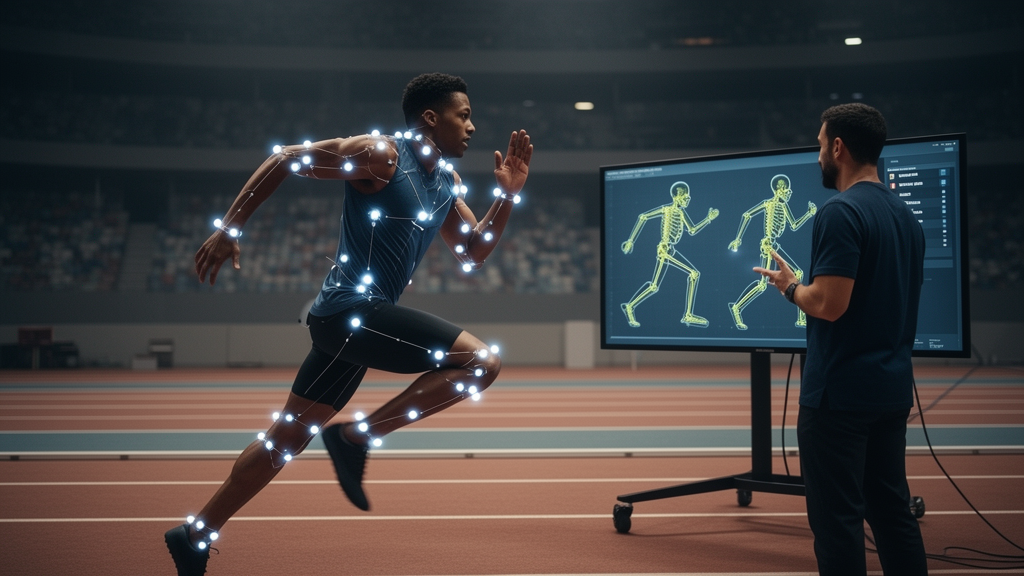
A new artificial intelligence system for sports training combines the pattern-recognition power of deep learning with the transparency of decision trees, and reports both record-level accuracy and an explanation for every call it makes. The model, described as a deep neural decision forest, was developed by Zhibin Hu and published in the journal Discover Artificial Intelligence. In benchmark tests on three public sensor datasets, it reached 98.5 percent action recognition accuracy and an F1 score of 98.3 percent, 4.3 percentage points above a traditional convolutional neural network, while still producing decision paths that coaches can read and audit.
The problem the system targets is a familiar one in applied machine learning. Motion recognition systems built on computer vision depend heavily on lighting, camera angle and whether the athlete is occluded, and they raise privacy concerns. Wearable inertial measurement units avoid those limits but produce noisy signals and models whose reasoning is opaque. Deep networks such as convolutional and recurrent architectures perform well on recognition tasks, yet their black-box character makes it hard for a coach to know why a movement was flagged as faulty. Classical machine learning methods such as support vector machines and random forests are interpretable but struggle with the complex, high-dimensional time series that sports data generate. Most existing pipelines also train feature extraction and classification separately, which the author identifies as a source of error accumulation and information loss.
The new architecture fuses the two traditions into a single end-to-end trainable model. Raw three-axis accelerometer and gyroscope data enter a multi-granularity scanning layer, which slices the time series with sliding windows of different sizes. The window count follows a simple formula based on window length and step size, and the overlapping windows ensure that both transient bursts, such as the explosive phase of a jump, and long-term rhythms, such as a steady gait cycle, are captured simultaneously. Each subsequence then passes through convolutional layers that extract local spatiotemporal features using shared weights and ReLU activations, producing multi-scale feature maps.
The distinctive component is what happens next. Instead of feeding those features into a conventional classifier, the system routes them through differentiable decision trees. Standard decision trees make hard, non-differentiable splits, which blocks gradient-based training. The model solves this with a soft binning function: a softmax over scaled feature values assigns each input a probability distribution across possible split points, controlled by a temperature hyperparameter. When the temperature approaches zero the behavior approaches a hard split; as it grows the distribution flattens. For multi-feature inputs, a Kronecker product combines the per-feature binning distributions into a continuous path probability across the tree, so that every leaf’s contribution to a prediction can be traced and the whole structure optimized by backpropagation.
A forest of five such trees runs in parallel, and their outputs are fused by an adaptive weighting scheme rather than the static voting of a traditional random forest. Each tree’s weight is computed from its accuracy on a validation set through a softmax-like formula with a smoothing factor, so better-performing trees carry more influence and anomalous trees are down-weighted. The training loss combines a cross-entropy classification term with a mean-squared-error scoring term, optimized with the Adam algorithm at a learning rate of 0.001, with dropout and early stopping to guard against overfitting.
The system also produces something most recognizers do not: a movement quality score from 0 to 100, derived from the entropy of the forest’s output probability distribution. A low entropy means the model is confident the movement matches a standard template and yields a high score; a high entropy signals ambiguity or deviation. In one field demonstration during squat training, the score plummeted at the fifteenth second, exactly matching the trainer’s logged observation of a movement fault. The model can also correlate the deviation back through the decision path. For the squat example, the first two tree layers split mainly on frequency-domain energy from the vertical accelerometer axis, weighted at 68 percent, which the paper notes is consistent with the loading biomechanics of the exercise.
Evaluation drew on three public datasets: the WISDM smartphone sensor dataset, the UCI human activity recognition dataset, and the Daphnet freezing-of-gait dataset, all preprocessed with a unified pipeline of outlier removal, Z-score standardization, 2.56-second sliding windows with 50 percent overlap, and balanced sampling for class imbalance. A field experiment involved 50 volunteers split into experimental and control groups of 25, with the control side using baseline models including convolutional neural networks, support vector machines, random forests and long short-term memory networks. Performance was measured with ten-fold cross-validation, robustness with injected Gaussian noise, and practicality on a Raspberry Pi 4B single-board computer.
The numbers reported are striking across several dimensions. Beyond the headline accuracy and F1 scores, the model held 92.7 percent accuracy when Gaussian noise reduced the signal-to-noise ratio to 10 dB, while traditional methods fell below 86 percent, an advantage the author attributes to the adaptive ensemble damping the influence of outlier trees. On the embedded platform the forward pass took 12.1 milliseconds with 28.7 megabytes of memory, roughly 63.5 percent of the CNN’s footprint, and a complete end-to-end pipeline including preprocessing and score calculation came to about 18.3 milliseconds, within the sub-30-millisecond threshold the paper sets for real-time coaching feedback. Ablation tests showed that removing multi-granularity scanning cut recognition of short burst movements by 7.2 percent while affecting long steady-state movements by only 1.1 percent, and removing the adaptive integration raised variance under artificial noise. Decision path consistency, a measure of how reproducible and traceable the model’s reasoning is, reached 94.6 percent, far above the black-box baselines. Cross-dataset transfer from WISDM to Daphnet cost only 7.2 percentage points of accuracy, and scaling training data from 10 to 100 percent lifted accuracy by 6.4 percent with roughly linear growth in training time.
The author is candid about the limits. The training data come mainly from laboratory environments, and real training settings involve coupled disturbances the Gaussian noise tests do not capture, such as sensor drift from rising body temperature, changing electrode-skin impedance during vigorous exercise, and altered movement patterns under fatigue or injury. Planned remedies include adversarial domain adaptation, Kalman filtering at the input stage, and confidence thresholds that trigger recalibration when prediction entropy rises too high. The model also weakens on extremely rare action types, reflecting a long-tail data problem that may require data augmentation or small-sample learning. A single unified model currently serves all subjects, so personalized tuning is a future goal, as are multi-modal fusion with video, ECG and EMG signals, model compression through distillation, pruning and quantization, online incremental learning, and uncertainty estimation with fault detection for high-stakes competitive settings where a misclassification could carry real consequences.
Even with those caveats, the study sketches a plausible route from action recognition to what the paper calls intelligent coaching: a wearable or tablet-based loop in which the system labels movements in real time, scores their quality, and pushes a visual feedback report to the coach with a 12.1-millisecond delay, supporting individualized correction plans. The broader significance may lie less in the accuracy figures than in the demonstration that interpretability and deep-learning performance need not be traded against each other. By making the tree structure itself differentiable, the work joins a growing line of research trying to give neural networks auditable reasoning, and it suggests that in domains where human experts must trust and act on machine judgments, that combination could matter as much as raw accuracy.
Subject of Research: A differentiable deep neural decision forest for interpretable, real-time sports motion recognition and training feedback
Article Title: Deep neural decision forest-driven sports specific training system
Article References: Hu, Z. (2026). Deep neural decision forest-driven sports specific training system. Discover Artificial Intelligence, 6(1), Article 988. https://doi.org/10.1007/s44163-026-02044-y
Image Credits: AI Generated
DOI: 10.1007/s44163-026-02044-y
Keywords: deep neural decision forest, motion recognition, sports training, interpretable AI, wearable sensors, convolutional neural network, decision trees, edge computing, human activity recognition, machine learning, adaptive ensemble, movement quality scoring
Cite Scienmag News
Blake Davidson. (October 28, 2026). AI model makes sports training decisions transparent with 98.5% motion recognition accuracy. Scienmag. https://scienmag.com/ai-model-makes-sports-training-decisions-transparent-with-98-5-motion-recognition-accuracy/
Blake Davidson. "AI model makes sports training decisions transparent with 98.5% motion recognition accuracy." Scienmag, 28 October 2026, https://scienmag.com/ai-model-makes-sports-training-decisions-transparent-with-98-5-motion-recognition-accuracy/. Accessed 28 October 2026.
Blake Davidson. "AI model makes sports training decisions transparent with 98.5% motion recognition accuracy." Scienmag. October 28, 2026. https://scienmag.com/ai-model-makes-sports-training-decisions-transparent-with-98-5-motion-recognition-accuracy/