


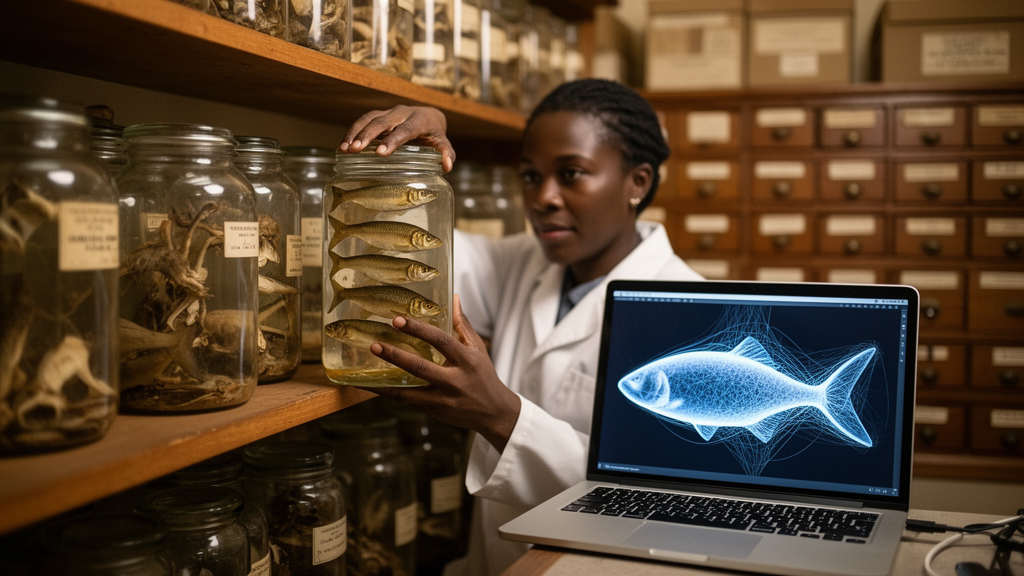
In a basement storeroom in Bulawayo, a team of researchers pointed an ordinary smartphone at jars of preserved fish and set out to answer a question that could reshape how natural history museums work: can artificial intelligence learn to see the secrets held by specimens that have been sitting in collections for decades? The answer, according to a new study published in Natural History Collections and Museomics, is a cautious but compelling yes. Using just 53 images of preserved Zimbabwean freshwater fish from the Natural History Museum of Zimbabwe, the researchers trained a family of deep-learning models to recognise two traits of major ecological importance — body shape and caudal fin morphology — and found that even the smallest, most lightweight models performed with striking reliability.
The study focused on YOLOv11, a state-of-the-art object detection architecture whose name — You Only Look Once — reflects its design philosophy of identifying objects in an image in a single computational pass. The team trained three variants of the model, designated nano, small and medium, which differ in the number of parameters they carry and therefore in the computing power they demand. This size comparison mattered because many museums, particularly in developing countries, operate without the high-performance GPUs, large storage systems and reliable connectivity that heavy AI workloads typically require. If a nano model could match its larger siblings, the door to AI-assisted curation would swing open for institutions with modest infrastructure.
To build the training data, the researchers photographed preserved specimens from four major freshwater fish orders found in Zimbabwe — Cypriniformes, Characiformes, Cichliformes and Siluriformes — using smartphone cameras with resolutions as low as 540 by 960 pixels, deliberately demonstrating that expensive imaging equipment is not a prerequisite. Each fish was captured in lateral view against a plain white background, and the team manually annotated two trait regions per image using bounding boxes. Body shapes were labelled as fusiform, the streamlined torpedo outline of fast-swimming open-water species, or compressiform, the laterally flattened form suited to manoeuvring through vegetation and rocky habitats. Caudal fins were classified as forked, emarginate, truncate or rounded, categories that carry direct functional meaning for locomotion, habitat preference and foraging behaviour.
Because 53 images is a tiny dataset by deep-learning standards, the team applied aggressive offline data augmentation using the Albumentations library, generating variations in lighting, orientation, scale and blur on the annotated trait regions themselves while preserving the museum’s characteristic plain backgrounds. The final post-augmentation dataset contained 1,221 images, split into 1,098 for training and 123 for validation. All three models were trained under default settings for 100 epochs on a single desktop workstation equipped with an NVIDIA GeForce RTX 4070 graphics card, and each was evaluated on five randomly generated validation subsamples to quantify how sensitive the performance estimates were to the composition of the validation data.
The results were remarkably consistent. Across all three model sizes, mean recall — the proportion of true trait instances the models successfully detected — exceeded 0.95, meaning the models almost never missed a trait they were looking for. Mean average precision at the standard 50 percent overlap threshold, known as mAP@0.5, ranged from 0.75 to 0.78, indicating strong overall detection quality. The nano variant achieved the highest mAP@0.5 at 0.780, while the medium model edged ahead on precision and stricter localisation as measured by mAP@0.5:0.95. Crucially, one-way ANOVA tests found no statistically significant differences among the three model sizes on any metric, a finding that directly challenges the assumption that bigger models are always better and suggests lightweight networks are viable for trait detection under resource-constrained conditions.
Trait-level analysis revealed a clear pattern in what the models found easy and hard. All three variants classified emarginate and truncate tail types and fusiform body shapes with 100 percent accuracy, and forked tails followed closely at 93 to 98 percent. Traits with sharp edges and angular boundaries, it turns out, are readily learnable even from preserved specimens that show discolouration or physical deterioration. The trouble came with subtler forms: rounded tails scored 85 to 87 percent, and compressiform body shapes were the weakest class of all, with correct classification rates of only 43 to 57 percent, often confused with the background itself. The researchers attribute this to the gentle, ill-defined contours of compressed body forms, which lack the geometric boundaries that convolutional networks latch onto, a problem compounded by preservation-related deformation and low contrast against the white imaging background.
The study’s most sobering finding came from its generalisation stress test. The team evaluated the trained models on 59 fish images sourced from the Global Biodiversity Information Facility, an open platform hosting photographs contributed by researchers and citizen scientists. These images differed radically from museum conditions: variable lighting, cluttered backgrounds, odd orientations and specimens photographed in life colouration rather than preserved tones. The models retained a partial ability to localise traits, with mean intersection-over-union values between 0.517 and 0.581 and reasonably low bounding-box errors, showing that some learned morphological features do transfer. But classification performance collapsed, with precision falling to between 0.073 and 0.166 and recall to between 0.153 and 0.251. In other words, a model that was nearly flawless on museum shelves became unreliable in the wild.
This domain gap is a well-known phenomenon in machine learning, but the study documents it concretely for biodiversity data and points toward its solution: heterogeneity. Models trained on small, curated datasets from a single institution with standardised imaging simply cannot absorb the full visual variability of the natural world. The authors argue that expanding training datasets to include images from additional museums, field photographs and community-science platforms, along with augmentation strategies that mimic real-world conditions, will be essential for building tools that work beyond the gallery. They also suggest that segmentation-based annotations, which trace the precise outlines of subtle forms rather than drawing rectangular boxes around them, could sharpen the detection of traits like compressiform bodies that currently blur into the background.
What makes the study genuinely significant is its setting. Most deep-learning applications in biodiversity science have been built on large datasets from well-funded institutions in wealthy countries, trained on live or freshly captured specimens. This work demonstrates a proof of concept for high-scarcity data, echoing earlier research that used 3D scans of mammal specimens to synthesise training images when real photographs were rare. By showing that 53 smartphone photos of preserved fish can seed a functioning trait-detection system, the researchers have lowered the entry barrier for the very institutions that hold much of the world’s biodiversity knowledge but lack the computational muscle to exploit it. Lightweight models that run on modest hardware could eventually allow curators to automate trait-based cataloguing, screen digitised collections for quality control and prioritise specimens for further study — and, integrated into mobile-friendly platforms, put such tools into the hands of students and field researchers using ordinary phones.
The broader message is that natural history museums are no longer just repositories of the past; they are becoming training grounds for the algorithms that will catalog the future. Millions of preserved specimens worldwide sit as an untapped reservoir of morphological information, and this Zimbabwean fish case study shows that even a small, resource-constrained collection can contribute meaningfully to AI-driven biodiversity research. The limitations are real — generalisation remains poor outside curated conditions, and the dataset captured only a fraction of Zimbabwe’s fish diversity — but the trajectory is clear. As digitisation accelerates and image archives grow, the gap between what museum specimens look like and what algorithms need to learn from them is narrowing, one bounding box at a time.
Subject of Research: AI-driven computer vision detection of morphological traits in preserved Zimbabwean fish museum specimens
Article Title: Leveraging museum specimens for AI -driven trait detection using computer vision: A case study on Zimbabwean fish
Article References: Mafuwe, K., Sebata, N., Zimunya, M. T., & Crossley, M. S. (2026). Leveraging museum specimens for AI-driven trait detection using computer vision: A case study on Zimbabwean fish. Natural History Collections and Museomics, 3, Article e187529. https://doi.org/10.3897/nhcm.3.187529
Image Credits: AI Generated
Keywords: museum specimens, computer vision, deep learning, YOLO, fish morphology, trait detection, Zimbabwe, natural history collections, biodiversity, object detection, GBIF, data augmentation
Cite Scienmag News
Blake Davidson. (October 16, 2026). AI Learns to Read Fish Traits from Century-Old Museum Specimens in Zimbabwe. Scienmag. https://scienmag.com/ai-learns-to-read-fish-traits-from-century-old-museum-specimens-in-zimbabwe/
Blake Davidson. "AI Learns to Read Fish Traits from Century-Old Museum Specimens in Zimbabwe." Scienmag, 16 October 2026, https://scienmag.com/ai-learns-to-read-fish-traits-from-century-old-museum-specimens-in-zimbabwe/. Accessed 16 October 2026.
Blake Davidson. "AI Learns to Read Fish Traits from Century-Old Museum Specimens in Zimbabwe." Scienmag. October 16, 2026. https://scienmag.com/ai-learns-to-read-fish-traits-from-century-old-museum-specimens-in-zimbabwe/


