


Every year, nearly a million babies in South Asia die during labor or shortly after birth, and a large share of those deaths trace back to a simple failure: nobody notices in time that the fetus is in distress. A new study from Nepal suggests that a strap-on, alarm-equipped fetal heart rate monitor could change that arithmetic. Researchers report that switching hospitals from intermittent to continuous fetal heart rate monitoring with a portable device called Moyo shortened the interval between detecting an abnormal heart rate and delivery by more than an hour, and reduced the risk that a newborn would fail to breathe and require resuscitation by 31 percent.
The study, published in Frontiers in Drug Safety and Regulation, was led by Omkar Basnet of Golden Community in Lalitpur, Nepal, together with collaborators at Uppsala University and the University of Gothenburg. It took place in seven public referral hospitals, each representing one of Nepal’s provinces, over an eight-month period from October 2020 to June 2021. The team enrolled 1,091 women during a control period in which nurses checked fetal heart rates intermittently with the Moyo device, and 8,687 women during an intervention period in which the same device was used continuously until delivery. In total, 32,269 deliveries occurred in the participating hospitals during the study window, from which the analyzed cohort was drawn after exclusions and consent procedures.
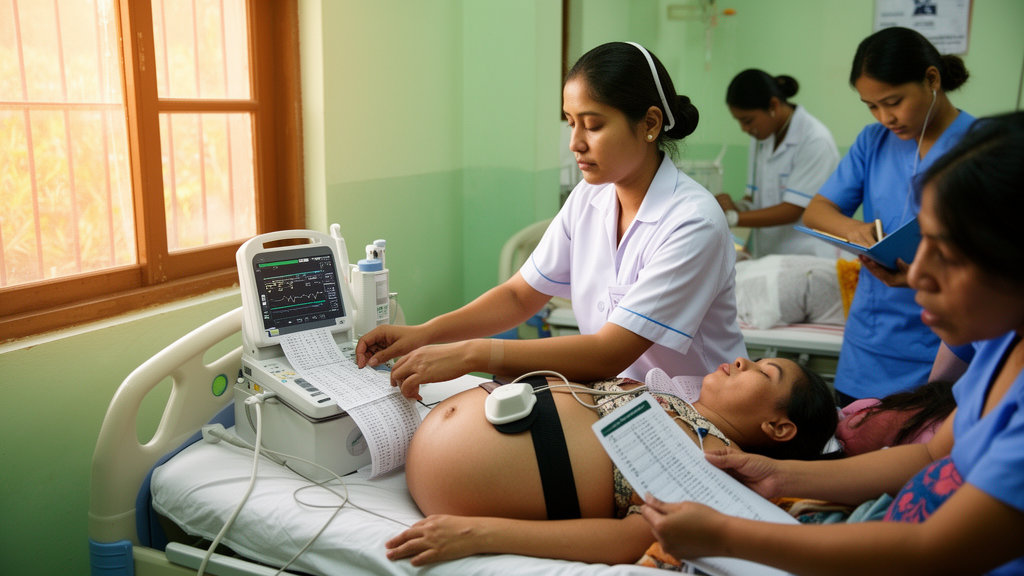
The technology at the center of the trial is deliberately simple. Moyo is a portable fetal heart rate monitor built around a nine-crystal Doppler ultrasound sensor that straps onto the mother’s abdomen. Unlike a handheld Doppler, which a midwife must pick up and position every 30 minutes during the first stage of labor and every 15 minutes during the second, Moyo tracks the fetal heart rate continuously and displays it through sound waves, numerical readouts, and color coding. Crucially, it also sounds an alarm if an abnormal heart rate, defined as above 160 or below 110 beats per minute, persists for three minutes. That alarm allows a single midwife, who in some Nepali hospitals may be responsible for roughly 900 deliveries a year, to keep watch over several laboring women at once.
The results on timing were striking. The median time from the first detection of an abnormal fetal heart rate to delivery fell from 132 minutes under intermittent monitoring to 73 minutes under continuous monitoring. After adjusting for maternal and fetal complications and for intrauterine resuscitation, the researchers calculated a 30 percent reduction in that interval, corresponding to an adjusted reduction of 66.5 minutes. The time from the last abnormal heart rate check to delivery shortened by about 43 minutes, and the total time from first monitor placement to delivery fell by 67 minutes. Only the interval from first monitor placement to first abnormal detection, which shrank by 35.5 minutes, missed the threshold of statistical significance.
Because the exposure was not randomized, the team took unusual statistical care. They used generalized linear models for the time intervals, then applied causal mediational modeling to separate the direct effect of monitoring type on newborn outcomes from its indirect effect through intrapartum resuscitation, treating intrapartum complications as confounders. Risk estimates were standardized with the Mantel–Haenszel homogeneity method. The researchers also ran sensitivity analyses using propensity scores, including inverse probability weighting, and found that the direction and magnitude of the associations held, though some effect estimates were attenuated. Meta-regression across the seven hospitals showed low heterogeneity for the key delivery-timing outcomes, suggesting the findings were not driven by one unusually well-run facility.
The downstream clinical outcomes are where the findings become most consequential. Non-crying at birth, a clinical sign that a newborn needs resuscitation within the first fifteen seconds of life, occurred in 11.5 percent of babies in the control group versus 10.0 percent in the intervention group. After mediational adjustment, the risk was 31 percent lower with continuous monitoring, a statistically significant result with a risk ratio of 0.69. The need for neonatal ventilation, at 5.1 percent versus 4.3 percent, likewise showed a 31 percent lower adjusted risk. Intrapartum stillbirth fell from 4.5 to 3.0 per 1,000 births, a 35 percent crude reduction, but with such a rare outcome the confidence interval stretched across the null, and the authors caution that the analysis may simply have been underpowered to confirm a mortality effect.
The mechanism the authors propose is physiologically straightforward. When a fetus experiences hypoxic stress during labor, prolonged delay before intervention allows injury to accumulate. Continuous monitoring compresses two critical delays: the time it takes to notice that something is wrong, and the time it takes the clinical team to act once the alarm sounds. In the Nepali hospitals studied, where a single provider may face eight laboring women and two active deliveries at any moment, intermittent checks every half hour are difficult to sustain. The device’s histogram review of the previous 30 minutes of heart rate tracing, combined with its automatic alarm, effectively gives each midwife a continuous surveillance capability that would otherwise require far more staff.
The findings align with evidence from Tanzania, where randomized trials comparing continuous Moyo monitoring with intermittent Doppler assessment found earlier detection of abnormal fetal heart rates and fewer newborns requiring resuscitation in the continuous group. Earlier studies that compared cardiotocography with intermittent auscultation in high-resource settings often failed to show improvements in perinatal death, which makes the consistency of the low-resource findings notable. The Nepali authors suggest that the difference may lie in the alarm function and the portability of the device, features designed specifically for settings where continuous electronic monitoring with wired equipment is impractical.
The study is not without limitations, and the authors are candid about them. Blinding was impossible, monitoring frequency itself differed by design between the two periods, and some time intervals were recorded through routine clinical documentation, which can vary across settings. There was also selection bias: women who were eligible but not enrolled differed in obstetric characteristics from those who were, though the mediational analysis adjusted for measured differences. The small control group of 1,091 women, relative to 8,687 in the intervention arm, further limits the precision of comparisons. The authors also note that the high uptake of continuous monitoring may partly reflect the presence of research staff supporting the quality improvement process, and that neonatal mortality itself was not among the measured outcomes.
Even with those caveats, the policy implications are hard to ignore. Poor-quality intrapartum care has been linked to nearly six million deaths over the past 25 years, and although institutional births in Nepal rose from 9 percent in 2001 to 78 percent in 2024, only about a third of women receive high-quality care during labor. The authors argue that continuous fetal heart rate monitoring with low-cost portable devices is a practical, sustainable investment: it reduces the workload per provider, shortens the window of fetal vulnerability, and lowers the number of newborns who arrive needing resuscitation. In settings where the ratio of births to birth attendants is extreme, a device that watches every labor continuously and shouts when something goes wrong may be the closest thing to adding staff without hiring them.
Subject of Research: Implementation of continuous versus intermittent fetal heart rate monitoring during labor and its effects on intrapartum care and neonatal outcomes in Nepal
Article Title: Evaluating the implementation of intermittent versus continuous fetal heart rate monitoring on intrapartum care and early neonatal outcomes using causal mediational modeling
Article References: Evaluating the implementation of intermittent versus continuous fetal heart rate monitoring on intrapartum care and early neonatal outcomes using causal mediational modeling. (n.d.). https://doi.org/10.3389/fdsfr.2026.1755487
Image Credits: AI Generated
DOI: 10.3389/fdsfr.2026.1755487
Keywords: fetal heart rate monitoring, Moyo device, intrapartum care, neonatal resuscitation, Nepal, stillbirth, causal mediational modeling, low-resource settings, obstetrics, newborn health, Doppler monitoring, maternal health
Cite Scienmag News
Harold Sullivan. (October 16, 2026). Continuous Fetal Monitoring in Nepal Speeds Delivery Decisions and Cuts Newborn Resuscitation Risk. Scienmag. https://scienmag.com/continuous-fetal-monitoring-in-nepal-speeds-delivery-decisions-and-cuts-newborn-resuscitation-risk/
Harold Sullivan. "Continuous Fetal Monitoring in Nepal Speeds Delivery Decisions and Cuts Newborn Resuscitation Risk." Scienmag, 16 October 2026, https://scienmag.com/continuous-fetal-monitoring-in-nepal-speeds-delivery-decisions-and-cuts-newborn-resuscitation-risk/. Accessed 16 October 2026.
Harold Sullivan. "Continuous Fetal Monitoring in Nepal Speeds Delivery Decisions and Cuts Newborn Resuscitation Risk." Scienmag. October 16, 2026. https://scienmag.com/continuous-fetal-monitoring-in-nepal-speeds-delivery-decisions-and-cuts-newborn-resuscitation-risk/


