


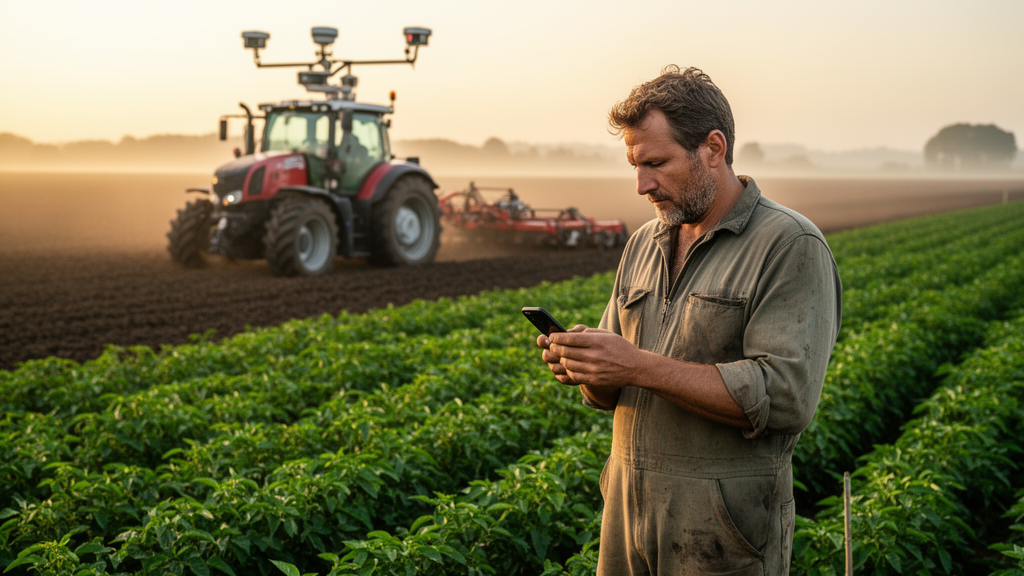
Artificial intelligence has quietly become one of the most powerful tools in modern agriculture, promising to reshape how the world grows food under intensifying climate pressure. A comprehensive critical review published in Discover Artificial Intelligence by Mostafa Farajpour of the Mazandaran Agricultural and Natural Resources Research and Education Center synthesizes 186 peer-reviewed studies published mostly between 2023 and 2026, examining AI applications across precision irrigation, nutrient and soil management, yield prediction, pest and disease detection, and AI-powered decision support. The review’s central message is strikingly two-sided: the technology delivers remarkable performance numbers in research settings, yet widespread, equitable deployment in real fields remains stubbornly out of reach for many of the world’s farmers.
The stakes could hardly be higher. The global population is projected to reach approximately 9.7 billion by 2050, requiring an estimated 70 percent increase in food production compared with current levels. Climate change has intensified droughts and floods, geopolitical conflicts have disrupted supply chains, and fertile soil and freshwater continue to degrade. Conventional agriculture, which treats entire fields uniformly with standardized applications of water, fertilizer, and pesticides, is increasingly recognized as inadequate for these challenges. The response has been the transition to Agriculture 4.0, the Fourth Agricultural Revolution, in which the Internet of Things, big data analytics, artificial intelligence, and automated systems converge to enable site-specific, data-driven crop management.
Nowhere is AI’s promise more tangible than in precision irrigation. AI-based systems integrate data from field sensors, IoT networks, and wireless sensor networks to continuously monitor soil moisture and weather conditions, then use machine learning and deep learning algorithms to predict irrigation requirements and optimize water application. Models including Multi-Layer Perceptrons, Support Vector Machines, and optimized neural network architectures have achieved prediction accuracies exceeding 99 percent for irrigation scheduling, contributing to reported water savings of up to 27 percent and energy savings of up to 57 percent. In one practical example, AI-based irrigation management in cherry tomato production increased water-use efficiency by 20.7 percent while improving fruit yield and quality. Emerging approaches push further: deep learning models can now estimate crop irrigation status directly from leaf imagery, and Digital Twin technologies combined with machine learning allow farmers to simulate irrigation scenarios before committing a single drop of water.
Beneath the soil, AI is decoding relationships that traditional agronomy struggled to capture. Artificial Neural Networks and General Regression Neural Networks have modeled the complex nonlinear interactions governing nutrient dynamics within the soil-plant system. In citrus nurseries, a dual-metric feature selection approach identified seven key nutrients associated with seedling vigor, with the GRNN model achieving a coefficient of determination of 0.94. In black raspberry, Multi-Layer Perceptron models indicated that reducing potassium application by 30 percent while increasing magnesium and copper could raise antioxidant activity by up to 89 percent. Machine learning algorithms have also achieved classification accuracies exceeding 95 percent for soil type identification using hyperspectral data, and Artificial Neural Networks have estimated Soil Quality Indices with R-squared values near 0.98, enabling identification of limiting factors such as elevated calcium carbonate, pH imbalances, and salinity.
Yield prediction and harvest forecasting have advanced equally fast. Graph Neural Networks and Long Short-Term Memory models have outperformed conventional methods for potato yield prediction by capturing both spatial and temporal dependencies. Random Forest models integrating UAV-derived multispectral imagery achieved an R-squared of 0.90 for wheat yield estimation, while Gradient Boosting models combining meteorological variables, pesticide records, and soil information reached an extraordinary 99.99 percent. Computer vision systems built on the YOLO architecture have predicted weekly strawberry yields with R-squared values up to 0.908, classified tomato ripeness with a prediction error of just 6.85 percent, and estimated lettuce harvest dates with a mean error of 2.35 days. These capabilities translate directly into better labor planning, harvest scheduling, and supply chain logistics.
Pest and disease detection, however, stands out as the domain closest to genuine real-world translation. Convolutional Neural Networks have achieved detection accuracies exceeding 98 percent for Mediterranean fruit fly infestation in citrus, while a customized CNN for potato disease diagnosis reached 95 percent accuracy when deployed on embedded NVIDIA Jetson Nano hardware suitable for field use. YOLO-NAS achieved a mean Average Precision of up to 97.9 percent for detecting five major diseases in common bean and was implemented within an Android-based decision-support app. Beyond images, a hybrid CNN-Bi-LSTM model analyzing the acoustic signals of insects achieved 98.91 percent identification accuracy, detecting pests before visible crop damage occurs. Named consumer applications such as Plantix, Leaf-Byte, and Bioleaf demonstrate that mobile-native computer vision tools have already reached farmers’ hands, unlike most other AI applications in the review.
Yet the review’s most sobering finding concerns what happens when these models leave the lab. Random Forest yield models achieving a correlation coefficient of 0.81 under conventional validation collapsed to 0.39 when evaluated with spatial cross-validation that accounts for geographic autocorrelation, a 52 percent reduction observed across six fields on a single Canadian farm. In a 27-year sweet corn dataset spanning two U.S. regions, location and year, rather than any agronomic variable, were the dominant predictors of yield. The pattern recurs in soil organic carbon prediction, where machine learning’s advantage over process-based models collapsed under leave-one-site-out validation. In other words, many models capture location-specific patterns rather than broadly transferable relationships, meaning published accuracy figures systematically overstate real-world reliability.
Reproducibility compounds the problem. Across representative primary studies, only a small minority deposit genuinely public datasets, and none release a complete public repository covering the full modeling pipeline. Most studies state that data are available only upon request, a designation that imposes a substantially higher barrier to replication. Of the image-based studies reviewed, only three described their annotation methodology in meaningful detail, and none reported a quantitative inter-annotator agreement statistic such as Cohen’s kappa. Conventional k-fold cross-validation, applied without regard to geographic or temporal structure, produces inflated performance estimates. Encouraging counterexamples exist: the OpenPlant benchmark consolidates 41 public repositories into a single dataset of 635,176 images spanning 1,167 species with full evaluation code, and the PlantSeg dataset provides pixel-level segmentation masks for in-the-wild plant disease images, proving that rigorous open practice is technically feasible.
Perhaps the review’s most consequential contribution is its formalization of what it calls the climate resilience divide, a four-stage causal chain describing how AI can widen rather than close global gaps in adaptive capacity. Approximately 70 percent of AI applications in agriculture are concentrated in temperate, data-rich regions, while arid zones and low-income countries, often the most climate-vulnerable, remain severely underrepresented in training datasets. Models trained predominantly on overrepresented regions encode location-specific relationships that fail when transplanted elsewhere. The populations least represented in training data are frequently the same populations least able to absorb the infrastructure costs of sensors, connectivity, and computing required to benefit from AI tools. Left unaddressed, the review warns, AI risks functioning as an amplifier of existing climate injustice rather than the equalizing force it is often presented as.
The path forward, according to the review, requires coordinated action on three fronts. Researchers should report model performance under spatially independent cross-validation as standard practice and prioritize transfer learning and physics-informed hybrid models capable of generalizing to data-scarce regions. Data and infrastructure investment must target underrepresented arid and low-income regions rather than further concentrating resources in temperate economies. Policy frameworks should pair hardware subsidies for smallholder farmers with requirements for model transparency through Explainable AI and demonstrated cross-regional validation, since hardware access alone cannot compensate for unreliable models. Emerging techniques including federated learning, continual learning, self-supervised learning, retrieval-augmented generation, and agentic AI offer genuine technical promise, and large language models have already shown striking capability: responses generated by ChatGPT to questions from Nigerian rice farmers were rated higher than those of human extension agents in 78 percent of evaluated cases. But the review’s conclusion is unambiguous: without deliberate intervention across research, data, and governance, the AI revolution in agriculture will serve those who need it least, while the farmers most exposed to climate risk are left waiting for tools that were never built for them.
Subject of Research: Applications of artificial intelligence in precision agriculture, sustainability, and climate change adaptation and mitigation
Article Title: Current applications of artificial intelligence for advancing agriculture, sustainability and climate mitigation
Article References: Farajpour, M. (2026). Current applications of artificial intelligence for advancing agriculture, sustainability and climate mitigation. Discover Artificial Intelligence, 6(1), Article 1525. https://doi.org/10.1007/s44163-026-02540-1
Image Credits: AI Generated
DOI: 10.1007/s44163-026-02540-1
Keywords: artificial intelligence, precision agriculture, machine learning, climate-smart agriculture, deep learning, computer vision, digital twins, explainable AI, large language models, smallholder farming, irrigation optimization, climate resilience divide
Cite Scienmag News
Blake Davidson. (October 17, 2026). AI Is Transforming Farming, But Its Biggest Wins May Not Reach the Farmers Who Need Them Most. Scienmag. https://scienmag.com/ai-is-transforming-farming-but-its-biggest-wins-may-not-reach-the-farmers-who-need-them-most/
Blake Davidson. "AI Is Transforming Farming, But Its Biggest Wins May Not Reach the Farmers Who Need Them Most." Scienmag, 17 October 2026, https://scienmag.com/ai-is-transforming-farming-but-its-biggest-wins-may-not-reach-the-farmers-who-need-them-most/. Accessed 17 October 2026.
Blake Davidson. "AI Is Transforming Farming, But Its Biggest Wins May Not Reach the Farmers Who Need Them Most." Scienmag. October 17, 2026. https://scienmag.com/ai-is-transforming-farming-but-its-biggest-wins-may-not-reach-the-farmers-who-need-them-most/


