


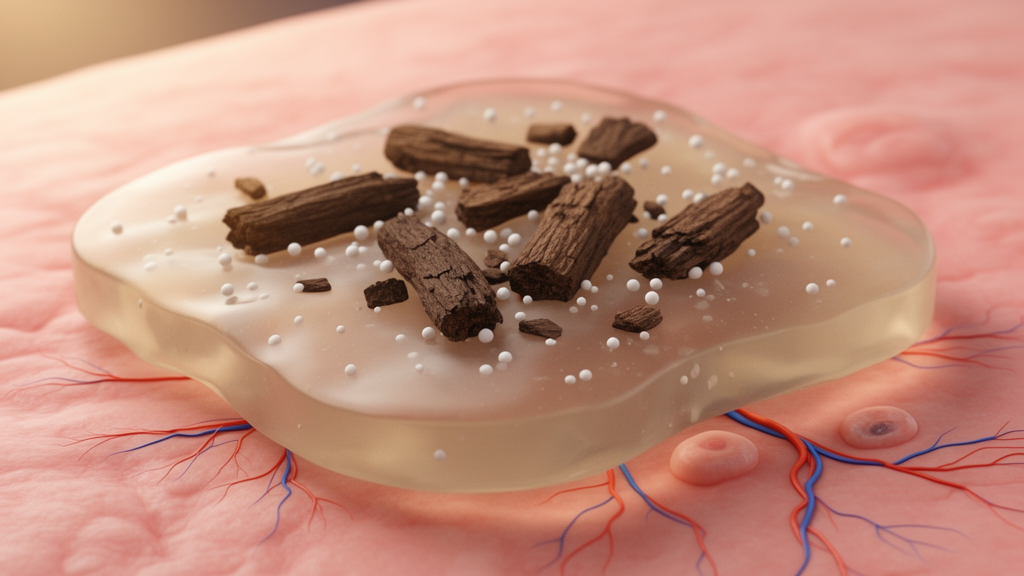
Researchers at Seoul National University have built a wound dressing out of three unlikely ingredients: chitosan, a sugar-derived polymer from shellfish skeletons; lignin, the woody polymer that paper mills throw away by the ton; and magnesium oxide nanoparticles. The result, described in Advanced Composites and Hybrid Materials, is a thin, flexible film patch that scavenges destructive molecules, kills bacteria on contact, shields the wound from ultraviolet light, and helped close mouse wounds faster than a leading commercial dressing. What makes the work stand out is not any single property but the way the team folded all of these functions into one bio-based platform without adding a drug.
The lead film closed 74.1 percent of experimental wounds in a mouse model after 15 days, compared with 63.8 percent for DuoDerm, a widely used commercial hydrocolloid dressing, and 60.1 percent for untreated wounds. In laboratory scratch assays, fibroblast cells migrated across an artificial wound and achieved complete closure within 48 hours. Histological examination of the healed tissue showed less residual granulation tissue and increased collagen deposition, the structural protein that gives repaired skin its strength. Immunohistochemical staining revealed a nonsignificant trend toward reduced infiltration of CD45-positive inflammatory cells, suggesting the patch may help calm the chronic inflammation that stalls difficult wounds.
Each component in the nanocomposite plays a distinct structural and biochemical role. Chitosan, a positively charged polysaccharide obtained by deacetylating chitin, forms the continuous matrix of the film. Phenolated kraft lignin, processed into nanoparticles roughly 100 nanometers across with a negative surface charge of about −29 millivolts, contributes aromatic phenolic groups that neutralize reactive oxygen species, the chemically aggressive molecules that damage cells and delay healing. Magnesium oxide nanoparticles, about 192 nanometers in diameter with a surface charge near −14 millivolts, act as the inorganic reinforcing phase, stiffening and strengthening the soft polymer network much as rebar strengthens concrete.
Spectroscopic fingerprints confirmed that the components genuinely interact rather than simply coexist. Fourier-transform infrared spectroscopy, X-ray diffraction, and X-ray photoelectron spectroscopy all detected shifts in intermolecular interactions and changes in the local chemical environment after the lignin and MgO nanoparticles were incorporated. These analytical signatures indicated altered hydrogen bonding and coordination between the phenolic lignin, the amine-rich chitosan backbone, and the metal oxide surfaces, interactions that underpin the film’s mechanical and functional performance.
The physicochemical measurements reveal why the patch works so well on moist, protein-rich wound beds. The film swelled to 91.6 percent of its dry weight, absorbing wound exudate while maintaining a hydrated environment. Its water contact angle dropped to 41.40 degrees, meaning the surface became markedly more hydrophilic and wettable, properties that encourage cell attachment. Tensile strength reached 80 megapascals, high enough for the patch to survive handling and mechanical stress. The material also adsorbed an impressive 2.3 grams of bovine serum albumin per gram of film, a proxy for how effectively it captures the proteins that mediate clotting and cell migration at a wound site.
Antioxidant performance was equally striking. In ABTS assays the film registered 325 ± 8 micrograms of Trolox equivalents per milliliter, and in DPPH assays 152 ± 5 micrograms per milliliter, both standard benchmarks for radical-scavenging capacity. The phenolic hydroxyl groups on the lignin nanoparticles donate hydrogen atoms to stabilize free radicals, converting them into less reactive species. Because reactive oxygen species accumulate in wounds and damage surrounding tissue, a dressing that continuously mops them up could support the transition from the inflammatory phase to the proliferative phase of repair.
Antibacterial results add a critical layer of protection. The film inhibited more than 95 percent of Escherichia coli and Staphylococcus aureus, two of the most common and dangerous wound pathogens. Staphylococcus aureus in particular forms biofilms that resist antibiotics and stall healing in chronic wounds. The positively charged chitosan matrix disrupts bacterial membranes, while the MgO nanoparticles generate oxidative stress at the nanoparticle-bacterium interface. Combined with robust ultraviolet shielding, which protects the fragile new tissue from photo damage, the patch creates a hostile environment for microbes while remaining gentle on human cells.
Biocompatibility testing showed the material is safe for the cells it is meant to help. More than 90 percent of HaCaT keratinocytes and human dermal fibroblasts survived exposure to the film, and hemolysis remained below 12 percent, indicating the patch does not significantly damage red blood cells. Blood-clotting indices hovered around 40 percent, a favorable reading that suggests the material supports hemostasis without provoking excessive coagulation. These cytocompatibility results, together with the low inflammatory-cell trend in vivo, position the patch as a material that actively supports rather than irritates the healing cascade.
The choice of raw materials carries weight beyond the laboratory bench. Kraft lignin is an abundant byproduct of the pulp and paper industry, and chitosan is derived from chitin, the structural polymer in crustacean shells that seafood processing generates in enormous quantities. Building a wound dressing from these renewable feedstocks, reinforced with an inexpensive inorganic oxide, offers a sustainable alternative to petroleum-derived polymers that dominate commercial dressings. The open-access study, funded by the National Research Foundation of Korea, suggests that phenolated lignin-chitosan/MgO nanocomposites could become promising multifunctional wound-dressing materials, though clinical translation will require further validation in larger animal models and eventually human trials.
Subject of Research: Multifunctional transdermal nanocomposite patch based on phenolated lignin-chitosan reinforced with MgO nanoparticles for wound healing
Article Title: Multifunctional transdermal nanocomposite patch based on phenolated lignin-chitosan reinforced with MgO nanoparticles for wound healing
Article References: Fakhar, A., Hong, S., Ahmed, M. A., Ha, Y., Kim, T. M., & Choi, J. W. (2026). Multifunctional transdermal nanocomposite patch based on phenolated lignin-chitosan reinforced with MgO nanoparticles for wound healing. Advanced Composites and Hybrid Materials. https://doi.org/10.1007/s42114-026-02124-8
Image Credits: AI Generated
DOI: 10.1007/s42114-026-02124-8
Keywords: Multifunctional, transdermal, nanocomposite, patch, based, phenolated, lignin-chitosan, reinforced, nanoparticles, wound, healing, scientific research
Cite Scienmag News
Denise Maddox. (October 17, 2026). Lignin and magnesium oxide nanoparticles team up in a chitosan patch that heals wounds faster. Scienmag. https://scienmag.com/lignin-and-magnesium-oxide-nanoparticles-team-up-in-a-chitosan-patch-that-heals-wounds-faster/
Denise Maddox. "Lignin and magnesium oxide nanoparticles team up in a chitosan patch that heals wounds faster." Scienmag, 17 October 2026, https://scienmag.com/lignin-and-magnesium-oxide-nanoparticles-team-up-in-a-chitosan-patch-that-heals-wounds-faster/. Accessed 17 October 2026.
Denise Maddox. "Lignin and magnesium oxide nanoparticles team up in a chitosan patch that heals wounds faster." Scienmag. October 17, 2026. https://scienmag.com/lignin-and-magnesium-oxide-nanoparticles-team-up-in-a-chitosan-patch-that-heals-wounds-faster/


