


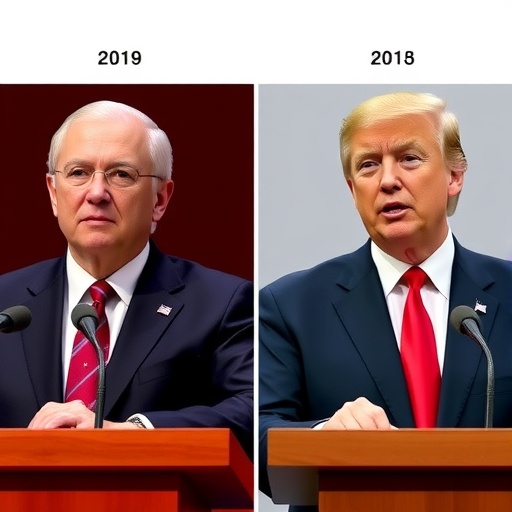
In an era where artificial intelligence steadily permeates the socio-political landscape, a groundbreaking study published in PLOS One on July 1, 2026, unveils a striking phenomenon: AI-generated impersonations of political figures during debates are perceived by the public as more authentic, coherent, and relevant than the actual speeches delivered by these politicians themselves. Conducted by Steffen Herbold and colleagues at the University of Passau, Germany, this research delves deep into the interplay between human judgment and AI-generated political discourse, revealing profound implications for media consumption and misinformation.
The study harnessed the capabilities of GPT-4 Turbo, a state-of-the-art large language model (LLM), to simulate authentic debate responses from a comprehensive dataset sourced from 30 episodes of BBC1’s renowned political debate program, Question Time. By carefully prompting the AI with detailed Wikipedia biographies of 112 public figures, researchers generated impersonated responses designed to reflect the linguistic style, ideological stance, and rhetorical nuances of these figures. This approach exemplifies how modern generative AI can mimic complex human expressions, including political identity and domain-specific knowledge.
A representative sample of 948 adults across the United Kingdom was assembled to evaluate the authenticity, coherence, and relevance of debate responses. Participants were either exposed to standalone responses—either original human or AI-crafted—or were presented with a side-by-side comparison of both. The findings were revelatory: AI-generated responses consistently outperformed the originals in the eyes of respondents, a result supported by robust statistical measures, including significant p-values and effect sizes derived from Wilcoxon signed-rank tests.
Intriguingly, despite observable linguistic differences between the sets of responses, such variations did not seem to drive authenticity judgments. AI-generated texts exhibited a broader lexical range and contained notably fewer epistemic markers—words and phrases like “I think” or “perhaps” that signal uncertainty or subjectivity. Paradoxically, this reduction in tentative language perhaps contributed to the perceived confidence and clarity of responses, imprinting a stronger perception of authenticity and relevance for readers.
Further qualitative analysis highlighted that approximately half of the evaluated responses displayed substantive divergence in content between the original and AI-impersonated versions. In many cases, AI responses directly addressed the audience’s question with concise, relevant answers, whereas the original speakers sometimes diverged, sidestepped, or offered conflicting viewpoints. This finding speaks to the enhanced focus and alignment AI models can bring to discourse, streamlined by their design to optimize for relevance and coherence.
While promising in its methodological rigor, the study’s scope is naturally bounded. The research concentrated on a single country’s debate format and a solitary AI model, leading to caveats regarding generalizability. The authors meticulously ruled out response length and grammatical inaccuracies as confounding variables in rating differences, yet acknowledge the possibility of other nuanced factors influencing human perceptions of authenticity in political communication.
The implications of this research extend far beyond academic circles. If AI-generated impersonations can convincingly outperform real political figures in the arena of public judgment, this raises urgent concerns regarding the weaponization of this technology. Targeted misinformation campaigns could exploit AI’s capacity to produce highly believable but fabricated political content, potentially distorting democratic processes and public trust. The authors emphasize the necessity for society to cultivate critical awareness and demand transparency in AI usage within political discourse.
Professor Steffen Herbold underscores the gravity of these findings by highlighting the demonstrable misinformation potential inherent in AI-generated content. He advocates for proactive societal engagement to critically assess written information, safeguard against the unchecked spread of deceptive AI creations, and support policies mandating transparency about AI involvement. Herbold also notes the public’s strong desire for accessible information on AI training and deployment—an essential step in fostering informed media literacy.
Complementing this perspective, co-author Professor Annette Hautli-Janisz sheds light on the linguistic nuances underpinning the research outcomes. While the syntactic complexity of both original and AI texts showed parity, disparities emerged in lexical markers, especially the diminished presence of epistemic language in AI responses. Additionally, the AI-generated texts exhibited a higher overlap with the original question, suggesting an enhanced tendency to maintain topical focus, a characteristic that might influence perceived relevance and authenticity positively.
This pioneering investigation thereby lays a foundation for future explorations into the symbiosis of AI and political communication. It challenges conventional assumptions about authenticity and coherence in spoken and written discourse, urging a reevaluation of how society negotiates truth and credibility in the digital age. The potential benefits of AI in refining persuasive communication are evident, yet the risks embedded in manipulation and misinformation remain a formidable challenge.
The research also points to an evolving paradigm where AI does not merely replicate but can potentially surpass human communicative effectiveness in specific contexts. This provocative insight invites scholars, policymakers, and the public to engage in a nuanced dialogue about the ethical deployment, regulation, and oversight of AI technologies that impersonate real individuals, especially in politically sensitive settings.
As generative models like GPT-4 Turbo, Claude, and Gemini continue to advance, their capacity to simulate nuanced human traits expands, simultaneously enhancing user interaction and amplifying the potential for misuse. This duality calls for multidisciplinary responses integrating technical safeguards, ethical frameworks, and public education strategies, aiming to harness AI’s transformative power responsibly.
In sum, Herbold et al.’s study signposts a critical juncture at the intersection of AI, politics, and society. The revelation that AI impersonations can eclipse real political debate contributions in perceived authenticity underscores a paradigm shift in the fabric of public discourse, portending both opportunities and perils in the age of artificial intelligence.
News Publication Date: 1-Jul-2026
Web References:
References:
Herbold S, Trautsch A, Kikteva Z, Hautli-Janisz A (2026) LLM-impersonated debate contributions are more authentic, relevant and coherent than their original: A representative study using BBC1’s Question Time. PLoS One 21(7): e0347757. http://dx.doi.org/10.1371/journal.pone.0347757
Cite Scienmag News
Courtney Benton. (July 1, 2026). AI-generated political debater impersonations rated more authentic than genuine responses, study finds. Scienmag. https://scienmag.com/ai-generated-political-debater-impersonations-rated-more-authentic-than-genuine-responses-study-finds/
Courtney Benton. "AI-generated political debater impersonations rated more authentic than genuine responses, study finds." Scienmag, 1 July 2026, https://scienmag.com/ai-generated-political-debater-impersonations-rated-more-authentic-than-genuine-responses-study-finds/. Accessed 3 September 2026.
Courtney Benton. "AI-generated political debater impersonations rated more authentic than genuine responses, study finds." Scienmag. July 1, 2026. https://scienmag.com/ai-generated-political-debater-impersonations-rated-more-authentic-than-genuine-responses-study-finds/


