


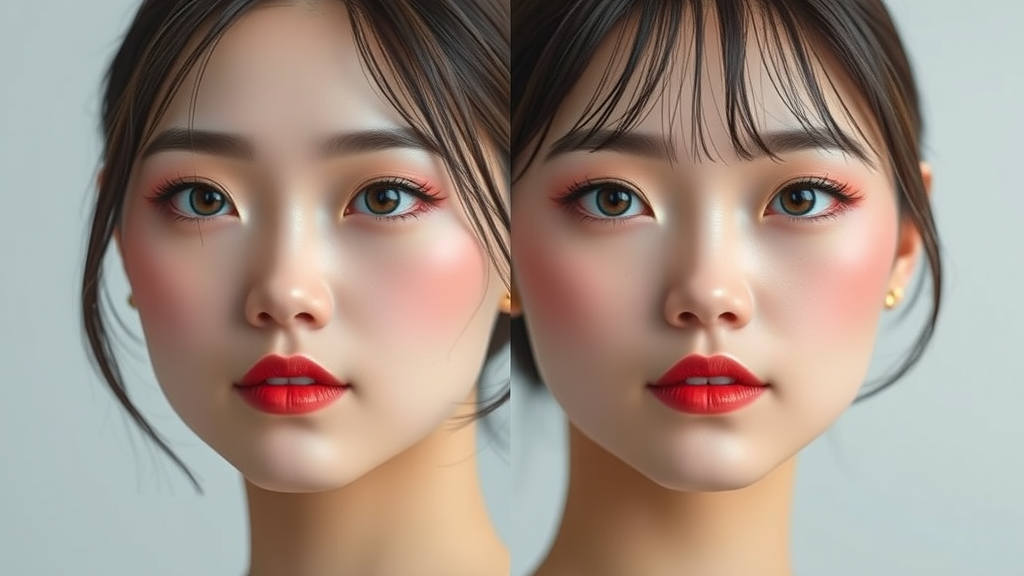
When millions of people across East Asia pick up a smartphone to take a selfie, they are participating in an aesthetic culture that is far more varied than the phrase “East Asian beauty” suggests. A new integrative review published in the journal AI & Society argues that this diversity—visible in measurable differences in skin hue across selfie cultures in China, Japan, and South Korea—is being systematically eroded as beauty migrates from individual self-expression to institutional design. The study, led by Jaeyoun You of Hanyang University with colleagues at Seoul National University, introduces a striking concept for what happens next: selective aesthetic compression, the targeted stripping away of nationally specific skin-tone cues while commercially profitable warm-tone qualities are carefully preserved.
The research challenge begins with a claim the authors say is both widespread and wrong: the assumption that East Asian beauty aesthetics form a single, homogeneous category. This flattening happens in popular discourse, in marketing, and even in the technical literature on how artificial intelligence represents human faces. Drawing on postcolonial theory, prior colorimetric evidence from East Asian selfie cultures, practitioner accounts of K-beauty as a commercial mediation chain, and an exploratory colorimetric audit of commercially produced virtual human figures, the review assembles a picture of an aesthetic landscape that is differentiated, contested, and increasingly vulnerable to homogenization by design.
The colorimetric evidence is central to the argument. Previous analyses of East Asian selfie cultures documented nationally differentiated hue patterns—measurable, systematic differences in how skin tones are rendered and preferred across countries. These patterns resist reduction to a single whitening desire, the review emphasizes. The popular narrative of an undifferentiated drive toward paler skin obscures the distinct aesthetic traditions, cosmetics industries, and self-presentation practices that shape how skin tone is experienced and displayed in different national contexts. Historical scholarship cited in the review, including studies of Japanese whitening cosmetics culture and analyses of K-beauty’s global marketing, shows that whiteness in Asian beauty practices is entangled with class, gender, and postcolonial history in ways that vary by country rather than converging on one ideal.
The turning point in the study comes when individual expression gives way to institutional production. Practitioner accounts describe K-beauty not as a pure reflection of consumer taste but as a commercial mediation chain—a pipeline of brands, marketers, and designers who decide which aesthetic cues survive the journey from local culture to global marketplace. When the researchers conducted an exploratory colorimetric audit of commercially produced virtual human figures—the synthetic faces increasingly used by brands and virtual influencers across Asia—they found that this pipeline appears to erode national differentiation. The synthetic faces converged toward a narrower band of tones, losing the hue distinctions that had marked, for example, Japanese and Korean selfie aesthetics as distinct traditions.
Crucially, the compression is selective rather than uniform. The review documents that commercially legible warm-tone properties—those qualities that global audiences can readily read as “glowing,” “healthy,” or recognizably K-beauty—are preserved and even amplified in synthetic faces, while nationally specific hue cues are the casualties. The authors describe this as the targeted erosion of difference in the service of commercial legibility. A face designed to sell products to the widest possible audience cannot afford the ambiguity of national specificity; it must be legible to everyone and rooted nowhere. The result is a synthetic beauty that signals “East Asian” to global consumers while carrying almost none of the actual chromatic diversity of East Asian people and their self-presentation practices.
To frame this phenomenon, the authors reach for two influential concepts from media theory. Koichi Iwabuchi’s notion of mukokuseki—”culturally odorless” cultural products that are scrubbed of national markers to travel smoothly across borders—describes the commercial logic at work. Jia Tolentino’s “Instagram Face,” the blended, filter-derived ideal that makes every face look like a slightly different version of the same celebrity, describes the consumptive endpoint. Selective aesthetic compression, the review argues, is what happens when these two forces meet in the design of synthetic faces: the face is made odorless of national hue specificity but retains the warm tones that sell.
The most consequential claim of the paper extends the analysis to generative artificial intelligence. Image-generation systems are trained on vast corpora of existing imagery, and if that imagery has already been compressed by commercial design pipelines, the models will learn the compressed aesthetic as the norm. The review argues that generative AI systems trained on commercially compressed imagery may recursively normalize a narrowed aesthetic range: the model produces synthetic faces that match the compressed ideal, those faces flood the visual culture, and future training data becomes even more homogeneous. This feedback loop echoes prior findings in the AI fairness literature, which the review cites, showing that text-to-image systems amplify demographic stereotypes at scale and that unsupervised image representations encode human-like biases. Earlier work documenting the whiteness of AI—the tendency of even abstract artificial intelligence to be imagined and rendered as white—provides the broader conceptual backdrop for this specific, measurable loss of chromatic diversity.
The technical stakes are not merely metaphorical. Skin color measurement is a mature science, with validated skin color charts and standard color-difference metrics that make it possible to quantify how far a synthetic face deviates from the hue distributions of real populations. The review’s colorimetric approach demonstrates that aesthetic claims can be tested: the differences between national selfie cultures were measurable, and their disappearance from synthetic faces is measurable too. This matters because aesthetic homogenization of the kind the authors describe is invisible precisely where it operates. A single synthetic face looks innocuous; only a systematic comparison against the chromatic statistics of real communities reveals what has been removed. Without quantitative audit, compression can proceed unnoticed and unchallenged, one commercially optimized face at a time.
The implications stretch well beyond the beauty industry. The authors situate their argument within a postcolonial framework that includes foundational critiques of Orientalism and of who is permitted to speak for subaltern cultures, and they note that market forces amplify the problem: K-beauty cosmetics exports rank among the world’s largest, and the virtual influencer market is expanding rapidly, giving compressed aesthetics enormous commercial distribution. The review closes on a question that generalizes far from cosmetics: can algorithmic systems preserve the aesthetic plurality they inherit from the cultures they are trained on, or does every cycle of commercial mediation and model training grind cultural difference a little finer? The authors do not offer a simple fix, but their concept of selective aesthetic compression gives researchers, designers, and regulators a name for the phenomenon—and a measurable target. If diversity is being compressed selectively, it can, in principle, be audited selectively, restored selectively, and defended before it becomes the only aesthetic the training data remembers.
Subject of Research: How commercial design and generative AI selectively compress nationally distinct East Asian skin-tone aesthetics into a homogeneous synthetic beauty ideal.
Article Title: From selfies to synthetic faces: selective aesthetic compression in East Asian beauty representation
Article References: You, J., Park, S., Suh, B., & Hong, S.-K. (2026). From selfies to synthetic faces: selective aesthetic compression in East Asian beauty representation. AI & SOCIETY. https://doi.org/10.1007/s00146-026-03318-w
Image Credits: AI Generated
DOI: 10.1007/s00146-026-03318-w
Keywords: East Asian beauty, selective aesthetic compression, K-beauty, selfies, virtual humans, generative AI, skin whitening, postcolonial AI, algorithmic bias, AI & Society, beauty filters, virtual influencers
Cite Scienmag News
Blake Davidson. (September 20, 2026). AI-Generated Faces Are Quietly Erasing East Asian Beauty Diversity, Study Warns. Scienmag. https://scienmag.com/ai-generated-faces-are-quietly-erasing-east-asian-beauty-diversity-study-warns/
Blake Davidson. "AI-Generated Faces Are Quietly Erasing East Asian Beauty Diversity, Study Warns." Scienmag, 20 September 2026, https://scienmag.com/ai-generated-faces-are-quietly-erasing-east-asian-beauty-diversity-study-warns/. Accessed 4 October 2026.
Blake Davidson. "AI-Generated Faces Are Quietly Erasing East Asian Beauty Diversity, Study Warns." Scienmag. September 20, 2026. https://scienmag.com/ai-generated-faces-are-quietly-erasing-east-asian-beauty-diversity-study-warns/


