


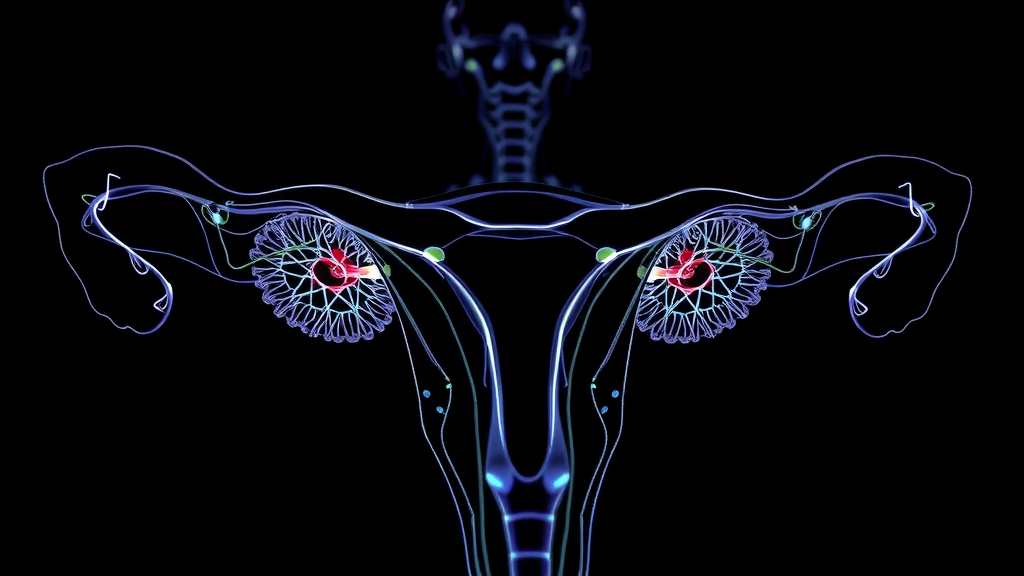
A woman’s ovarian reserve—the pool of follicles remaining in her ovaries—has long been estimated through a handful of laboratory numbers and a picture on an ultrasound screen. Anti-Müllerian hormone (AMH), follicle-stimulating hormone (FSH), and estradiol measured in a single blood draw, together with antral follicle counts performed by a sonographer, form the backbone of fertility assessment in clinics worldwide. Yet each of these markers, taken alone, captures only a fragment of a deeply complex biological reality. A new review published in the Journal of Ovarian Research argues that artificial intelligence is now positioned to knit these fragments together, integrating hormonal, imaging, clinical, and genetic data into assessments that are simultaneously more quantitative, more qualitative, and more personal than anything the traditional single-marker paradigm has offered.
The review, led by Li Tang and colleagues at Peking University Third Hospital, is a structured narrative synthesis rather than a single experiment. The team searched PubMed and Web of Science for literature published between 2013 and 2025, screening roughly 400 records and ultimately including 68 articles that focus on machine learning and deep learning models applied to biochemical and imaging data in ovarian reserve evaluation. By systematically mapping how these algorithms have been used—what inputs they consume, how they are trained, and how they perform—the authors have produced one of the clearest portraits to date of a field moving rapidly from proof-of-concept studies toward tools that could reshape reproductive medicine.
At the technical heart of the review lies a distinction between what conventional diagnostics measure and what machine learning can infer. Traditional biomarkers such as AMH are produced by small growing follicles and correlate broadly with the number of resting follicles, but they say little about follicular quality, the trajectory of decline in an individual woman, or how she might respond to ovarian stimulation during assisted reproductive technology (ART). Imaging offers complementary information: antral follicle counts, ovarian volume, and stromal characteristics visible on ultrasound carry predictive signal that blood tests miss. The problem has historically been that these data streams live in separate silos, interpreted by different specialists using subjective visual criteria. Machine learning models, and particularly multimodal architectures that fuse inputs from multiple sources, are designed precisely to dissolve those silos.
One of the most mature applications documented in the review is automated follicle detection on ultrasound. Deep convolutional neural networks—the same class of models that powers facial recognition and autonomous driving—can be trained on annotated ultrasound images to identify and count antral follicles with a consistency that human observers struggle to match across scans, machines, and sonographers. Inter-observer variability in manual follicle counting is a well-known source of error in ovarian reserve testing; a follicle near the size threshold may be included by one operator and excluded by another. Automated segmentation and detection pipelines reduce this noise while dramatically speeding up the analysis, and the review reports that representative AI systems in this domain have achieved sensitivity of approximately 90 percent and specificity of 80 percent in classifying ovarian reserve status—performance figures that approach or exceed those of conventional workflows.
Beyond counting follicles, the review highlights how AI models can perform genuine multimodal fusion. Rather than treating AMH, FSH, estradiol, and ultrasound features as parallel numbers to be eyeballed, modern architectures such as multi-input neural networks learn cross-modal relationships: how a given hormone level changes its predictive meaning depending on follicular morphology, age, menstrual cycle characteristics, or clinical history. Some models described in the literature ingest longitudinal data, tracking how a patient’s markers evolve across cycles to estimate the individual rate of ovarian aging. The authors emphasize that this capacity for integration enables what they call personalized “endocrine age” modeling—an estimate of how fast a particular woman’s reproductive endocrine system is aging, which may diverge substantially from her chronological age.
Natural language processing adds a third, less obvious data stream. Decades of clinical narratives—consultation notes, procedure records, and cycle outcome descriptions stored in electronic health records—contain rich information about ovarian response that is locked in free text. Transformer-based language models can extract structured variables from these documents at scale, allowing researchers to assemble training datasets far larger than what manual chart review would permit. Combined with genetic data, which the review notes can flag conditions such as fragile X-associated diminished ovarian reserve, these extracted variables expand the feature space available to predictive models of ART outcomes, including ovarian stimulation response and oocyte yield.
The clinical implications are substantial. In fertility clinics, ovarian reserve testing drives decisions about the timing of treatment, the choice and dosing of gonadotropin stimulation protocols, and the counseling of women considering delaying childbearing. Inaccurate assessments carry real costs: a patient misclassified as a poor responder may be subjected to unnecessary anxiety or inappropriate high-dose stimulation, while a falsely reassuring profile can delay treatment until options have narrowed. By improving both the accuracy and the granularity of assessment, multimodal AI could support more individualized stimulation protocols, better prediction of hyper-response risk in conditions such as polycystic ovary syndrome, and more honest, data-grounded fertility counseling. The review frames this as a movement from isolated biomarkers toward personalized, precise reproductive care.
Yet the authors are careful to temper enthusiasm with a sober accounting of the obstacles standing between published algorithms and routine clinical use. Data standardization is the most immediate challenge. Ultrasound images acquired on different machines with different settings, hormone assays with different calibration standards, and clinical records encoded in incompatible formats all degrade the ability of models to generalize. Models trained on data from a single center routinely perform worse when deployed elsewhere, and the review stresses that large-scale, multicenter validation is essential before any AI-driven ovarian reserve tool can be trusted across diverse patient populations. In a domain as consequential as fertility, a model that works only in the population where it was trained is not a clinical tool but a local artifact.
Explainability presents a second, equally serious barrier. Deep learning models are notoriously opaque: a network may output a risk score without articulating which features drove the prediction. Clinicians asked to base stimulation decisions or counseling conversations on an algorithm’s output need to understand why the algorithm reached its conclusion—both to exercise appropriate judgment and to earn patient trust. The review notes that developing clinician-oriented decision-support tools, in which AI outputs are presented in interpretable form alongside traditional measures rather than replacing them, remains an unfinished task. The authors also point to broader issues of external validation, regulatory oversight, and integration into existing clinical workflows as prerequisites for real-world adoption.
Taken together, the review sketches a field at an inflection point. The technical ingredients—automated image analysis, multimodal fusion architectures, language models capable of mining clinical text, and growing repositories of longitudinal reproductive data—have matured to the point where reported performance is clinically meaningful. What remains is the slower, harder work of medicine: harmonizing data across institutions, validating models in the populations they will serve, making their reasoning legible to the clinicians who must act on them, and embedding them into the daily rhythms of fertility care. If that work succeeds, the authors conclude, the assessment of ovarian reserve may shift from a snapshot of scattered numbers toward a dynamic, individualized portrait of reproductive aging—one in which hormones, images, and clinical histories are finally read together rather than apart. For the millions of women who undergo fertility testing each year, that integration could translate into better-timed treatments, safer stimulation protocols, and answers that are more precise than any single blood test or ultrasound has ever been able to provide.
Subject of Research: Artificial intelligence for multimodal assessment of ovarian reserve
Article Title: Bridging hormones and imaging: artificial intelligence advances multimodal quantitative and qualitative assessment of ovarian reserve
Article References: Tang, L., Ma, Z., Li, Y., Jin, Z., Zhang, J., Hu, H., Jin, Y., Lin, R., Chai, X., Wang, L., Heng, D., Zhang, W., Zhang, H., Xin, X., Zhu, Y., Ye, Y., Li, J., & Li, D. (2026). Bridging hormones and imaging: artificial intelligence advances multimodal quantitative and qualitative assessment of ovarian reserve. Journal of Ovarian Research. https://doi.org/10.1186/s13048-026-02245-0
Image Credits: AI Generated
DOI: 10.1186/s13048-026-02245-0
Keywords: ovarian reserve, artificial intelligence, machine learning, deep learning, anti-Müllerian hormone, ultrasound, follicle detection, multimodal fusion, fertility, assisted reproductive technology, endocrine age, reproductive medicine
Cite Scienmag News
Blake Davidson. (September 12, 2026). AI Fuses Hormones and Imaging to Transform Ovarian Reserve Assessment. Scienmag. https://scienmag.com/ai-fuses-hormones-and-imaging-to-transform-ovarian-reserve-assessment/
Blake Davidson. "AI Fuses Hormones and Imaging to Transform Ovarian Reserve Assessment." Scienmag, 12 September 2026, https://scienmag.com/ai-fuses-hormones-and-imaging-to-transform-ovarian-reserve-assessment/. Accessed 4 October 2026.
Blake Davidson. "AI Fuses Hormones and Imaging to Transform Ovarian Reserve Assessment." Scienmag. September 12, 2026. https://scienmag.com/ai-fuses-hormones-and-imaging-to-transform-ovarian-reserve-assessment/


